
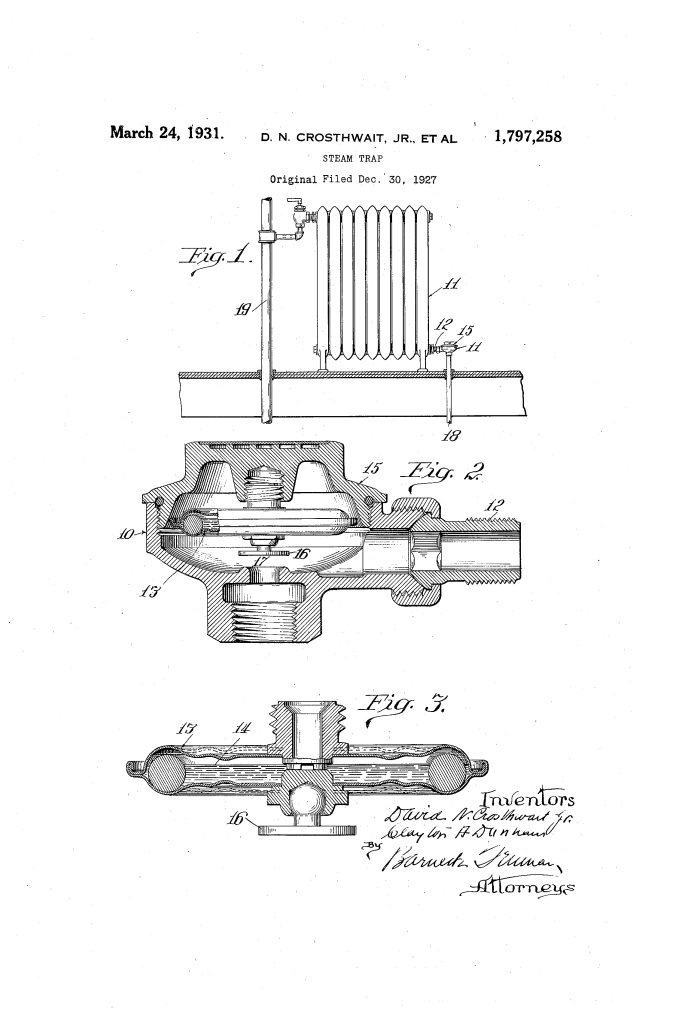
Steam Trap (Crosthwait & Dunham, No. 1,797,258)
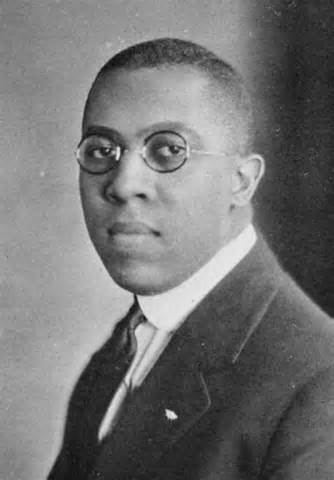
This 1931 patent by David N. Crosthwait, Jr. and Clayton A. Dunham describes an advanced thermostatic Steam Trap (Patent No. 1,797,258). David Crosthwait, Jr., a prominent African American engineer and expert in heat transfer, designed this trap to solve a specific problem in steam heating: how to automatically evacuate air and water (condensate) from a radiator while preventing the escape of valuable steam, across a wide range of pressures.
1. Structure and Mechanical Operation
The trap is a self-regulating valve installed at the outlet of a radiator.
- Casing (10): The outer shell connected to the radiator.
- Flexible Metal Capsule (13): A corrugated, hermetically sealed vessel containing a volatile liquid mixture (14). This capsule acts as the “brain” of the trap.
- Valve (16) and Seat (17): When the capsule expands, the valve moves down to close the port leading to the return pipe (18).
2. The Thermostatic Principle
The trap operates based on the temperature difference between steam and cooler condensate/air.
- Contraction (Opening): When cool air or water enters the trap, the volatile liquid inside the capsule stays liquid or exerts low pressure. The capsule remains contracted, keeping the valve open so the waste can drain out.
- Expansion (Closing): When hot steam reaches the trap, the liquid inside the capsule vaporizes, creating high internal pressure. This causes the capsule to expand, pushing the valve against the seat and “trapping” the steam inside the radiator.
3. The Volatile Liquid Mixture
The core of Crosthwait and Dunham’s invention is the specific chemical composition inside the capsule. A single liquid (like water or pure alcohol) cannot maintain a consistent “closing force” across varying pressures.
The inventors developed a mixture that ensures the internal pressure always exceeds the external steam pressure by about 11 lbs. per square inch, regardless of whether the system is under a vacuum or high pressure.
The Preferred Formula:
- 99.5% Benzene (C6H6): Acts as the base liquid.
- 0.5% Denatured Alcohol: A mix of Ethyl and Methyl alcohol with a trace of water.
By mixing these miscible liquids, the vapor pressure curve of the mixture “parallels” the pressure curve of steam. This allows the trap to work effectively from a 25-inch vacuum up to 25 lbs. of pressure without needing any manual adjustment.
4. Technical Design Requirements
Crosthwait and Dunham identified several “Variable Factors” a successful trap must overcome:
| Requirement | Technical Solution |
| Saturated Vapor | Ensuring enough liquid remains so that pressure depends only on temperature, not volume changes. |
| Corrosion Resistance | Selecting chemicals that do not eat through the metal capsule or solder. |
| Low Latent Heat | Allowing the trap to respond “sensitively” and quickly to temperature changes. |
| Residual Air | The capsule is evacuated to a high vacuum (within 2 inches of barometric vacuum) before sealing to ensure air doesn’t interfere with the vapor expansion. |
Engineering Significance
David N. Crosthwait, Jr.’s contributions were foundational to modern HVAC (Heating, Ventilation, and Air Conditioning) systems.
- Vacuum Heating: This trap was essential for the “Dunham Differential Vacuum Heating System,” which allowed large buildings (like the Rockefeller Center, where Crosthwait consulted) to be heated efficiently.
- Precision Control: By using a complex chemical solution rather than a simple mechanical spring, the trap achieved a level of automation that reduced fuel waste and maintenance.
- Versatility: The trap’s ability to operate at altitudes or varying barometric pressures made it a universal solution for the global heating market.
