
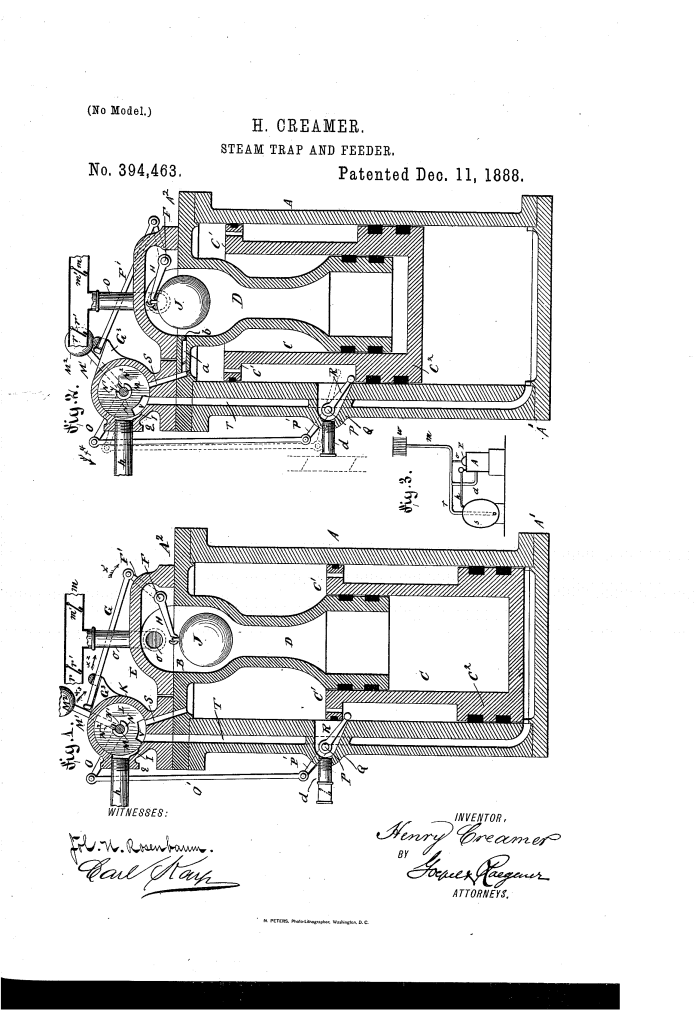
Steam-Trap and Feeder: Henry Creamer (Patent No. 394,463)
The patent by Henry Creamer of New York, N.Y. describes a Steam-Trap and Feeder (Patent No. 394,463), issued on December 11, 1888. This invention is an automatic mechanical system designed to capture water of condensation from steam pipes and engines and return it directly to the boiler, maintaining system efficiency without manual intervention.
The “Why”
In the late 19th century, steam was the lifeblood of industry, but it had a persistent enemy: condensation. As steam cooled in pipes or radiators, it turned back into water (“condensate”). If this water remained in the lines, it caused “water hammer” (violent banging that could rupture pipes), reduced thermal efficiency, and wasted the purified water already inside the boiler loop. Existing traps were often prone to clogging or mechanical failure under high pressure. Creamer sought to create a “simple, effective” device that could not only clear the lines but also act as a secondary pump for cold water.
Inventor Section: Henry Creamer
Henry Creamer was a prolific Black inventor active during the height of the American Industrial Revolution and the onset of the Jim Crow era. Operating out of New York City, Creamer’s engineering philosophy centered on mechanical automation and fluid dynamics. At a time when many Black innovators were denied access to formal technical guilds, Creamer’s work on steam-traps and steam-engine governors demonstrated a sophisticated grasp of pressure differentials and valve timing. His inventions were not merely “gadgets” but essential infrastructure components that made large-scale steam heating and power safer and more economical.
Key Systems Section
1. The Concentric Piston & Water Cylinder
Instead of a simple tank, Creamer utilized a telescoping dual-cylinder design. An inner water cylinder (C) moves vertically within a larger steam cylinder (A).
- Modern Translation: This acts as a reciprocating displacement pump.
- Function: The water cylinder collects condensate until its weight and a secondary float trigger a pressure shift, using live steam to drive the entire assembly upward.
2. The Gravity-Weighted Rocking Valve
The control center of the trap is a rocking valve (L) managed by a weighted arm (M).
- Modern Translation: An over-center mechanical linkage with a gravity-biased actuator.
- Function: This ensures a “snap-action” response. Once the float reaches a certain level, the weight falls, instantly switching the valve from “Exhaust” to “Live Steam” mode, preventing the valve from getting stuck in a neutral position.
3. The Buoyancy-Triggered “Check-Rod”
A float (J) is suspended within a neck (D) at the top of the assembly.
- Modern Translation: A liquid-level sensor/interlock.
- Function: The float doesn’t move the valve directly; it moves a “check-rod” (G) that acts as a physical stop. When the water level rises, the rod moves, releasing the weighted arm to perform the work. This separation of sensing and acting increases the tool’s durability.
Comparison Table
| Feature | Standard Methods (1880s) | Creamer’s Innovation |
| Reset Mechanism | Manual or spring-loaded (prone to fatigue). | Gravity-weighted toggle for reliable, automatic resetting. |
| Internal Friction | High; sliding parts often seized due to scale. | Neck-and-Cylinder design with specific packing grooves to maintain seals. |
| Versatility | Passive drainage only. | Dual-functionality: Can be adjusted to pump cold water via vacuum. |
| Steam Loss | Significant “blow-through” of live steam. | Timed cycle: Only uses steam when the cylinder is full of water. |
Significance Section
- Precursor to Modern Boiler Feed Systems: The logic of returning condensate to a pressurized vessel is the foundation of modern closed-loop HVAC.
- Automation of Fluid Logic: Creamer’s use of a float to trigger a high-energy mechanical event (the falling weight) is a direct ancestor to modern float switches and solenoid controllers.
- Efficiency Standards: By recycling “hot” water back to the boiler, it reduced the energy required to bring fresh, cold water to a boil—an early milestone in industrial energy conservation.
