
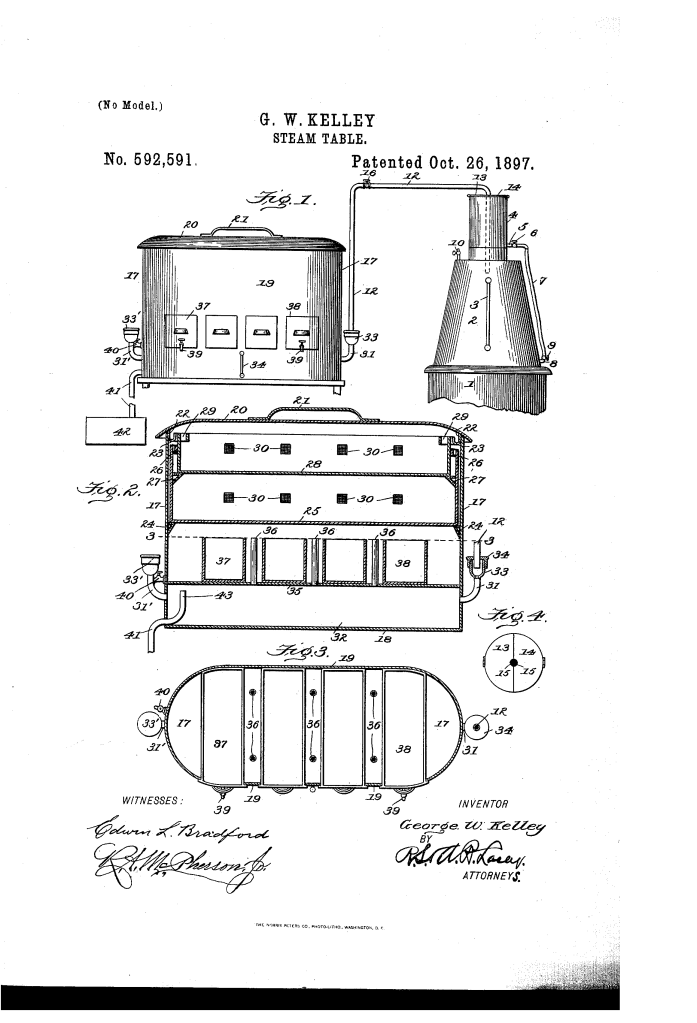
Steam-Table (1897)
U.S. Patent No. 592,591, granted on October 26, 1897, to George W. Kelley, describes a specialized, self-contained steam-table system designed to keep various foods, beverages, and baked goods warm, moist, and ready to serve in commercial dining environments. George W. Kelley, an inventor based in Norfolk, Virginia, developed a practical solution for hotels, restaurants, and dining rooms.
This invention addressed a frequent challenge in food service: maintaining a variety of dishes at safe serving temperatures without drying out the food or allowing raw steam to soak and ruin delicate items like bread and roasts.
The Innovation: Tiered Steaming and Moisture Control
Traditional food warmers often either dried out dishes or over-saturated them with heavy condensation. Kelley solved this by creating a multi-tiered heating structure backed by a controlled steam-filtration mechanism.
The unit connects a dedicated boiler directly to a multi-compartment warming chest, utilizing fine wire-gauze diaphragms to regulate moisture exposure.
Key Features of the Design
- Controlled Moisture Delivery: Fine wire-gauze diaphragms allow just enough dry steam to pass into the food compartments to replace lost moisture without drenching the food.
- Integrated Boiler and Feed System: A dedicated cylindrical heater uses a top-mounted feed-water tank that is pre-heated by the main steam line, improving thermal efficiency.
- Reversible Hookups: Twin inlet tubes with removable caps allow the steam-supply pipe to connect to either side of the table, offering operational flexibility for different kitchen layouts.
How the Apparatus Functions
The process uses a closed-loop thermal workflow to maintain consistent heat and reuse condensed water efficiently:
| Step | Action | Operational Purpose |
| 1. Steam Generation | Water is heated in the cylindrical boiler (2) over a stove top (1); steam rises through supply pipe (12). | Generates continuous steam while pre-heating incoming feed water in tank (4). |
| 2. Distribution | Steam enters the hot-water space (32) and ascends through vertical tubes (36) into the chamber above. | Evenly distributes thermal energy across the bottom section of the table. |
| 3. Moisture Filtering | Steam passes through gauze-covered orifices (30) into nested food trays (25, 28). | Condenses excess water on the mesh, letting only dry steam reach the food. |
| 4. Drainage & Recirculation | Condensed steam drains via drip-cock (40) or overflow pipe (43) into receptacle (42). | Allows collected warm water to be recycled back into the feed-water tank (4). |
Technical Components
- Boiler & Water Feed (2, 4): A conical cylindrical heater equipped with a vertical glass water-gage (3) and an elevated feed-water tank (4).
- Steam Supply Pipe (12): Extends through the center of the feed-water tank (4) to pre-heat fresh water before it enters the boiler via flexible hose (7).
- Warming Chamber (17): A insulated main body with a removable flange-sealed cover (20) featuring a built-in condensation gutter (23).
- Nested Food Trays (25, 28): Tiered, removable trays supported by internal angle-brackets (24, 27). Main tray (25) holds meats and larger roasts, while upper tray (28) holds bread and rolls.
- Drawers & Faucets (37, 38, 39): Sliding horizontal compartments situated above the heating floor. Outer drawers (38) include individual service faucets (39) to serve hot tea and coffee on demand.
Historical and Scientific Impact
Kelley’s steam-table represented an important advancement in commercial kitchen equipment during the late 19th century:
- Food Quality Preservation: By preventing saturated steam from making bread soggy or drying out meats, it significantly improved the quality of pre-cooked meals in mass dining establishments.
- Energy Efficiency: Passing the hot steam pipe through the cold feed-water reservoir recycled thermal energy, reducing the fuel required to maintain operating temperatures.
- Kitchen Ergonomics: The dual-side intake options and integrated beverage dispenser drawers streamlined restaurant service and saved valuable counter space.
About the Inventor: George W. Kelley
George W. Kelley operated out of Norfolk, Virginia, during the late 19th century. His work focused on practical mechanical innovations tailored to the expanding commercial hospitality and food-service industries in post-Reconstruction urban centers.
Summary of Claims
The patent explicitly claims:
- A steam-table structure combining a bottom steam-supply chamber, a middle steaming chamber, and an upper warming chamber.
- A central division where the bottom of the warming chamber serves directly as the top section of the lower steaming space.
- Vertical steam-supply tubes providing direct communication between the lower supply chamber and the upper steaming compartments, configured to leave defined steam space around food receptacles.
