
Steam Heating System, David N. Crosthwait, Jr., Patent No. 1,977,303
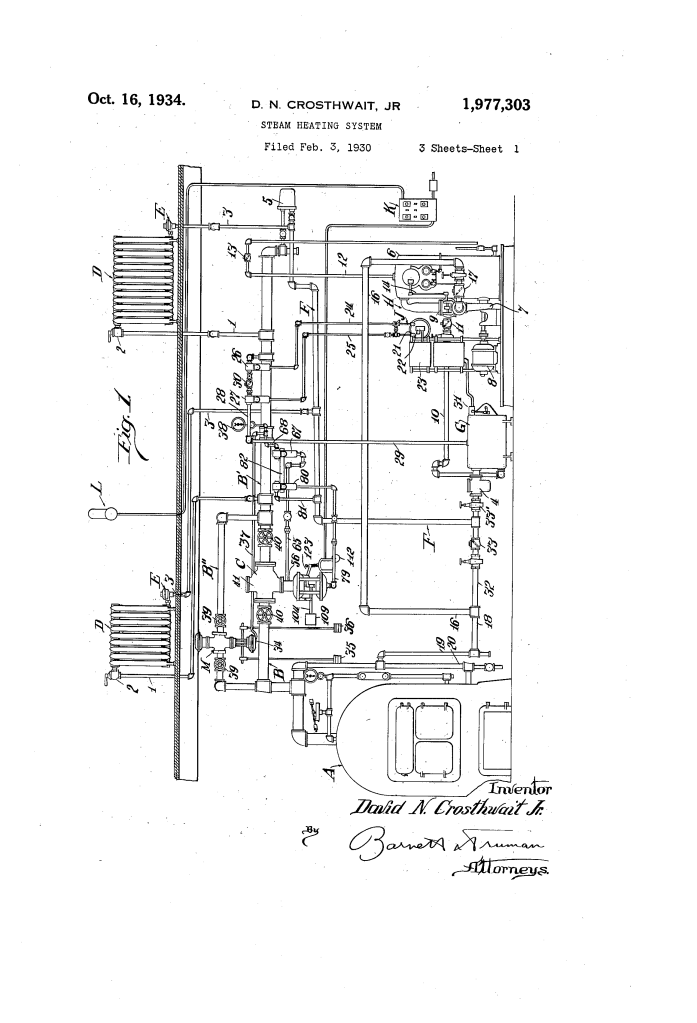
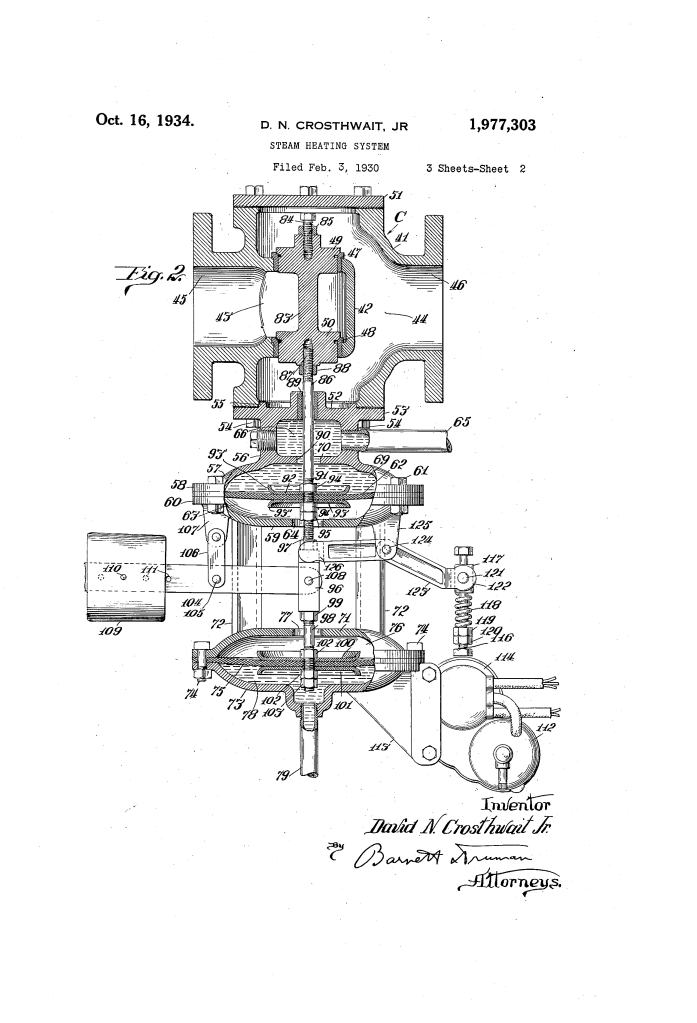
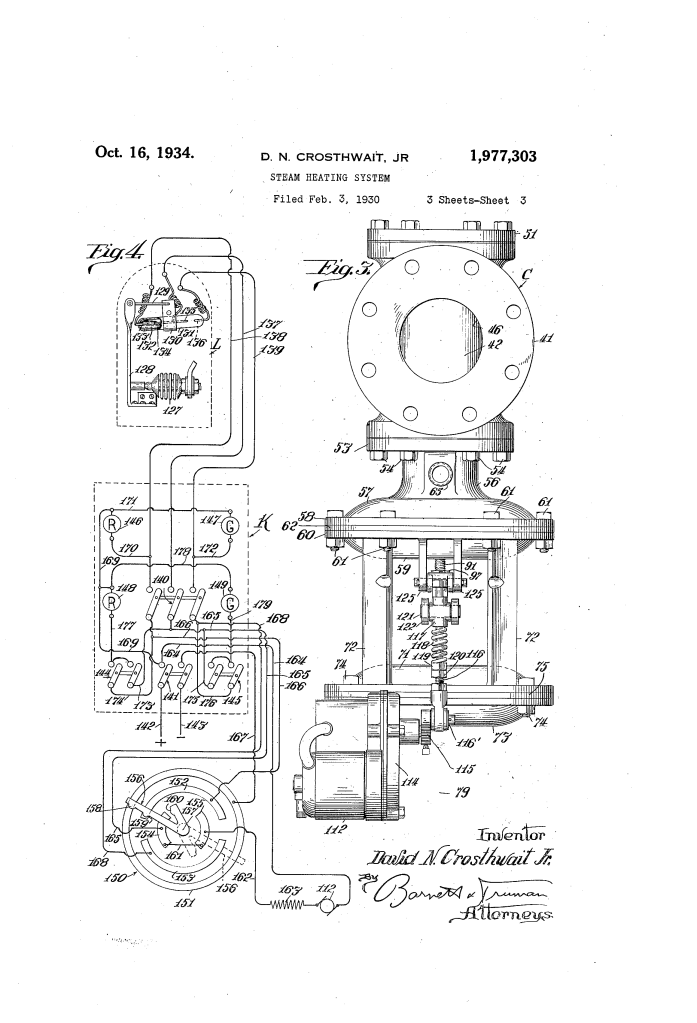
The patent by David N. Crosthwait, Jr. of Marshalltown, Iowa, describes a Steam Heating System (Patent No. 1,977,303), granted on October 16, 1934. This invention is a method for automated thermodynamic regulation that balances steam supply with the real-time condensation rate within a building’s radiators, ensuring consistent warmth and extreme fuel efficiency.
The “Why”
In the 1930s, heating large structures was a game of manual guesswork. If the boiler pushed too much steam, the pressure spiked, making rooms sweltering and noisy; if it pushed too little, the vacuum in the return lines stalled, leaving rooms cold. Crosthwait targeted the “condensing lag”—the inefficiency caused by the delay between changing outside temperatures and the building’s heat response. He sought a system that utilized the pressure differential as a living sensor to throttle steam supply without human intervention.
Inventor Section: David N. Crosthwait, Jr.
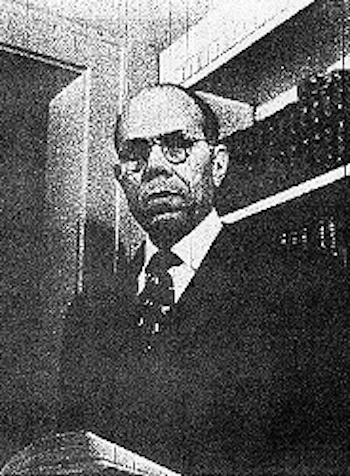
David Crosthwait’s engineering philosophy was defined by precision and systemic integration. He didn’t just see a radiator; he saw a heat exchanger that needed to breathe. As one of the few Black engineers of his era to hold high-level corporate authority (at C.A. Dunham Co.), Crosthwait had to prove his theories were mathematically superior to overcome the racial biases of the Great Depression. This patent represents his “Method” patent—the intellectual blueprint for the “Apparatus” patent (No. 1,977,304), demonstrating his mastery of both the how and the why of industrial thermodynamics.
Key Systems Section
1. The Differential Feedback Loop
- Function: Uses the radiator itself as a “metering device.”
- Modern Translation: Closed-Loop Feedback Control.
- If steam is supplied faster than it can turn into water (condense), the pressure in the radiator rises. The system “senses” this increase in the gap between supply and return and automatically chokes the flow.
2. Sub-Atmospheric Circulation
- Function: Operates the entire system under a partial vacuum.
- Modern Translation: Vacuum-Based Heat Transfer.
- By lowering the pressure, steam can be generated at temperatures as low as 133°F (instead of the usual 212°F). This allows for “mild” heat during autumn or spring, preventing the “all-or-nothing” overheating of traditional boilers.
3. Orifice-Based Proportioning
- Function: Equalizes steam distribution across a massive network of pipes.
- Modern Translation: Flow Calibration Orifices.
- Crosthwait placed specifically sized plates in the risers. This prevented “short-circuiting,” where the radiators closest to the boiler got all the heat while the top floors stayed frozen.
4. The Mercury-Switch Thermostatic Override
- Function: Acts as a master safety and comfort cutoff.
- Modern Translation: Electromechanical Temperature Override.
- A mercury-filled tube tilts based on room temperature. When the room is warm enough, it triggers a motor to physically close the main supply valve, regardless of the pressure readings.
Comparison Table
| Feature | Primitive Steam Heating | Crosthwait’s Method |
| Operating Pressure | High pressure (Dangerous/Dry). | Sub-atmospheric (Safe/Mild). |
| Response Type | Static (Manual valve turning). | Dynamic (Automatic balancing). |
| Fuel Efficiency | High waste (Heat vented from windows). | Optimized (Matches condensation rate). |
| Distribution | Unbalanced (Hot near boiler, cold far). | Synchronized (Orifice-balanced flow). |
Significance Section
- Pioneering “Smart” Buildings: This patent is an early conceptual ancestor to modern Building Management Systems (BMS).
- High-Rise Feasibility: Without Crosthwait’s method of vacuum-return and orifice balancing, heating the upper floors of 20th-century skyscrapers would have been prohibitively expensive and technically erratic.
- Thermodynamic Law Application: He utilized the principle that Q = m, where is heat released, $m$ is mass of steam, and $L$ is latent heat of vaporization, by precisely controlling $m$ via pressure differentials.
- The “Black Edison” Impact: His designs for Radio City Music Hall used these exact principles, proving that his mathematical methods could handle the most demanding architectural environments in the world.
