
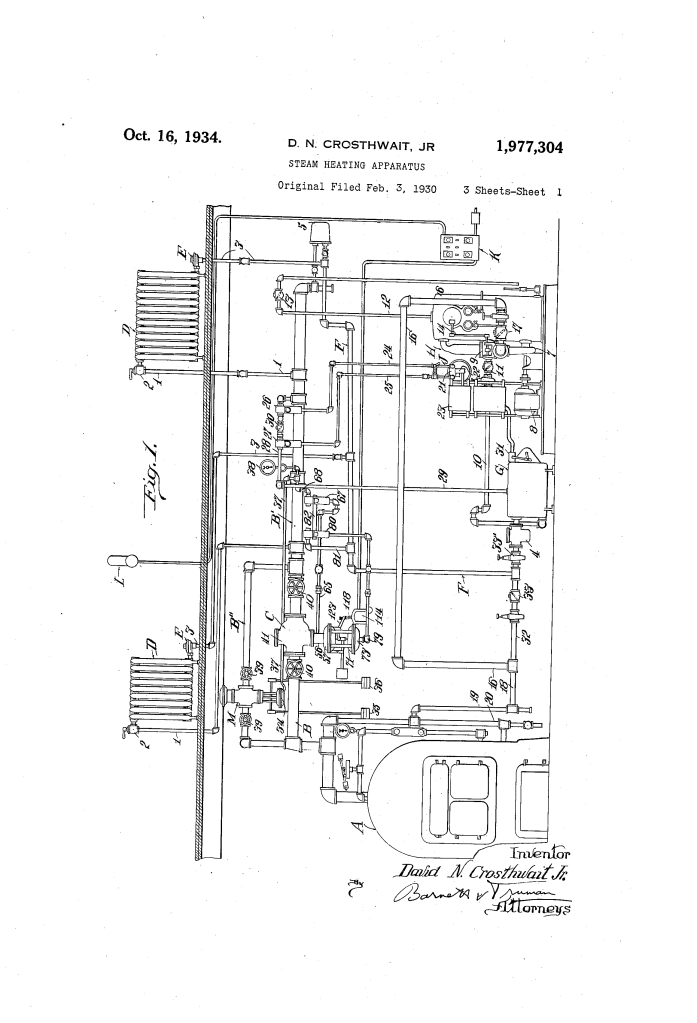
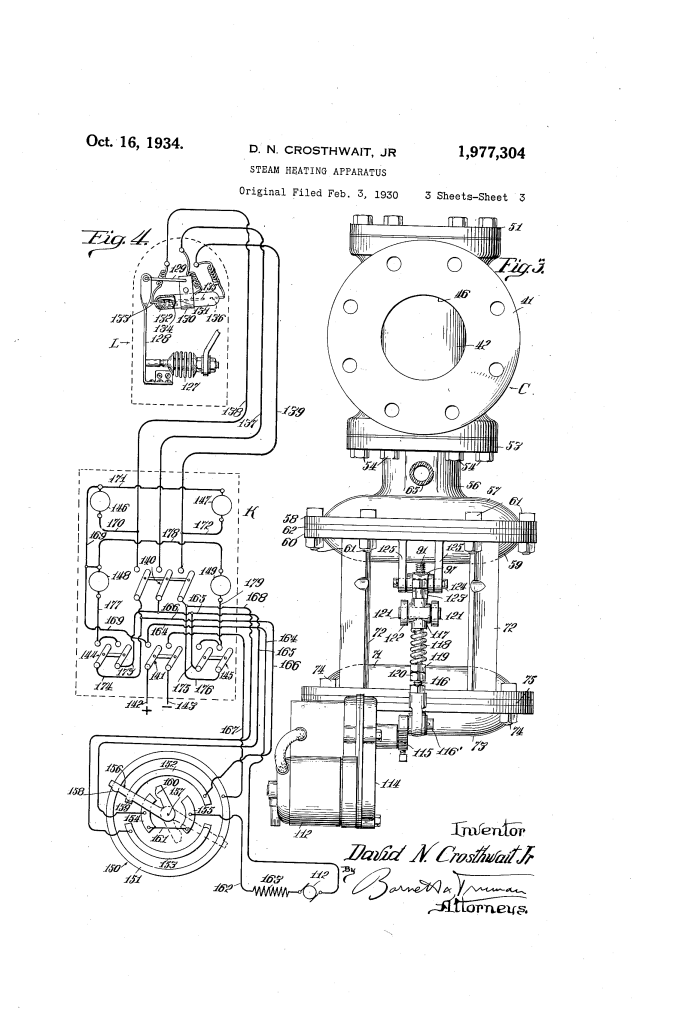
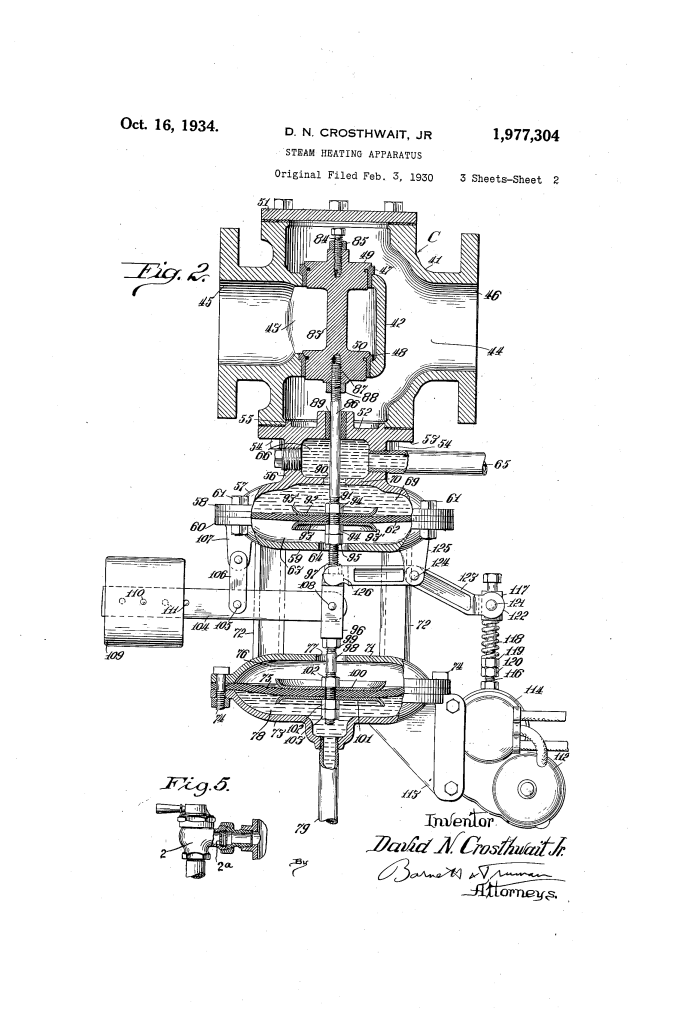
Steam Heating Apparatus, David N. Crosthwait, Jr., Patent No. 1,977,304
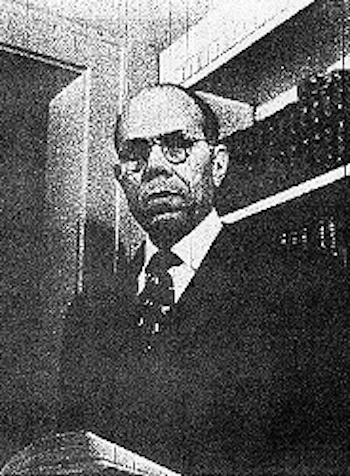
The patent by David N. Crosthwait, Jr., an inventor born in Nashville, Tennessee, and raised in Kansas City, describes a Steam Heating Apparatus (Patent No. 1,977,304), granted on October 16, 1934. This invention is an advanced differential pressure control system for large-scale buildings, designed to automatically balance the rate of steam supply with the rate of condensation in radiators.
The “Why”
In the early 20th century, heating large buildings (like skyscrapers) was notoriously inefficient. Systems either blasted occupants with excessive heat or left them freezing because steam couldn’t reach the furthest radiators. Crosthwait identified the “pressure imbalance” as the primary pain point. Without precise control, steam would often be supplied faster than it could condense, wasting fuel and creating uneven temperatures. He sought to create a “brain” for the boiler that could sense exactly how much steam was needed based on the vacuum levels in the return lines.
Inventor Section: David N. Crosthwait, Jr.
David Crosthwait was a titan of mid-century engineering. Holding a Master of Engineering from Purdue University, he served as the Director of Research for the C.A. Dunham Company. His engineering philosophy centered on fluid dynamics and thermodynamics as a means of social comfort. As a Black engineer rising to prominence during the height of the Great Depression and segregation, Crosthwait’s success was extraordinary. He didn’t just design parts; he designed integrated systems. His work was so foundational that he was commissioned to design the heating system for Radio City Music Hall and Rockefeller Center, proving that his ingenuity was essential to the infrastructure of modern America.
Key Systems Section
1. The Differential Pressure Controller
- Function: Monitors the “gap” between the supply pressure and the return vacuum.
- Modern Translation: Proportional Control System.
- This system ensures that the return main is always at a lower pressure than the radiators, allowing condensate and air to be “sucked” out effectively without losing live steam.
2. The Balanced Diaphragm Valve (Valve C)
- Function: Physically throttles the steam flow based on pneumatic signals.
- Modern Translation: Pneumatic Actuator Valve.
- The valve uses two flexible diaphragms ($62$ and $75$) separated by atmospheric pressure. This “balanced” approach allows the valve to respond to minute pressure changes without being forced open by the high-pressure steam from the boiler.
3. The Sub-Atmospheric (Vacuum) Pump
- Function: Creates a “pull” on the exhaust side of the system.
- Modern Translation: Vacuum Return Pump.
- By operating at “sub-atmospheric” pressures, the steam can be distributed at much lower temperatures ($< 212^\circ\text{F}$), which prevents the “burnt air” smell and over-drying common in older steam systems.
4. The Orifice Plate Distribution
- Function: Restricts steam flow at the entrance of each individual radiator.
- Modern Translation: Flow Restrictors / Balancing Valves.
- These plates ensure that the radiator closest to the boiler doesn’t “hog” all the steam, allowing the steam to reach the furthest units in a large building simultaneously.
Comparison Table
| Feature | Standard Steam Systems (Pre-1930) | Crosthwait’s System |
| Control Method | Manual on/off or simple “all or nothing” valves. | Variable flow based on real-time condensation rates. |
| Pressure Level | Super-atmospheric (High pressure, high heat). | Sub-atmospheric (Lower temp, higher comfort). |
| Efficiency | Significant fuel waste due to overheating. | Optimized fuel use; steam supplied only as used. |
| Building Size | Limited by pressure drop in long pipe runs. | Scalable for massive complexes like Rockefeller Center. |
Significance Section
- Foundation of Modern HVAC: Crosthwait’s work on vacuum-based heat transfer is the direct ancestor of modern variable refrigerant flow (VRF) and hydronic balancing.
- Energy Conservation: By matching supply to “condensing capacity,” he pioneered the concept of Load Matching, which is the gold standard for green building today.
- Urban Infrastructure: This patent allowed for the reliable heating of the first generation of American skyscrapers.
- Automation: The use of a thermostat ($L$) to override a mechanical pressure system ($C$) represents an early transition into electromechanical building automation.
