
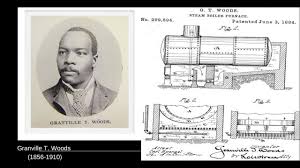
The Steam Boiler Furnace by Granville T. Woods – 1884 – Patent No. 299,894
Granville T. Woods received his first patent on June 3, 1884, for an improved Steam Boiler Furnace, patent number 299,894. His invention aimed to increase the efficiency of steam boiler furnaces by promoting better combustion and economizing fuel. It achieved this through the provision, construction, and arrangement of an auxiliary bridge-wall in connection with a forced blast.
Specifically, the invention included:
- An auxiliary bridge-wall placed behind the ordinary bridge-wall, extending from near the ash-pit to close to the boiler.
- One or more horizontal apertures in this supplemental bridge-wall, positioned below the grate-level, to allow passage of gaseous combustion products.
- A blast-pipe with nozzles arranged to discharge air or steam rearward through these apertures.
- A space adjacent to the boiler behind the auxiliary bridge-wall.
The apparatus worked by highly heating the gaseous products of combustion and keeping their temperature above the point of thorough combustion, while simultaneously drawing them away from the cooler surfaces of the boiler. It also created a partial vacuum that drew cooler gases back into the system for reheating and thorough combustion.
About Granville T. Woods
Granville Tailer Woods (April 23, 1856 – January 30, 1910) was a prolific American inventor, often referred to as “The Black Edison” due to the breadth and impact of his innovations. Born in Columbus, Ohio, to formerly enslaved parents, Woods had limited formal schooling. However, he was self-taught, apprenticing in a machine shop and learning the machinist and blacksmith trades. He continuously educated himself through various jobs in transportation and industry, even taking night courses in engineering.
Woods eventually settled in Cincinnati, Ohio, where he established his own electrical engineering business and dedicated himself to inventing. Over his lifetime, he secured more than 60 U.S. patents, primarily in the fields of electrical and mechanical engineering, with a significant focus on trains and streetcars.
Personal and Historical Significance of the Invention
While the steam boiler furnace was Woods’s first patent, it laid the groundwork for a remarkable career. Its significance, though perhaps overshadowed by his later, more famous electrical inventions (like the Synchronous Multiplex Railway Telegraph, which revolutionized train communication and safety), demonstrates his early talent for improving industrial efficiency and economizing resources.
Personal Significance for Granville T. Woods:
- First Patent and Validation: This patent marked the beginning of Woods’s formal recognition as an inventor. It was the crucial first step in a career that would see him become one of the most prolific African American inventors of his time.
- Foundation for Future Work: The success of this initial invention likely provided him with the confidence and motivation to pursue further innovations, particularly in the realm of electricity and transportation, which would become his lifelong focus.
- Establishing a Business: Shortly after this patent, Woods and his brother, Lyates Woods, formed the Woods Electric Company in Cincinnati, which aimed to develop, manufacture, and sell electrical machinery. This initial success contributed to his ability to become a full-time inventor.
Historical Significance of the Invention:
- Contribution to Industrial Efficiency: In the late 19th century, steam power was central to many industries, including manufacturing and transportation. Improvements in boiler furnace efficiency, like Woods’s, contributed to fuel economy and better performance, which had a positive impact on industrial operations.
- Early Example of Woods’s Ingenuity: While not as revolutionary as some of his later inventions, the steam boiler furnace showcased Woods’s innovative problem-solving skills and his ability to apply scientific principles to practical challenges.
- Context of a Larger Legacy: The steam boiler furnace is an important part of the broader story of Granville T. Woods, a pioneering African American inventor who achieved significant technological advancements despite facing considerable racial discrimination and legal challenges in his efforts to profit from and defend his intellectual property. His work, including this early patent, contributed to advancements that are still relevant in modern technology.
