

Starter Generator, Frederick M. Jones (1949)
Patented in July 1949, this invention by Frederick M. Jones (U.S. Patent No. 2,475,842) completely reimagined the design of an electric starter generator. Jones, the engineering genius behind Thermo King, needed a specialized motor that could both start a gas engine and generate power for refrigeration units while remaining compact, durable, and self-cooling.
His breakthrough was a “reversed” internal architecture. In standard motors of the time, the heavy magnetic field was on the outside and the spinning armature was on the inside. Jones flipped this: he put the stationary magnets in the center and made the heavy armature spin on the outside.
The “Why”
Standard starter generators had several flaws when used in heavy-duty transport:
- Low Inertia: Small internal armatures didn’t provide enough “flywheel” effect to smooth out the vibration of a gas engine.
- Overheating: Internal spinning parts are hard to cool because they are trapped inside a stationary shell.
- Maintenance: Replacing brushes often required disassembling the entire unit.
The Solution: By rotating the armature as an “outer shell,” Jones turned the motor itself into a powerful flywheel and a centrifugal blower. This dual-purpose design stabilized the engine’s crankshaft and kept the entire system cool without needing extra parts.
Inventor Section: Engineering Philosophy
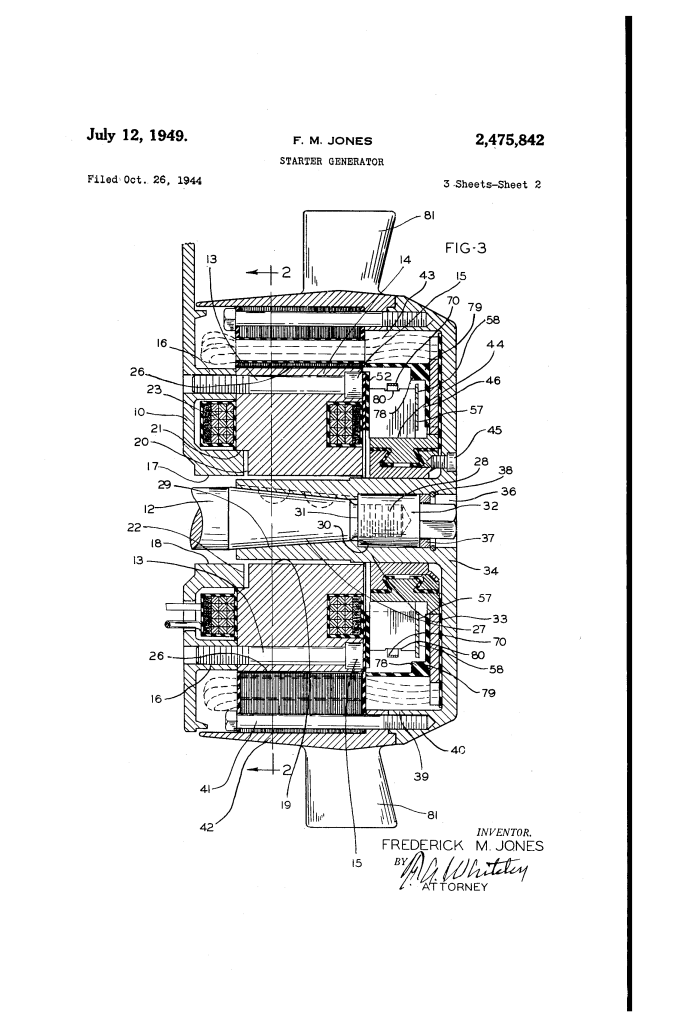
Frederick M. Jones’s philosophy was Component Multi-Tasking. He didn’t just want a starter; he wanted a starter that was also a flywheel, a fan, and a balancer. By mounting this heavy, rotating assembly on the front of the engine’s crankshaft (12), he perfectly counter-balanced the load on the other side of the engine (like a pulley or compressor). This “balanced system” approach significantly reduced mechanical wear and tear.
Key Systems Section
1. The “Inside-Out” Design
The architectural flip is the core of this patent.
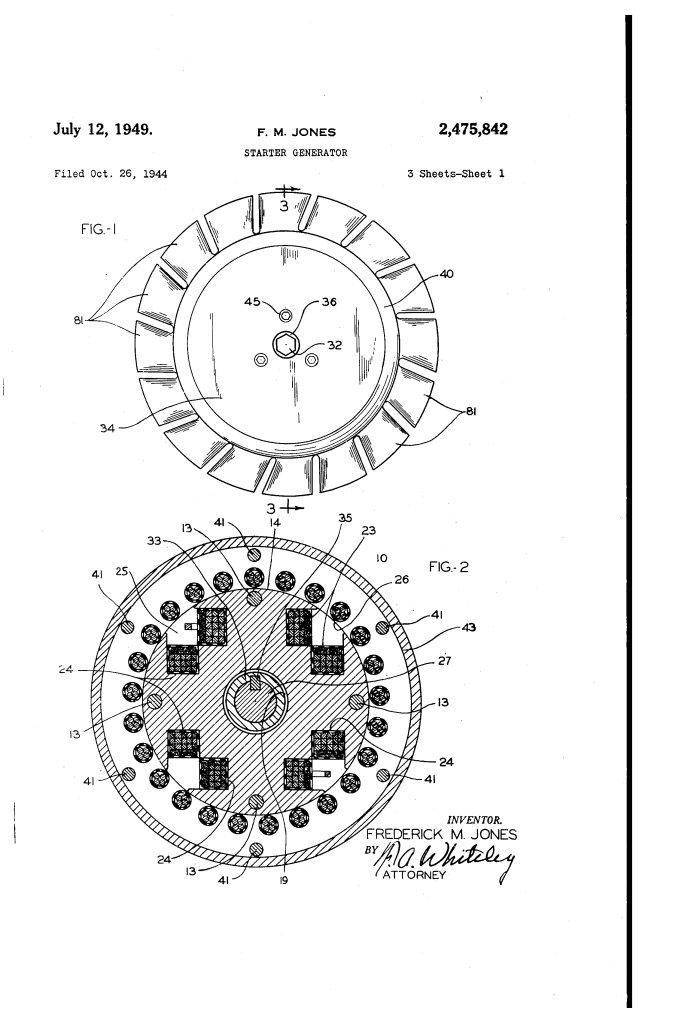
- Stationary Pole Piece (14): The magnetic field and windings (23) are bolted directly to the engine block and stay perfectly still at the center.
- Rotating Armature Shell (43): The armature is attached to a “Frame Plate” (34) that is keyed to the spinning crankshaft. It wraps around the stationary magnets like a cup.
- The Flywheel Effect: Because the heaviest part of the motor is spinning at the furthest possible distance from the center, it creates massive rotational inertia, acting as a built-in flywheel.
2. The Integrated Blower (Self-Cooling)
Because the outer shell of the motor is spinning, Jones utilized its surface for cooling.
- Blower Ring (42): A ring with angled vanes (81) is bolted to the outside of the rotating armature.
- The Shroud (82): A metal cover directs the air moved by these vanes.
- Dual Cooling: As the motor spins, it acts as a powerful fan that blows air over the engine’s radiator fins and simultaneously pulls heat away from the generator’s own electrical windings.
3. The “Automatic” Brush System
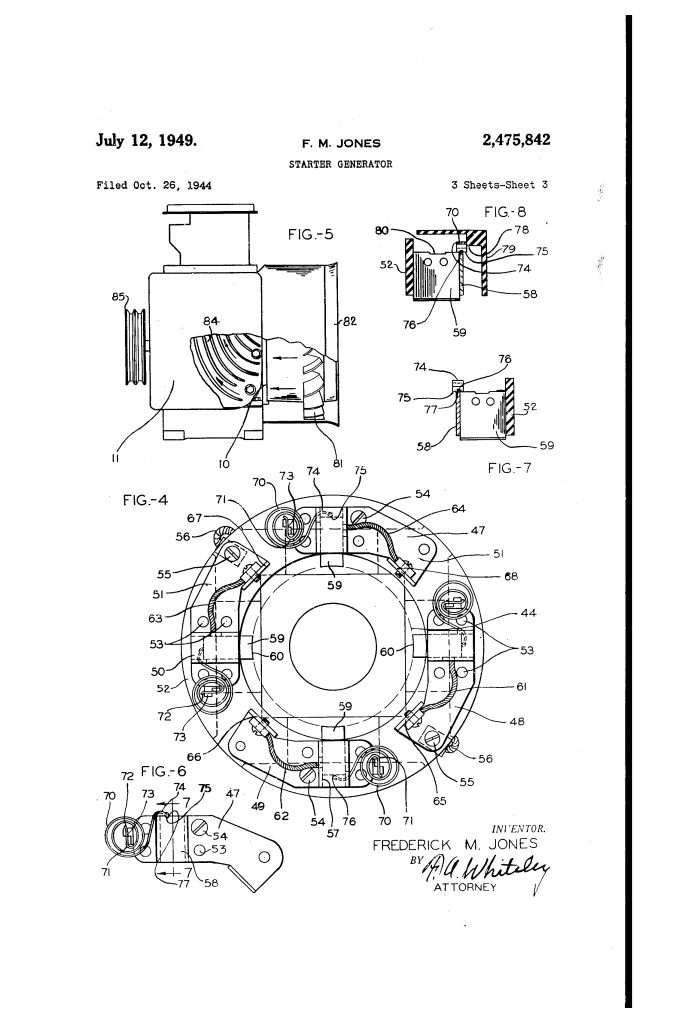
One of the most clever mechanical features is how Jones handled the electrical brushes (59).
- Retractable Brushes: When repairing the unit, brushes can be locked in an “inoperative” (pulled back) position using a specialized spring (70) and notch.
- Auto-Release: When the outer shell is pushed back onto the shaft during reassembly, an insulated ring (78) on the armature automatically strikes the springs, snapping the brushes forward into contact with the commutator (44).
- The Benefit: This prevents the brushes from getting crushed or damaged during maintenance, a common headache for mechanics.
Comparison: Standard vs. Jones Design
| Feature | Standard Generator | Jones Starter Generator |
| Magnetic Field | Outside (Stationary) | Inside (Stationary) |
| Armature | Inside (Rotating) | Outside (Rotating) |
| Flywheel | Requires separate part | Built-in to Armature |
| Cooling | Often requires separate fan | Integrated Vanes on Shell |
| Maintenance | Brushes hard to reach | Auto-snapping brush system |
Significance
This 1949 patent was vital for the success of long-haul refrigerated transport:
- Durability: The “inside-out” design was much more resistant to the vibration of constant road travel.
- Efficiency: By combining the flywheel and fan into the generator, Jones reduced the total weight of the refrigeration system, allowing trucks to carry more cargo.
- Compactness: The unit takes up very little space because it “hugs” the engine crankshaft, making it perfect for the tight compartments of a truck.
Final Insight: Jones’s design proves that sometimes the best way to solve a complex engineering problem is to simply turn the entire concept on its head. His “Inside-Out” generator remains a masterclass in elegant, multi-functional design.
