

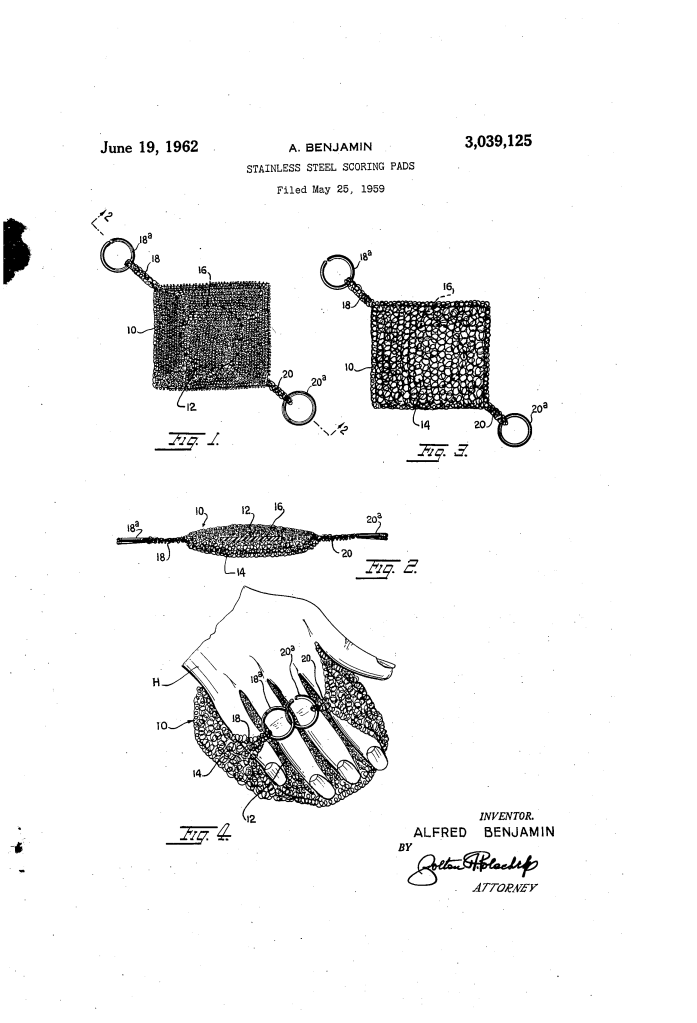
Stainless Steel Scouring Pads (1962)
U.S. Patent No. 3,039,125, granted on June 19, 1962, to Alfred Benjamin of New York, introduces a multi-functional improvement to the standard kitchen scouring pad. Benjamin’s design aimed to replace the need for multiple cleaning tools by combining different abrasive surfaces into a single, wearable device.
The Problem: Single-Purpose Tools
In the mid-20th century, cleaning heavily soiled pots and pans usually required two separate steps:
- Heavy Scouring: Using a coarse pad to remove large masses of burnt-on food or debris.
- Polishing: Using a fine-grade pad to restore the shine to the metal (copper, aluminum, or stainless steel) or ceramic surface.
Switching between different pads was inefficient, and standard steel wool pads were often difficult to grip when soapy and wet.
The Innovation: The Two-Ply Dual-Action Pad
Benjamin’s invention is a rectangular, two-ply scouring pad made of interwoven stainless steel wool. It features a distinct “coarse” side and a “fine” side, held together with a structural core and a unique hand-attachment system.
1. Dual Grades of Coarseness
The pad is constructed of two different weaves:
- The Coarse Ply (14): Woven from heavier gauge wire in a loose, open weave. This side is designed for “fast cutting” to aggressively remove stubborn debris from pot walls.
- The Fine Ply (12): Woven from fine steel wool in a tight, close weave. This side acts as a polishing agent, providing a smooth finish once the heavy cleaning is done.
2. The Internal Stiffening Disk
To prevent the pad from bunching up or losing its shape during vigorous scrubbing, a rigid disk (16) made of plastic or metal is inserted into a pocket between the two plies. This central disk provides a solid “spine” for the user to press against, ensuring even pressure across the scouring surface.
3. The Wearable “Loop” Attachment
Perhaps the most unique feature is how the pad is secured to the user’s hand:
- Woven Arms (18, 20): Two arms of woven steel wool extend from diagonally opposite corners of the rectangular body.
- Split Rings: The ends of these arms carry split rings. These rings can be linked together to form a loop, allowing the user to slide their hand through the loop or secure it around their fingers.
Comparison of Features
| Feature | Benjamin Scouring Pad | Conventional Steel Wool Pad |
| Abrasiveness | Dual-Sided (Fine & Coarse) | Single Grade |
| Grip Type | Wearable (Integrated Loop) | Manual Grip Only |
| Durability | Stainless Steel (Rust-Resistant) | Often Carbon Steel (Rusts) |
| Rigidity | Internal Stiffening Disk | Flexible/Compressible |
Summary of Utility
The Benjamin pad was designed for versatility across various materials including aluminum, copper, brass, ceramic, and porcelain. By integrating the coarse “cleaning” phase and the fine “polishing” phase into one tool—and ensuring that tool wouldn’t slip out of a soapy hand—it represented a significant ergonomic step forward in household maintenance.
