
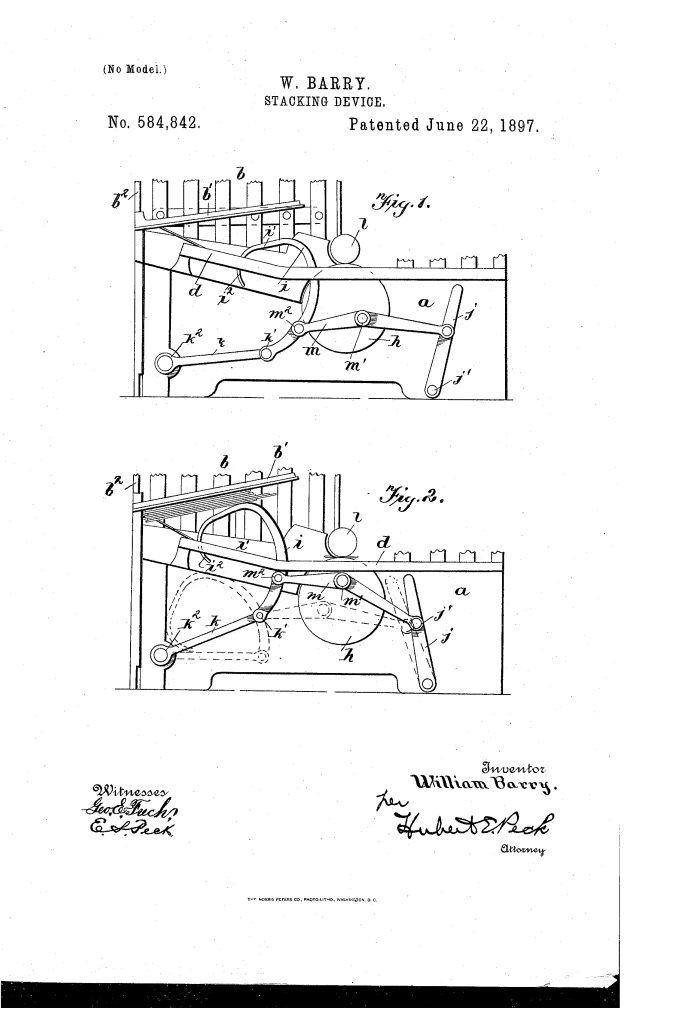
Stacking Device (1897)
U.S. Patent No. 584,842, granted on June 22, 1897, to William Barry, describes a high-speed mechanical stacking and packing mechanism designed primarily for mail-marking machines. Barry, an inventor based in Syracuse, New York, tackled a major bottleneck in early automated mail processing: clearing and neatly aligning letters as they were discharged at rapid speeds from cancelers and sorting rolls.
This invention solved a persistent mechanical problem: how to continuously move discharged letters out of the way of subsequent incoming mail without jamming, while simultaneously aligning the stack against a guide rail using a minimal number of moving parts.
The Innovation: The Shifting-Fulcrum Elliptical Pusher
Standard stackers often relied on complex, bulky gear assemblies or rigid reciprocating plungers that risked obstructing incoming letters or crumpling fragile envelopes. Barry’s breakthrough was an approximately J-shaped (or L-shaped) pusher arm mounted on a shifting fulcrum that travels along an elliptical or encircling path.
By coordinating a swinging link, an eccentric drive, and a controlling lever, the pusher enters behind a discharged envelope, pushes it laterally and rearwardly against the accumulated pack, and swings completely out of the way before the next letter arrives.
Key Mechanical Features
- J-Shaped Pusher (i): The curved, smooth working head (i1) engages letters flatly and tilts gradually during its stroke to pack envelopes without catching their edges. The return tip (i2) remains within a front wall slot to prevent snagging.
- Shifting Fulcrum Link (k): A pivoting link (k1) anchored to the frame (k2) allows the base of the pusher to float, creating a dynamic pivot point rather than a fixed axis.
- Eccentric Pitman Drive (m): Driven directly by an off-center crank pin (m1) on feed roll (h), this arm imparts continuous elliptical motion to the pusher assembly.
- Trajectory Control Lever (j): Fulcrumed at (j1), this swinging guide restrains the pitman to maintain precise angular alignment throughout the cycle.
Technical Components
| Component | Function |
| Feed Rolls (h, l) | Opposing vertical rollers that grip and rapidly discharge letters on edge across the front of the receiving bed. |
| Receiving Way (b) | The collection channel fitted with a side guide (b1) and spring-loaded follower (b2) to support the growing stack. |
| Pusher Bar (i) | J-shaped packing arm that swings through a slot in the front wall (d) to advance mail into the receiving way. |
| Swinging Link (k) | Movable pivot support that provides a shifting fulcrum for the pusher shank. |
| Pitman (m) | The main connecting rod joining the drive crank to the pusher and the stabilizing guide lever. |
| Guide Lever (j) | Control arm pivoted to the floor that restrains the pitman to trace an exact elliptical path. |
How the Mechanism Operates
The device executes a four-phase cycle synchronized with the letter feed:
- Discharge: Feed rolls (h, l) eject an envelope on edge across the front floor (a) and into the receiving way (b) behind wall (d).
- Entry: Driven by crank (m1), the J-shaped pusher swings through the wall slot, positioning its smooth lateral head (i1) directly behind the newly arrived letter.
- Sweeping & Alignment: The pusher advances along an elliptical path, tilting into an inclined angle to drive the letter both rearwardly into the stack and laterally against side guide (b1).
- Retraction: As the crank passes top dead center, the swinging link (k) pulls the pusher arm forward and clear of the receiving way, leaving the channel completely open for the next envelope.
Industrial Significance
William Barry’s stacking mechanism provided a durable, compact solution for postal automation during an era of rapidly expanding mail volumes:
- Part Reduction: Eliminated intricate cam tracks and gears by relying on a balanced four-bar linkage driven off the existing feed roll.
- Jam Prevention: The shifting fulcrum allowed the pusher to clear the delivery channel entirely on its return stroke.
- Continuous Alignment: Combining inward packing with lateral squaring ensured envelopes remained uniformly stacked for bundling.
About the Inventor: William Barry
William Barry was an inventor working in Syracuse, New York, during the late 19th-century boom in postal mechanization and office machinery. His work on high-speed feeds and linkage systems contributed practical mechanical solutions that allowed post offices to transition from manual processing to automated cancellation and sorting.
Summary of Claims
The patent explicitly claims:
- A stacking device featuring a pusher with a movable fulcrum driven by an eccentric pitman connection.
- The combination of a J-shaped pusher bar traversing an elliptical path through a slotted receiving wall.
- A controlling guide lever linked to the drive pitman to stabilize the motion path independently of the pusher arm.
