
Stabilized Straight Chain Hydrocarbons (1959)
U.S. Patent No. 2,889,306, granted on June 2, 1959, to Walter L. Hawkins, Vincent L. Lanza, and Field H. Winslow, describes a revolutionary method for protecting plastics like polyethylene from degradation caused by heat and sunlight. Developed at Bell Telephone Laboratories, this invention was critical for the durability of the national telecommunications infrastructure.
This specific invention solved a baffling problem in polymer science: the “Antioxidant Paradox.” While carbon black was known to protect plastics from UV light, it typically deactivated common chemical antioxidants, making it impossible to protect outdoor cables from both the sun and thermal oxidation simultaneously. Hawkins and his team discovered a class of materials that actually required carbon black to function, creating a powerful “synergistic” defense.
The Innovation: The “Synergistic Carbon-Sulfur” Defense
Polyethylene is subject to “autocatalytic oxidation”—a chain reaction where exposure to heat or light causes the polymer chains to snap, leading to brittleness and electrical failure.
The researchers discovered that thiuram disulfides (sulfur-containing compounds) act as “retarders” rather than traditional antioxidants. While these compounds are mostly ineffective in clear plastic, they become incredibly potent when paired with finely dispersed carbon black.
Why the Synergetic Effect?
- Thermal Stability: It prevents the plastic from breaking down during high-temperature manufacturing processes like extrusion.
- UV Shielding: The carbon black absorbs ultraviolet radiation, while the sulfur compounds stop the chemical “rot” that heat induces.
- Regeneration: The inventors postulated that the chemical reaction between the sulfur and the carbon black might actually “regenerate” the stabilizer, allowing it to protect the plastic for decades rather than years.
Key Chemical Components
The composition is a precise blend of a high-molecular-weight polymer and two protective additives:
| Component | Function |
| Polyethylene / Polypropylene | The base hydrocarbon polymer used for wire insulation and cable sheathing. |
| Carbon Black (0.5% to 5%) | Tiny particles (<1000 angstroms) that shield against UV light and act as a catalyst for the sulfur retarder. |
| Thiuram Disulfides (0.1% to 5%) | Specifically compounds like Tetramethyl thiuram disulfide; they stop the chain reaction of oxidation. |
| Tertiary Hydrogen Atoms | The specific “weak links” in the polymer chain that this invention is designed to protect. |
Performance: Extending the Life of Infrastructure
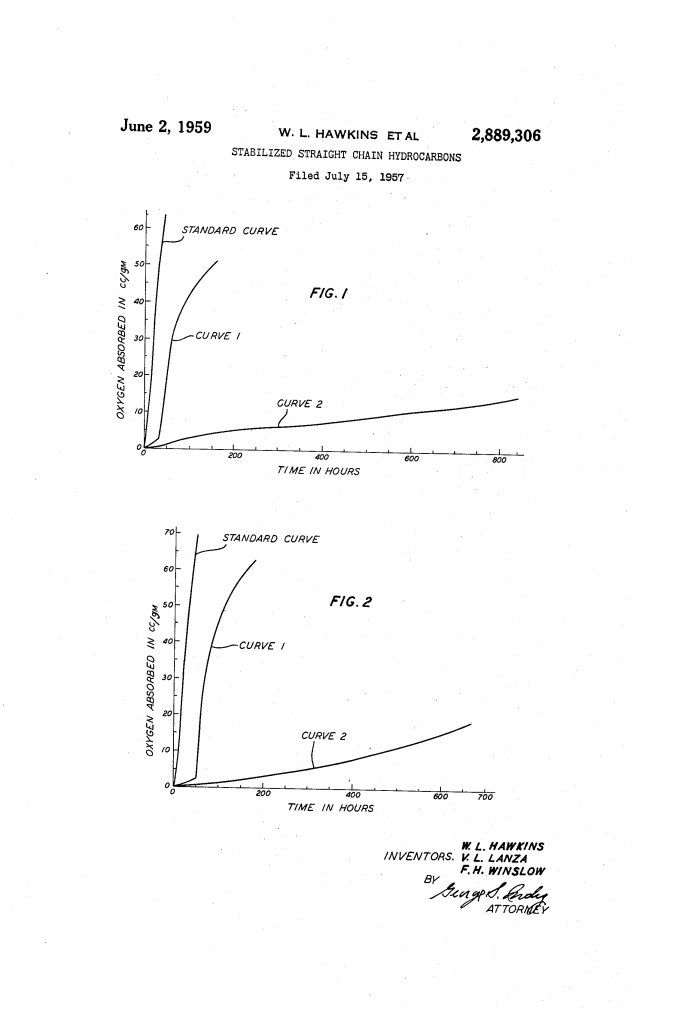
Hawkins’s patent includes dramatic evidence from “Accelerated Aging Tests” conducted at 140°C. These tests measured “oxygen uptake”—the more oxygen a plastic absorbs, the faster it is rotting.
Testing Results (Time to Critical Failure):
- Polyethylene (No Additives): Failed in just 8 hours.
- Polyethylene + Sulfur Retarder (No Carbon): Failed in 40-50 hours.
- Polyethylene + Carbon Black + Sulfur Retarder: Remained stable for over 550 hours.
The Manufacturing Process
Bell Labs utilized a precise “mill massing” technique to ensure the stabilizers were perfectly dispersed:
- Preparation: Create a “master batch” containing 25% carbon black and the polymer.
- Milling: Process on a two-roll mill at approximately 125°C.
- Dilution: Add more polyethylene to “cut back” the carbon black concentration to the desired 3%.
- Incorporation: Add the thiuram disulfide (retarder) while maintaining the temperature to avoid evaporation.
- Molding: Press the stabilized mix into 50-mil sheets for use in cable jackets or wire insulation.
About the Inventor: Walter L. Hawkins
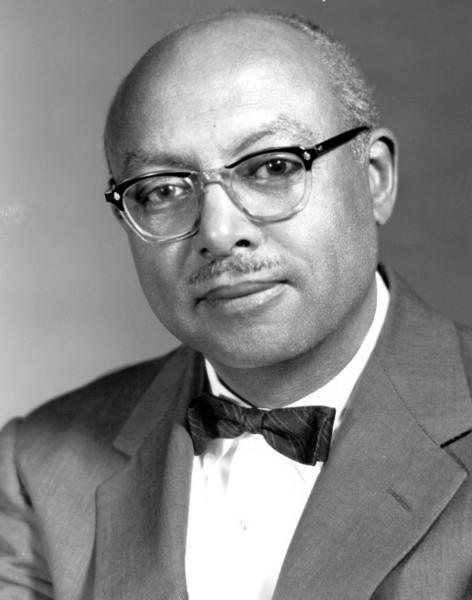
W. Lincoln Hawkins was a pioneering African American chemist and engineer at Bell Laboratories.
- Sustainability Pioneer: His work on this patent allowed the telephone industry to switch from expensive lead-sheathed cables to durable, lightweight plastic-coated wires, saving billions of dollars.
- Environmental Impact: By making plastics last for 40+ years in the outdoors, he contributed significantly to the early concepts of material conservation.
- Honors: Hawkins was the first African American elected to the National Academy of Engineering and was awarded the National Medal of Technology in 1992.
Summary of Claims
The patent explicitly claims:
- A composition stabilized against oxidation containing carbon black particles and a specific thiuram disulfide structure.
- The use of this blend in saturated hydrocarbon polymers like polyethylene, polypropylene, and polybutene-1.
- Specific claims for tetramethyl and tetraethyl thiuram disulfides as the preferred retarder materials.
- The requirement that the carbon black particles have a maximum size of 1000 angstroms for effective shielding and catalysis.
