
Stabilized Alpha-Mono-Olefinic Polymers (1967)
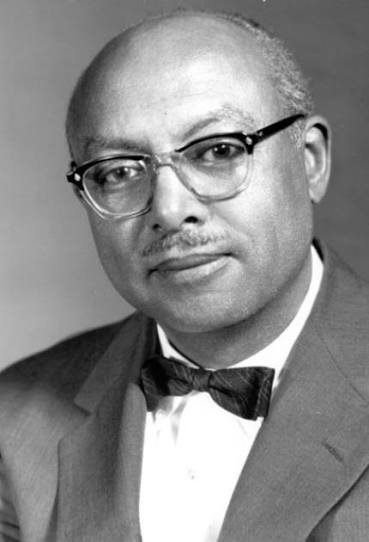
U.S. Patent No. 3,304,283, granted on February 14, 1967, to Walter L. Hawkins and Mary Ann Worthington, describes a synergistic antioxidant system designed to prevent the thermal oxidation and degradation of saturated hydrocarbon plastics. Walter L. Hawkins, a pioneering research chemist at Bell Telephone Laboratories, Incorporated, in Murray Hill, New Jersey, was a global leader in polymer chemistry and materials science.
This specific invention solved a critical operational bottleneck in telecommunications and materials engineering: how to prevent common plastics like polyethylene and polypropylene from becoming brittle, losing tensile strength, and suffering electrical breakdown when exposed to heat and oxygen during long-term service.
The Innovation: The Sulfur-Phenol/Amine Synergism
Saturated polyolefins containing tertiary hydrogen atoms (such as polyethylene and polypropylene) are vulnerable to thermal oxidation—a process driven by heat in ordinary atmospheres that steadily degrades polymer chains. While conventional antioxidants provided limited protection, individual additives often broke down quickly at elevated operating temperatures.
Hawkins and Worthington discovered that combining specific classes of organosulfur compounds with select biphenols or aromatic amines produced a powerful synergistic antioxidant effect. Neither component acting on its own could match the thermal stability achieved when both were combined within the polymer matrix.
Why This Synergistic Combination?
- Radical Interception and Peroxide Decomposition: The dual-action mechanism intercepts oxidative free-radical chain propagation while safely decomposing destructive hydroperoxides.
- Extended Induction Period: It significantly prolongs the induction period—the time before rapid autocatalytic oxygen absorption begins.
- Mechanical and Dielectric Preservation: It prevents early plastic embrittlement and preserves high dielectric insulation strength, ensuring cables and wiring survive decades of environmental stress.
Key Chemical Components
The composition is a synergistic blend where each component serves a distinct stabilization function:
| Component | Function |
| First Component: Organosulfur Compound | Decomposes harmful hydroperoxides into non-radical products. Classes include aromatic thioethers (e.g., thiobis-beta-naphthol), aliphatic disulfides (e.g., di-dodecyl disulfide), aromatic disulfides (e.g., di-beta-naphthyl disulfide), mercaptans (e.g., 2-naphthalenethiol), and thiuram disulfides. |
| Second Component: Biphenol or Aromatic Amine | Acts as a primary free-radical chain stopper. Includes bridged or direct biphenols (e.g., 4,4′-biphenol; 2,2′-methylenebis(4-methyl-6-tert-butylphenol)) and secondary aromatic amines (e.g., phenyl-beta-naphthylamine; diphenyl-p-phenylenediamine). |
| Base Polyolefin Resin | Saturated alpha-mono-olefin polymers (such as conventional and high-density polyethylene, polypropylene, polybutene-1, and related copolymers) providing mechanical and dielectric properties. |
Performance: Preventing Thermal Oxidation
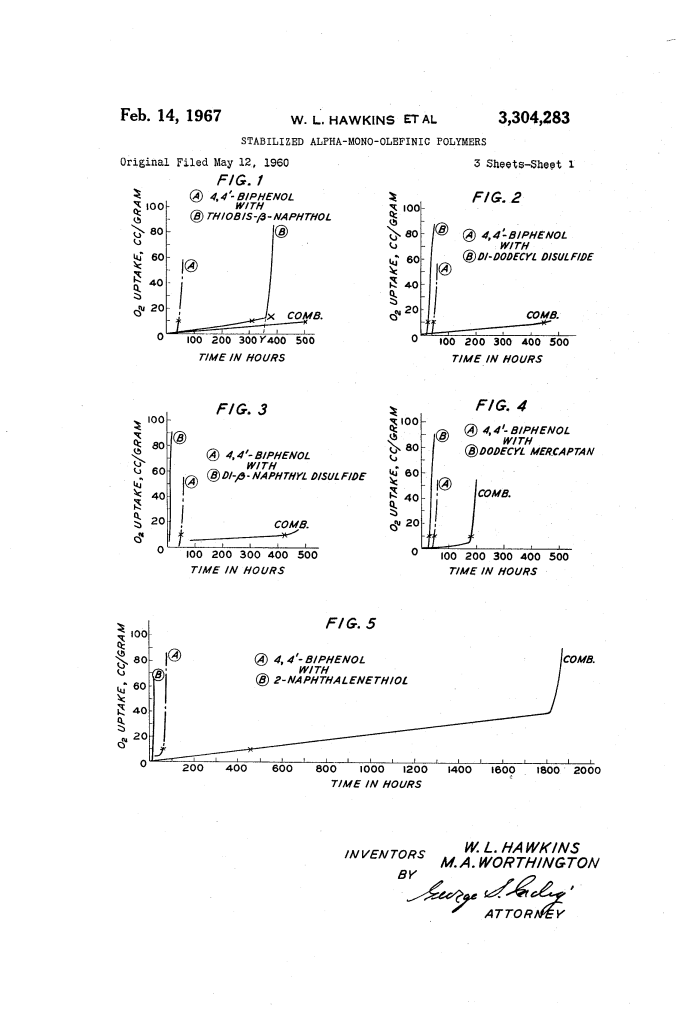
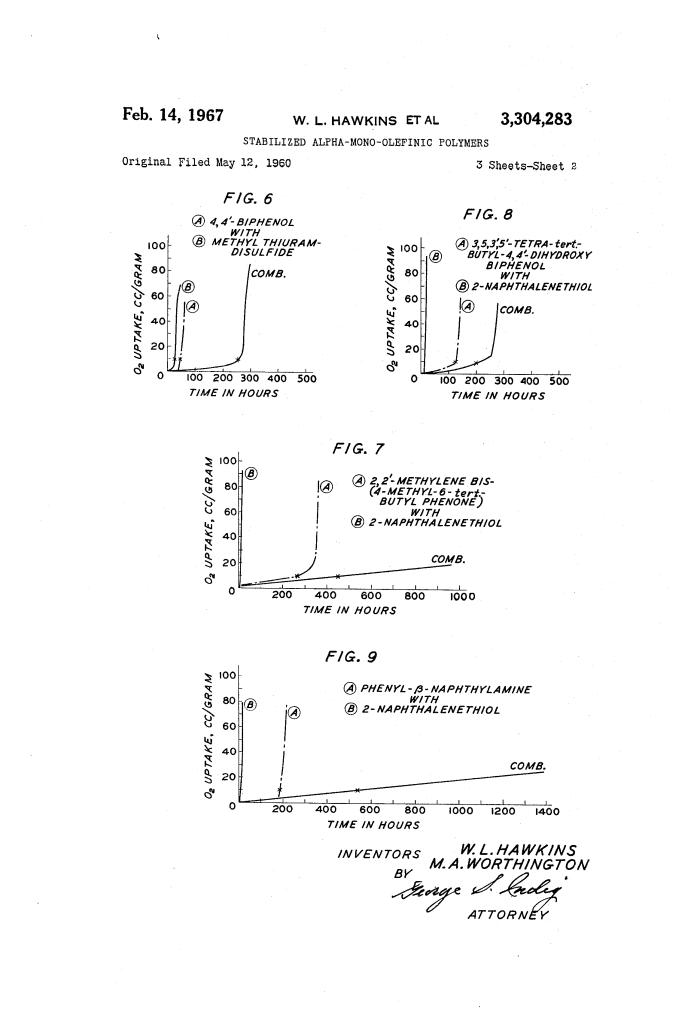
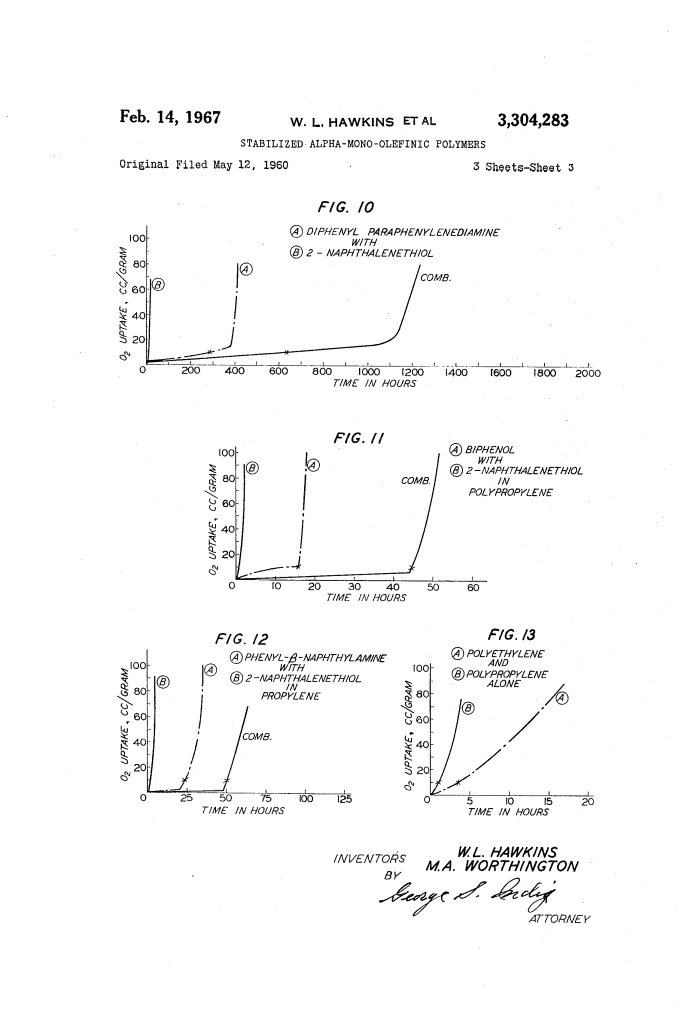
Hawkins and Worthington demonstrated the formulation’s performance using accelerated thermal oxidation tests at 140 C in pure oxygen, measuring oxygen uptake and the length of the induction period before degradation occurs. Useful life is considered compromised once a polymer absorbs 10 cc of oxygen per gram of sample (approximately 0.5% by weight).
Comparative Stability at 140 C:
- Uninhibited Polyethylene: Fails rapidly with virtually no induction period, absorbing destructive levels of oxygen in a matter of hours.
- Polyethylene with Sulfur Compound Alone (e.g., Thiobis-beta-naphthol): Provides moderate inhibition, but undergoes rapid degradation once the individual compound is consumed.
- Polyethylene with Phenol Alone (e.g., 4,4′-Biphenol): Delays oxidation marginally, failing early under continuous high heat.
- Polyethylene with Synergistic Combination: Extends the induction period (Point Y) to roughly 350 hours or more, providing hundreds of hours of additional service stability before reaching critical oxygen absorption thresholds.
The Manufacturing and Compounding Process
The patent outlines an exact industrial milling and compounding sequence:
- Heat the rolls of a two-roll mill (such as a 6-inch by 12-inch mill operating at 25 and 35 rpm) to approximately 120 C.
- Mass the polyolefin resin (such as commercial high-molecular-weight polyethylene or uninhibited virgin polypropylene) on the heated rolls.
- Incorporate the stabilizer components, adding at least 0.01% by weight (typically 0.1% of each component, up to a total of 5% to 10% maximum).
- Mill thoroughly until the organosulfur compound and phenolic/amine stabilizer are uniformly dispersed throughout the melted resin matrix.
- Extrude or mold the compounded plastic into wire insulation, cable sheathings, or structural shapes.
Historical and Industrial Impact
Walter L. Hawkins and Mary Ann Worthington’s work was central to the global expansion of modern telecommunications infrastructure:
- Long-Distance Communications: Polyethylene was the ideal material to coat telephone and electrical cables, but it degraded rapidly outdoors. Hawkins’s stabilized formulations enabled the deployment of thousands of miles of durable transatlantic and transcontinental telephone lines.
- Replacement of Lead Sheathing: The stabilization of polyethylene allowed the telecommunications industry to transition away from expensive, heavy, and toxic lead-sheathed cables to lightweight plastic coverings.
- Modern Polymer Stabilization: This research formed the scientific foundation for modern antioxidant packages used today across automotive plastics, aerospace components, consumer packaging, and electrical insulation.
About the Inventor: W. Lincoln Hawkins
Walter Lincoln Hawkins was one of the most prominent African American chemists and chemical engineers of the 20th century.
- Bell Laboratories Career: Joining Bell Labs in 1942 as its first African American scientist, Hawkins spent over three decades conducting essential research in polymer chemistry and materials reliability.
- Honors and Recognition: Hawkins was elected to the National Academy of Engineering in 1975 and was inducted into the National Inventors Hall of Fame. In 1992, he was awarded the National Medal of Technology by President George H.W. Bush.
- Mentorship and Advocacy: Throughout his life, Dr. Hawkins was an advocate for minority education in STEM, serving as chairman of the Montclair Board of Education and co-founding initiatives to recruit and mentor underrepresented students in science and engineering.
Summary of Claims
The patent explicitly claims:
- A stabilized polyolefin composition comprising an alpha-mono-olefin polymer having 2 to 12 carbon atoms and a two-component stabilizer system.
- A formulation containing at least 0.1% by weight of each component (up to a combined maximum of 10% by weight).
- A first component chosen from aromatic disulfides, alkyl disulfides, aromatic/aliphatic mercaptans, aromatic thioethers, diaryl thioethers, or thiuram disulfides.
- A second component chosen from biphenols (including methylene-bridged bisphenols) and diaryl secondary amines.
