
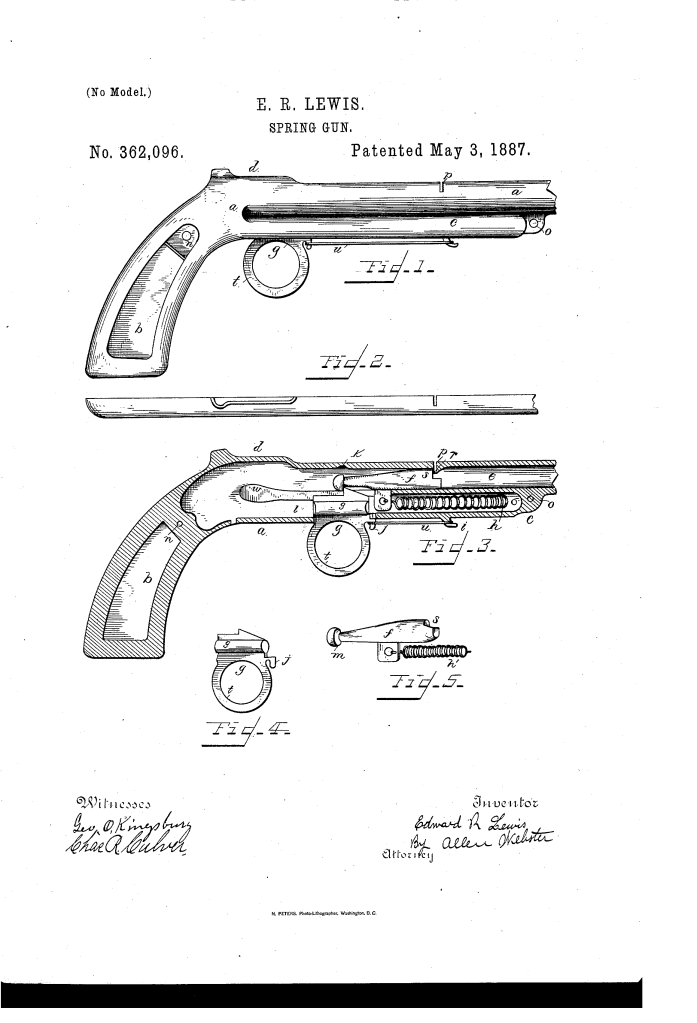
Spring Gun (Edward R. Lewis, No. 362,096)
The patent by Edward R. Lewis of Springfield, Massachusetts, describes an improvement in Spring Guns or Pistols (Patent No. 362,096, 1887). Designed primarily as a toy, this invention simplifies the firing process into a single, continuous motion—straining and releasing the mechanism with one pull of the trigger—while also incorporating a secondary function as a cap-firing hammer.
Inventor Background: Edward R. Lewis
Edward R. Lewis was an African American inventor based in Springfield, a city with a rich history of firearms manufacturing (home to the Springfield Armory). His patent, filed in 1886, represents a sophisticated contribution to the mechanical toy market. Lewis’s design focused on “automatic operation,” a term used at the time to describe mechanisms that didn’t require separate cocking and firing steps. By utilizing the geometry of the internal frame to release the firing pin, Lewis bypassed the need for complex internal latches, making the toy cheaper to manufacture and more durable for children.
Invention and Mechanism (Simplified)
The pistol is cast in two halves and uses a diverging internal track to trigger the release of a spring-loaded projectile.
1. The Diverging Track System (Key Innovation)
The interior of the frame is divided by a wedge-shaped wall (w) that creates two separate grooves: a top groove for the hammer and a bottom groove for the trigger.
- Tapered Geometry: The wall ($w$) is narrow at the front and becomes broadest at the rear end.
- The Release: As the child pulls the trigger (g) back, it remains latched to the projector/hammer (f). However, because the wall gets wider toward the rear, the hammer is forced to ride upward until it is pushed out of the trigger’s reach.
2. The Hammer and Projector (f)
- Dual Function: The piece ($f$) serves two purposes. Its front end strikes the projectile (like an arrow or pellet), while a secondary surface acts as a hammer to detonate explosives.
- Spring-Loaded Force: A projecting-spring (h) is attached to the hammer. When the trigger releases the hammer at the top of the incline, the spring snaps it forward with high velocity.
3. The Cap-Exploding Feature
- Cap Opening (p) and Ledge (r): The barrel features a small opening ($p$) where a “wafer-cap” can be inserted. This cap rests against a solid ledge or abutment (r).
- Simultaneous Action: Lewis specifically designed the hammer so that the portion hitting the projectile projects slightly further than the portion hitting the cap. This ensures the arrow is launched an instant before—or exactly as—the cap explodes, adding a realistic sound effect to the toy’s operation.
4. The Automatic Reset
- Rubber Trigger Spring (u): After firing, a rubber spring (u) pulls the trigger back to the front of the pistol.
- Sliding Latch: Because of a small recess (k) in the frame, the hammer can lift slightly, allowing the trigger to slide underneath it and re-engage the latch automatically for the next shot.
Concepts Influenced by This Invention
Edward R. Lewis’s spring gun influenced the design of simplified mechanical toys and geometrically actuated triggers.
- “One-Motion” Actuation: The concept of combining cocking and firing into a single trigger pull (now common in “double-action” mechanisms) was a major ergonomic improvement for toys and small tools.
- Cam-Based Release: Using the internal shape of the housing (the wedge-shaped wall) to trigger a mechanical release is a fundamental principle in modern manufacturing, seen in everything from quick-release cable ties to automatic industrial staplers.
- Redundant Functional Design: By creating a single moving part (the projector) that performed two distinct tasks (launching a projectile and detonating a cap), Lewis demonstrated an early mastery of part consolidation, a key goal in modern engineering to reduce cost and complexity.
- Integrated Safety Abutments: The use of an internal ledge ($r$) to contain a small explosion (the cap) within a cast-iron frame provided a controlled way to add sensory feedback (sound) to a toy safely.
