
Spraying Machine; Robert T. Smith; 1,970,984
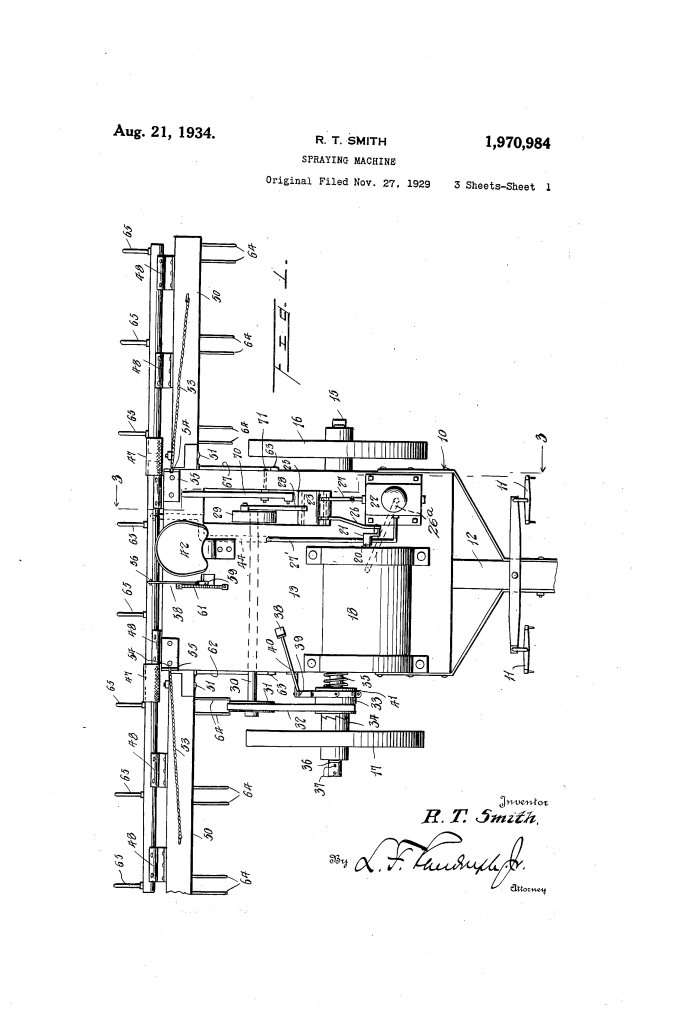
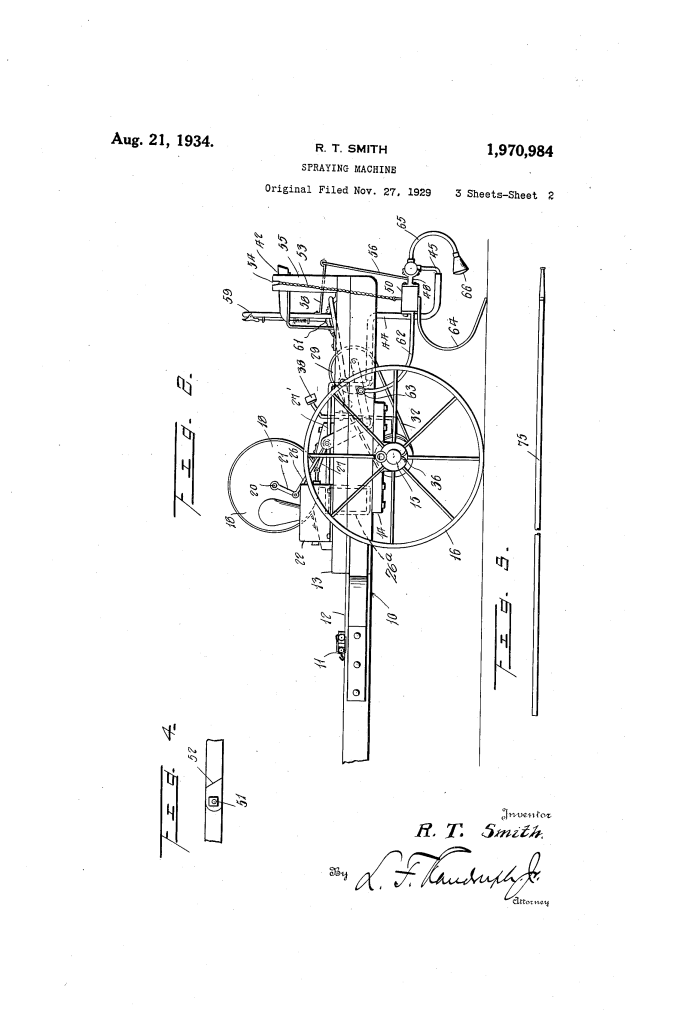
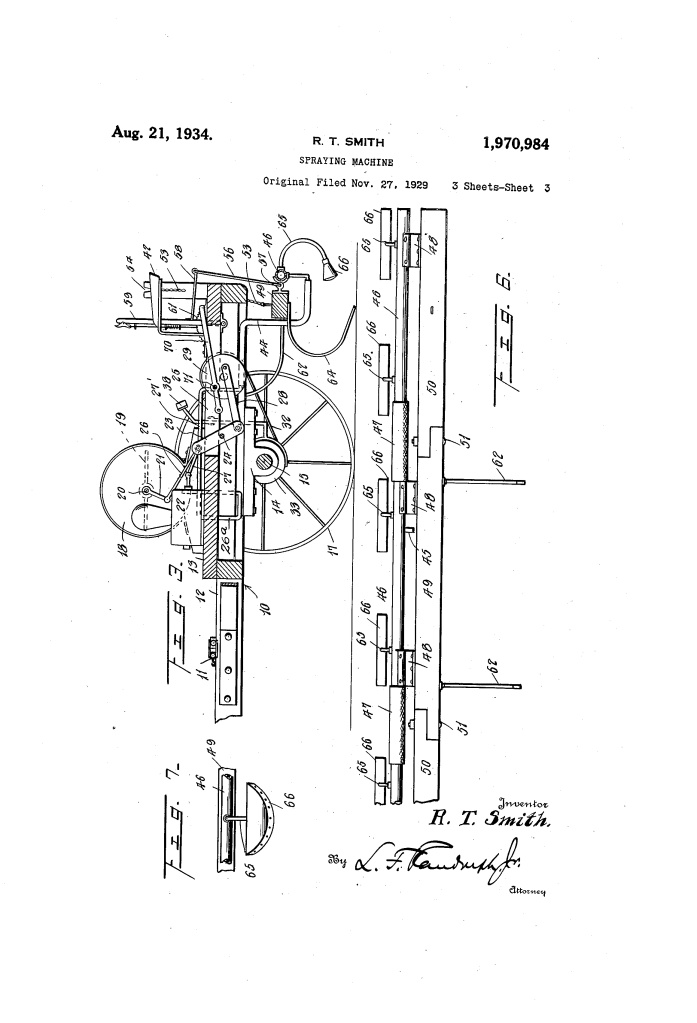
The patent by Robert T. Smith of Eufaula, Oklahoma, describes a Spraying Machine (Patent No. 1,970,984). This invention is a highly adjustable, horse-drawn mechanical applicator designed to deliver insecticidal solutions to row crops, such as cotton and potatoes, with a specific focus on reaching the vulnerable under-surfaces of foliage.
The “Why”
In the 1920s and 30s, the boll weevil and other pests posed an existential threat to the Southern agricultural economy. Standard spraying methods of the time simply “rained” poison onto the tops of leaves, which was largely ineffective because insects typically congregate and feed on the underside of the foliage. Smith’s primary “pain point” was this mechanical inefficiency; he recognized that for a pesticide to work, the machine had to physically manipulate the plant to expose its hidden surfaces.
The Inventor: Robert T. Smith
Robert T. Smith was an innovator focused on agricultural efficiency during the peak of the American Industrial Revolution. His engineering philosophy was centered on versatility and dual-utility. Living in Oklahoma during a period of transition from animal power to mechanization, Smith designed his machine to be “power-agnostic”—it could derive energy from the rotation of the wagon wheels while moving (automatic mode) or be operated by hand (manual mode) for stationary work in orchards.
Key Systems Section
Leaf-Depression Mechanism
- Mechanical Deflection: Smith utilized a series of spaced arms (leaf depressors) that physically pushed the vegetation downward as the vehicle passed over.
- Exposure Logic: This action “flips” or bends the leaves, momentarily exposing the undersides to the spray nozzles positioned immediately behind the depressors.
Variable-Width Boom System
- Articulated Beams: The machine features a central beam with secondary beams pivoted at the ends. These use inclined surfaces (mitered joints) to ensure they stay horizontal but can be folded or raised.
- Multi-Row Scalability: The system could be adjusted to spray anywhere from a single row up to eight rows simultaneously, a massive leap in labor productivity.
Ground-Driven Pump & Agitator
- Pitman Linkage: Power is transferred from the ground wheels via a belt and pulley to a pitman (a reciprocating connecting rod). This converts the rotary motion of the wheels into the back-and-forth motion required to drive the pump and the internal tank agitator.
- The Agitator: To prevent poisonous solutions from settling, the system uses a rotating shaft within the tank to keep the mixture homogenous.
Comparison: Standard Sprayers vs. The Smith Innovation
| Feature | Standard Sprayers (1920s) | The Smith Spraying Machine |
| Application Target | Top of the leaf (Passive) | Under-surface of the leaf (Active) |
| Mechanical Energy | Usually required separate engines | Ground-driven or Manual “Dual-Mode” |
| Row Flexibility | Fixed width | Adjustable/Foldable (up to 8 rows) |
| Chemical Consistency | Manual stirring | Integrated automatic tank agitator |
Significance
- Precursor to Integrated Pest Management (IPM): By focusing on the biology of the insect (where it hides) rather than just the crop, Smith’s design prefigured modern targeted application technology.
- Modular Engineering: The use of flexible hose connections and hinged “sections” is a direct ancestor to the folding hydraulic booms used on modern industrial tractors.
- Water Conservation: By targeting the underside of the leaf, the machine required less solution to achieve the same kill rate, a precursor to modern “low-volume” spraying techniques.
