
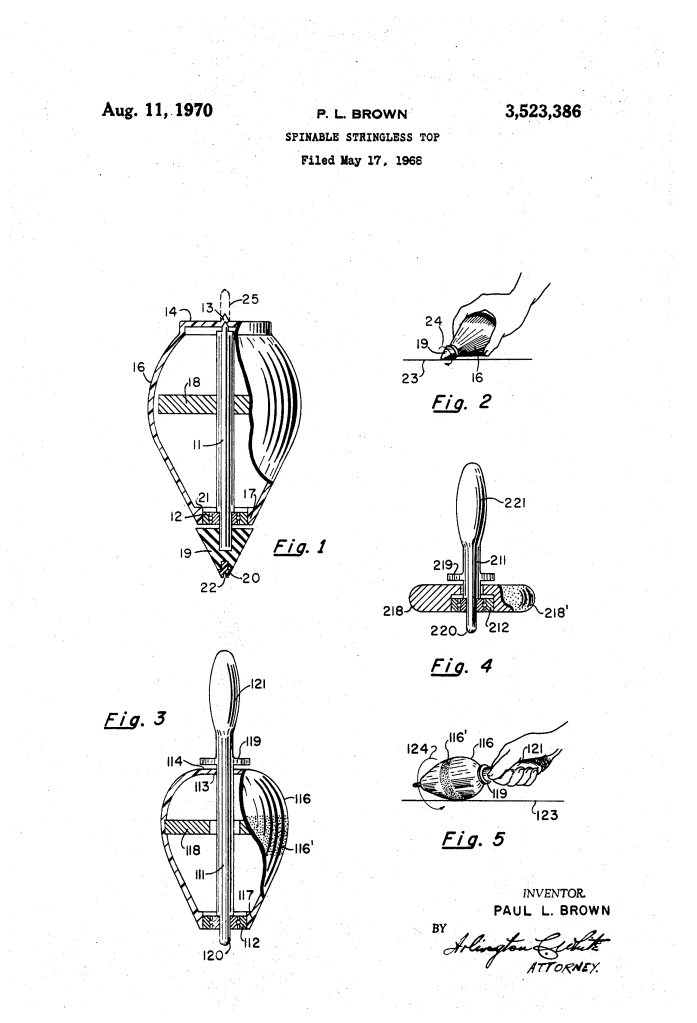
Spinable Stringless Top (1970)
U.S. Patent No. 3,523,386, granted on August 11, 1970, to Paul L. Brown of San Francisco, California (assigned to Mattel, Inc.), describes a self-contained, friction-activated gyroscope top engineered to spin for extended periods without a pull-string, cord, or exposed high-speed parts. Traditional toy tops required wrapping a cord tightly around a spindle and snapping the top onto a floor—a maneuver that demanded coordination, frequently produced weak spins, and needed constant rewinding. Meanwhile, early stringless gyroscope tops often left their heavy metal flywheels exposed, creating a safety hazard if parts fractured or struck a child’s fingers. Brown solved both problems by enclosing the internal flywheel inside a durable impact-resistant shell and using a small-diameter friction roller to build up high rotational momentum through simple repeated strokes against any flat surface.
The Core Design: Mechanical Advantage & Enclosed Flywheel Safety
The brilliance of Brown’s stringless top lies in its gear-like diameter ratio and protective housing (16). Instead of relying on a single pull of a string, the user “revs up” the internal flywheel (18) through successive unidirectional strokes—much like revving a friction-drive toy car—and can even pick up the spinning top mid-run to boost its speed again.
- The Small-Diameter Friction Roller (19) Secured to the lower end of the central steel shaft (11) outside the casing (16) is a cone-shaped friction roller (19) made of semi-soft rubber or resilient elastomer. Because the friction roller (19) has a substantially smaller diameter than the internal flywheel (18), rolling the small cone briskly across a tabletop forces the larger-diameter flywheel inside to spin at a dramatically higher peripheral speed. The wide base of the inverted cone extends slightly past the truncated bottom (17) of the casing so the rubber grips the surface cleanly without scraping the housing.
- The Protective Casing (16) & Low-Friction Bearing (12) An impact-resistant polystyrene casing (16)—which can be molded as a sphere, cone, or egg shape—completely encloses the heavy rotor (18). The vertical shaft (11) is supported at the bottom by a press-fitted ball bearing (12) (or nylon bushing) seated in the casing bore (21), and at the top by an integral pintle (13) inside the flat-rimmed cap (14). As the shaft and rotor accelerate, the outer race of the bearing (12) transmits smooth rotational motion to the outer casing (16) while shielding hands from the high-inertia flywheel within.
- Dual-End Spinning & Acoustic Customization Seated at the pointed nose of the rubber friction roller (19) is a rigid metal or plastic spinner tip (20), optionally formed with a small slit (22) to create playful leaning and precessing motions. In addition, the upper end of the shaft can extend above the top cap as a secondary tip (25), allowing the player to invert the top after revving it so it spins upside down. Piercing small holes into the casing or rotor turns the spinning top into a musical whistle.
Three Structural Embodiments
Brown designed three distinct mechanical variations to adapt the friction-revving principle across different toy styles and grip preferences:
| Embodiment | Grip & Drive Mechanism | Structural Arrangement |
| 1. Preferred Enclosed Roller Model (FIG. 1) | User holds the outer casing (16) and strokes the external rubber cone roller (19) across a surface (23). | Flywheel (18) is keyed to central shaft (11) inside casing (16); friction roller (19) drives the shaft from below and carries spinner tip (20). |
| 2. Palm-Handle Casing-Drive Model (FIG. 3) | User grasps an enlarged rounded palm handle (121) with thumb braced against flange (119) and rolls the rubber-coated lower casing (116′) on a surface (123). | Flywheel (118) is fixed directly to the inner wall of casing (116) and cored out around shaft (111), so casing and rotor spin as a single unit around bearing (112). |
| 3. Open-Rotor Palm-Handle Model (FIG. 4) | User holds palm handle (221) against flange (219) and strokes the rubber-coated flywheel (218′) directly along a surface. | Eliminates the outer casing entirely; shaft (211) is journaled inside bearing (212) confined within rotor (218) and tapers at the bottom to spinner tip (220). |
How the Top Operates
Activating and sustaining a long spin follows a simple, repeatable four-step sequence:
| Step | Action | Mechanical Result |
| 1. Grip & Contact | Hold the casing (16) (or palm handle 121/221) and press the resilient friction surface against any rigid tabletop or floor. | Establishes high-traction rolling contact without marring furniture surfaces. |
| 2. Unidirectional Stroking | Sweep the friction roller (19) briskly across the surface in repeated strokes in the same direction (arrow 24). | Each stroke adds angular velocity to shaft (11) and rotor (18) without reversing or braking accumulated spin. |
| 3. Release onto Tip | Lift the top and set the rigid spinner tip (20) (or inverted shaft tip 25) onto the playing surface. | Stored kinetic energy in the high-inertia flywheel (18) stabilizes the top gyroscopically for prolonged spinning. |
| 4. Mid-Spin Re-Acceleration | Pick up the slowing top, stroke the roller (19) across a surface again, and set it back down. | Restores peak rotational speed immediately without stopping to rewind a cord. |
Historical and Toy-Industry Impact
Assigned to Mattel, Inc. in 1968 and patented in 1970—during a golden era of mechanical toy innovation that also saw Mattel launch Hot Wheels and high-energy flywheel stunt toys—Paul L. Brown’s stringless top brought genuine gyroscopic physics to younger children who previously lacked the dexterity to launch traditional string-wound tops.
- Child-Safe Gyroscopic Play: Enclosing the heavy flywheel inside a shatter-resistant polystyrene housing eliminated pinch points and flying-part hazards while preserving true gyroscopic stability.
- Infinite Re-Energizing: Unlike spring-wind or cord-launch tops that lose energy in a single run, the unidirectional friction-roller drive allowed players to pick up, re-stroke, and transfer a spinning top across different surfaces indefinitely.
- Foundation for Friction-Flywheel Toys: The combination of a high-mass internal flywheel, low-friction ball bearings, and a small-diameter elastomer drive surface became a hallmark mechanism across 1970s Mattel gyro-tops, stunt cycles, and rip-free racers.
About the Inventor: Paul L. Brown
Paul L. Brown was a San Francisco-based mechanical designer and toy inventor who developed novel kinetic mechanisms for Mattel, Inc. during the late 1960s and early 1970s. Working alongside Mattel’s research and development teams in California, Brown focused on translating classic physics principles—such as angular momentum, gyroscopic precession, and mechanical gear ratios—into intuitive, child-safe play mechanisms that required no batteries or complicated winding tools.
Summary of Claims
The patent explicitly claims:
- A stringless toy top comprising a manually grippable portion, an elongated shaft freely rotatable within that portion, a high-moment-of-inertia rotor secured to the shaft, and a small-diameter friction roller on an exterior shaft extension that revolves the rotor at a substantially higher peripheral speed when rolled briskly on a rigid surface.
- A cone-shaped friction roller fabricated from soft rubber or resilient material whose base is wider than the bottom of the outer casing and carries a rigid metal or synthetic polymer spinner tip at its extremity.
- Low-friction bearings mounted at opposite ends of the grippable housing to journal the central shaft smoothly.
- An axial extension or top protuberance aligned with the central shaft enabling the top to be inverted and spun on either end.
