
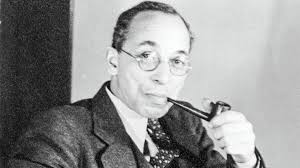
Elmer Samuel Imes (1883–1941) was a trailblazing African American physicist whose 1918 doctoral research at the University of Michigan fundamentally changed our understanding of the subatomic world. While Imes did not seek a patent for his work, he engineered a high-resolution infrared spectrometer that provided the first experimental proof that the rotation of molecules is “quantized”—meaning it happens in specific, discrete steps rather than in a continuous flow.
The Scientific Challenge: Proving Quantum Theory
In the early 20th century, Quantum Theory was still a controversial hypothesis. Scientists like Max Planck and Niels Bohr had theorized that energy comes in small packets (quanta), but they lacked precise evidence regarding how this applied to the rotation and vibration of molecules.
To prove this, Imes needed to look at the infrared absorption spectra of gases (like Hydrogen Chloride, with a level of detail that no existing instrument could provide.
The Innovation: Imes’s High-Resolution Spectrometer
Imes didn’t just use a tool; he significantly advanced the engineering of the double-prism grating spectrometer. His design combined two different methods of refracting light to achieve unprecedented resolution.
1. The Two-Stage Optical Path
- The Prism Stage: Light first passed through a salt prism, which provided a “coarse” separation of the infrared wavelengths.
- The Grating Stage: The light then hit a diffraction grating—a surface ruled with thousands of microscopic lines. This stage provided the “fine” resolution, spreading the light out so thin that Imes could see the individual peaks and valleys of the energy.
2. The Sensitive Thermopile
- The Detector: Because infrared light is heat, Imes used a highly sensitive thermopile (a device that converts thermal energy into electrical voltage).
- The Galvanometer: He coupled this with a mirror-galvanometer to measure the tiny electrical currents produced by the heat of the light.
The Discovery: Rotational-Vibrational Bands
Using his custom-built spectrometer, Imes mapped the absorption of infrared light. He discovered that the absorption lines were not single blurs, but were split into distinct, sharp “fine-structure” peaks.
- Experimental Proof: These peaks perfectly matched the mathematical predictions of quantum mechanics.
- Calculation of Atomic Distance: By analyzing the spacing between these peaks, Imes was able to calculate the exact distance between atoms in a molecule for the first time in history.
Impact on Modern Physics and Chemistry
Elmer Samuel Imes’s work is considered one of the most important contributions to molecular spectroscopy.
- Validation of Quantum Mechanics: His data was cited by nearly every major physicist of the era, including Albert Einstein, as the definitive proof that quantum rules applied to molecular motion.
- Development of Bond Length Theory: His ability to measure the distance between atoms laid the groundwork for modern structural chemistry.
- Legacy in Spectroscopy: High-resolution infrared spectroscopy (now often using lasers or Fourier Transform techniques) remains a primary tool used today in everything from pharmaceutical research to identifying the composition of distant stars.
