
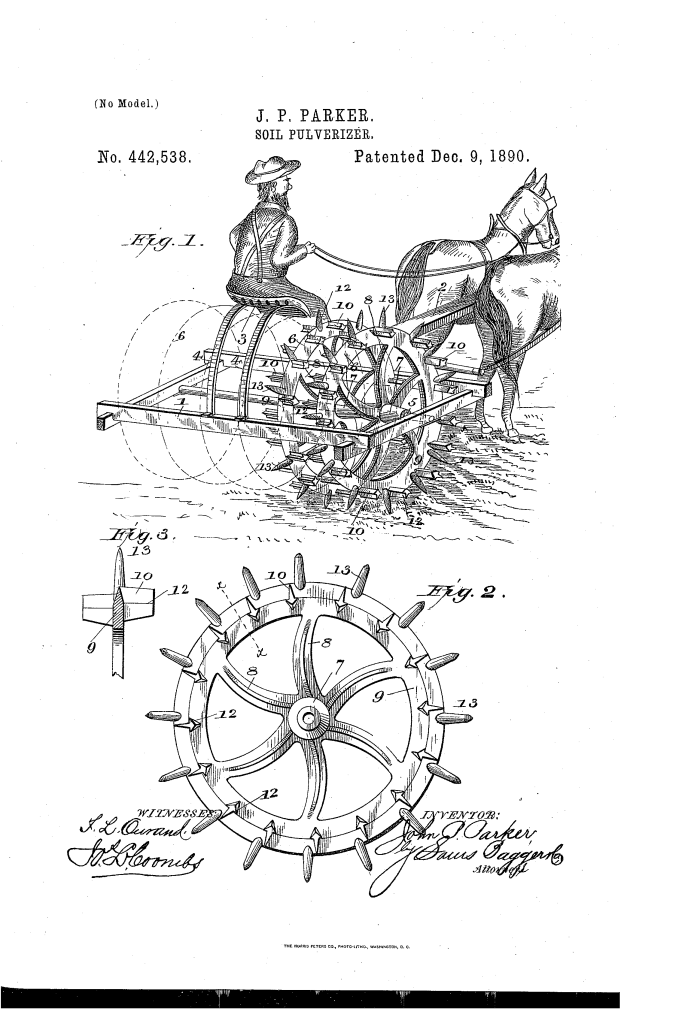
Soil-Pulverizer: John P. Parker; Patent No. 442,538
The patent by John Percial Parker of Ripley, Ohio, describes a Soil-Pulverizer (Patent No. 442,538). This invention is a specialized agricultural implement designed to break down dense clods of earth, mulch crop residue like cornstalks, and prepare a fine seedbed for planting through a unique rotary crushing mechanism.
The “Why”
In the late 19th century, preparing soil was a labor-intensive process that often required multiple passes with different tools. Standard plows could turn the earth but left behind large, hardened clods. Existing rotary pulverizers were prone to clogging or failed to effectively “mulch” tough organic matter like leftover cornstalks. Parker sought to create an all-in-one mechanical solution that could cut, crush, and pulverize simultaneously, reducing the physical toll on both the farmer and the draft animals.
The Inventor: John P. Parker
John Percial Parker (1827–1900) was an extraordinary figure in American history. Born into slavery, he eventually purchased his own freedom and became a successful industrialist and inventor in Ripley, Ohio.
His engineering philosophy was rooted in practical efficiency and industrial durability. As the owner of the Phoenix Foundry, Parker didn’t just design tools; he understood the metallurgy and casting processes required to make them last. Beyond his technical prowess, Parker was a daring conductor on the Underground Railroad, personally guiding hundreds of freedom seekers across the Ohio River. His inventions reflect a mind dedicated to liberation—whether from the shackles of slavery or the backbreaking inefficiency of 19th-century manual labor.
Key Systems Section
Integrated Rotary Hub and Axle
The machine utilizes a central rotating shaft (5) mounted within a rectangular frame. Unlike static harrows, Parker’s disks are secured to this axle via central hubs (7), allowing the weight of the entire frame to provide the downward force necessary for the “pulverizing” action.
Ogee-Shaped Lateral Projectors
The “secret sauce” of this patent lies in the ogee-shaped projections (10) extending from the sides of the wheel rims. In modern terms, an “ogee” refers to a double-curve (S-shape). These curves act as multi-directional wedges that exert lateral pressure on soil clods, shattering them rather than just pushing them deeper into the ground.
Dual-Action Cutting Teeth
The periphery of each wheel features outwardly-extending blades (12) and peripheral teeth (13). These function as high-torque cutting edges that use the rotational kinetic energy of the wheel to slice through tough cornstalks and root systems, preventing the “drag” common in standard blade designs.
Integral Cast Construction
Parker specified that the disks—including the arms, rims, and teeth—be cast as a single metal unit. This eliminated mechanical weak points (like bolts or rivets) that would otherwise shear off when striking rocks or hard-packed clay.
Comparison: 19th Century Methods vs. Parker’s Innovation
| Feature | Standard Methods (1890s) | Parker’s Soil-Pulverizer |
| Mechanical Action | Simple dragging or vertical slicing. | Tri-axial action: Cutting, lateral crushing, and pulverizing. |
| Residue Management | Cornstalks often required manual clearing. | Integral blades mulch stalks directly into the soil. |
| Durability | Multi-part assemblies prone to loosening. | Unitary cast construction for industrial-grade strength. |
| Soil Texture | Often left “cloddy” or uneven. | Leaves soil in a fine, aerated state ideal for seeding. |
Significance
- Precursor to the Modern Rototiller: The use of rotating blades to both cultivate and mulch is a direct ancestor to modern gasoline-powered tillers.
- Advancement in Metallurgy: Parker’s focus on integral casting influenced how high-stress agricultural “wear parts” are manufactured today.
- Efficiency Standards: By combining the functions of a cutter, a harrow, and a roller, Parker helped set the stage for modern “one-pass” farming techniques.
