
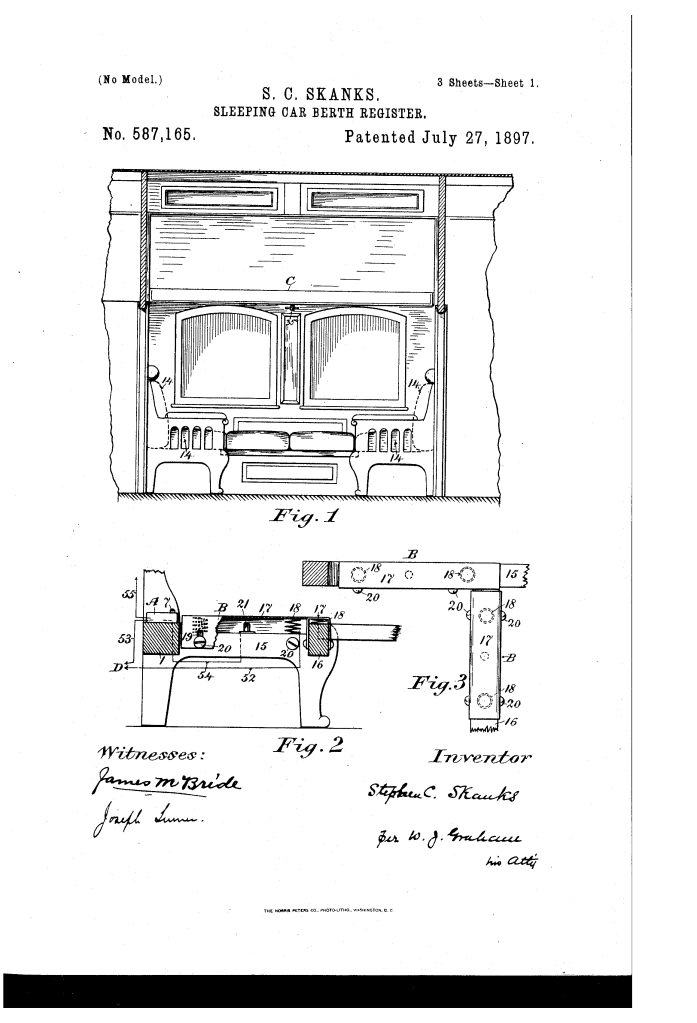
Electric Sleeping-Car-Berth Register (Stephen Chambers Skanks, No. 587,165)
The patent by Stephen Chambers Skanks of Toronto, Canada, describes an Electric Sleeping-Car-Berth Register (Patent No. 587,165, 1897). The invention’s object is to provide an electrical system to positively and reliably register or indicate the use or occupation of a sleeping-car berth each night.
Inventor Background: Stephen Chambers Skanks
Stephen Chambers Skanks was an inventor based in Toronto, Canada, who patented this device in both Canada and the United States. His invention targets a very specific logistical and economic problem in the railway industry: revenue management and auditing for sleeping cars (Pullman service). By automating the tracking of used berths, the system provided an objective record for conductors and management.
Invention and Mechanism
The system uses multiple, dedicated electrical circuits and pressure-sensitive contacts placed in the upper and lower berths, linked to a central register.
1. Lower Berth Registration (Seat-Cushion Pressure)
- Seat Contact (B): A metallic channel-plate (17) supported on springs (18) is mounted on the seat-frame rail.
- Function: When the seat-cushion (which forms the lower berth) is placed over the plate and occupied, the passenger’s weight depresses the plate (17) until it contacts a fixed stud (21), closing the circuit.
- Magnetic Circuit-Closer (A): The registration circuit is wired through a magnetic circuit-closing device (A).
- Function (Anti-Fraud): Once the lower berth is registered, the current flows through a magnet (3) which attracts an armature (5), mechanically opening (breaking) the circuit for subsequent registrations. This ensures only the first occupation registers.
- Daytime Disconnect: During the daytime, the back-cushion (14) is placed on the seat, where it depresses a bolt (7) on the device (A), holding the circuit mechanically open to prevent accidental registration.
2. Upper Berth Registration (Mattress Pressure)
- Contact Device: A pressure-sensitive mechanism housed in a plate (24) and supported by one of the spiral springs (22) supporting the mattress (23).
- Spring-Cap (26): A cap resting on a spring (28) pushes a central shank (27) upward, which is normally held down by a bolt (30) when the berth is closed.
- Function: When the berth is opened, the bolt (30) is released, allowing the cap (26) to rise. The first time a passenger’s weight is placed on the mattress, the cap is depressed. A projection (36) on the shank (27) deflects two contact springs (37, 38), closing the circuit to the register (50). The mechanism locks in the compressed position (via the bolt 30) after the first use, preventing subsequent registrations.
3. Upper Berth Status Check (The “Unoccupied” Alarm)
- Weight and Chain (42, 43): A chain (42) is attached to the hinge-rail of the upper berth, connected to a weight (43) that slides on a vertical guide-rod (45).
- Function: When the upper berth is closed up (retracted), the weight (43) is lifted. If the berth is later closed without having been occupied (i.e., the weight is lifted during the night), a stop-jointed arm (46) on the weight triggers contacts (48, 49), closing a circuit to the register (50).
- Purpose: This mechanism prevents the porter from fraudulently closing an unoccupied berth (and selling it later, or pocketing the revenue), ensuring the closing is also registered.
Concepts Influenced by This Invention
Skanks’s apparatus influenced subsequent designs in access control, auditing, and sensor technology by pioneering pressure-based, electronically-audited usage tracking.
- Access and Usage Auditing: The system of using an electrical contact to create an objective, auditable record of usage (rather than relying on human counting) influenced the development of modern:
- Keycard and Access Control Systems: Where the use of a facility (room, equipment) is logged automatically.
- Turnstile and Ticketing Systems: That count and log passenger movement.
- One-Shot/Event-Logging Sensors: The design principle of a pressure sensor (cap 26) that locks after the first trigger event influenced the engineering of single-event recorders and non-retriggering sensors used in auditing, counting, and safety systems, ensuring that only the initial use or occupation is logged.
- State-Dependent Safety Interlocks: The use of the state of an auxiliary component (the back-cushion) to mechanically enable or disable the registration circuit (preventing registration during the day) influenced the design of modern mode-dependent safety interlocks on machinery, where the function of one part depends on the physical position of another.
- Inertial/Gravitational Sensing: The use of the weight (43) and chain to sense the status of the berth (closed vs. open) is a simple, effective example of gravitational state sensing . This is a foundational method for sensing the position or closure of heavy hinged components.
