
Pneumatic Automotive Signaling Device (Benjamin A. Crenshaw, No. 1,836,705)
This 1931 patent by Benjamin A. Crenshaw of Chicago describes an early, sophisticated turn-signal system for automobiles. Long before modern electrical blinkers were standard, Crenshaw developed a pneumatically actuated device that utilized the engine’s own power to project physical signaling “hands” from the sides of the car. These hands were illuminated and designed to be visible from both the front and the rear, providing a clear warning to other drivers during both day and night.
1. The Signaling “Hand” and Lighting
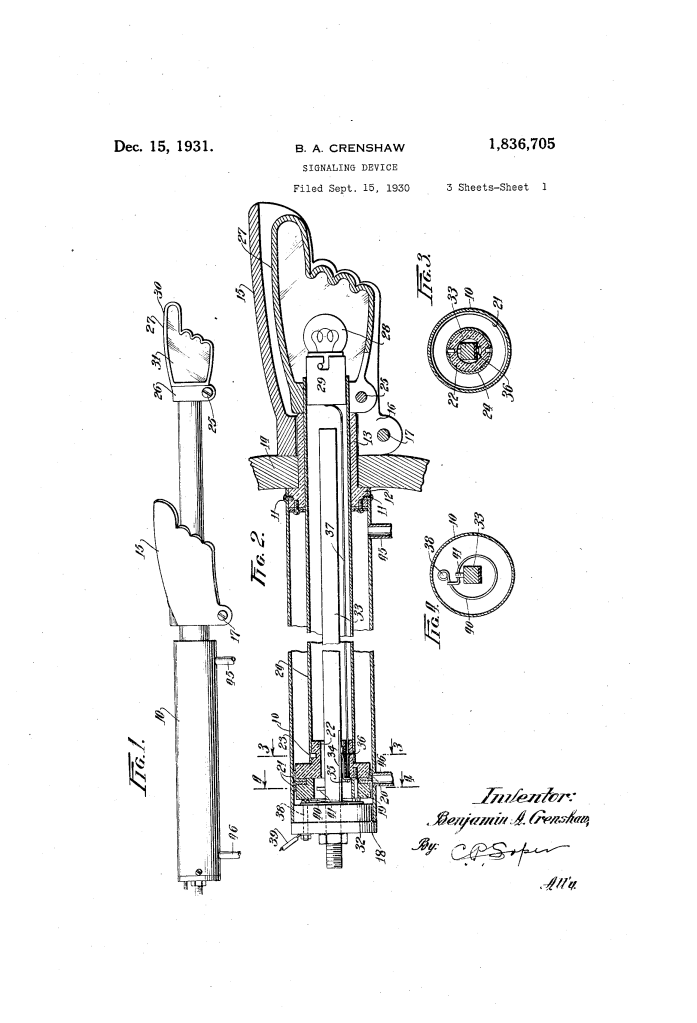
The signal itself is shaped like a human hand with the index finger extended.
- Dual Visibility: The hand is hollow and contains an electric bulb (28). It features colored lenses on both sides—typically red for the rear and green for the front. This allows an observer at night to tell immediately if the car is approaching them or moving away.
- Automatic Illumination: To make the signal more conspicuous, the light is designed to turn on the moment the arm begins to move from its retracted position.
- Wiper System: This is achieved via an internal wiper (36) that rests on an insulating strip (34) when retracted. As soon as the arm moves, the wiper slides onto a conducting bar (33), completing the electrical circuit and lighting the bulb.
2. Vacuum-Powered Actuation
Instead of using complex electric motors, Crenshaw’s device leverages the vacuum (suction) created in the engine’s intake manifold.
- Cylinder and Piston: The signaling arm is attached to a piston (19, 20) inside a cylinder (10).
- Directional Movement: By creating a vacuum on one side of the piston or the other, the arm is either sucked outward into the signaling position or sucked back into the car’s cowl for storage.
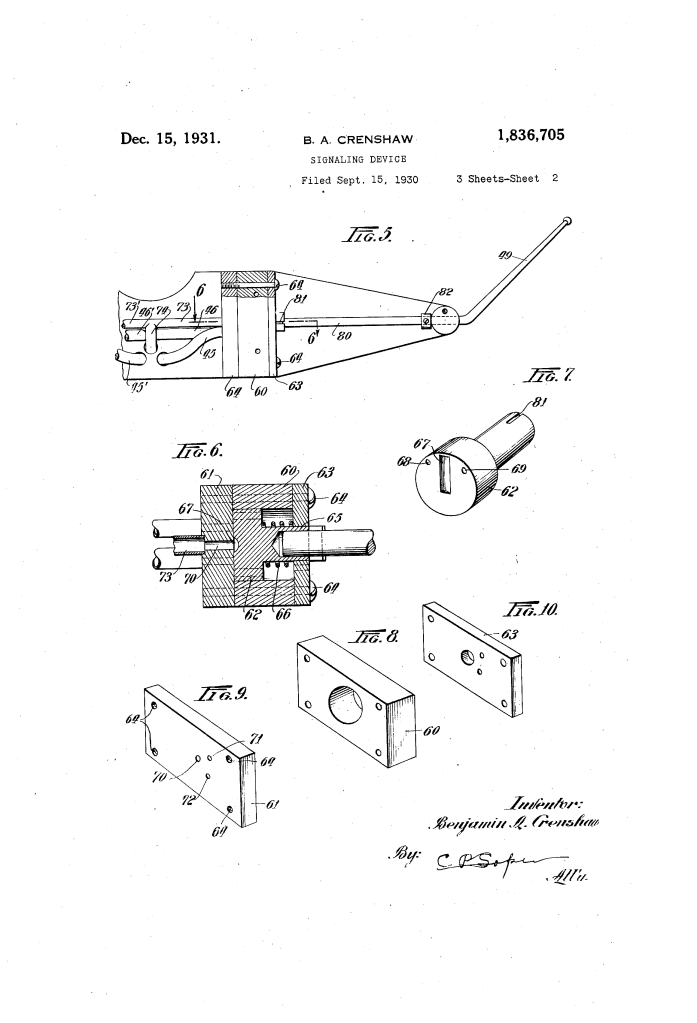
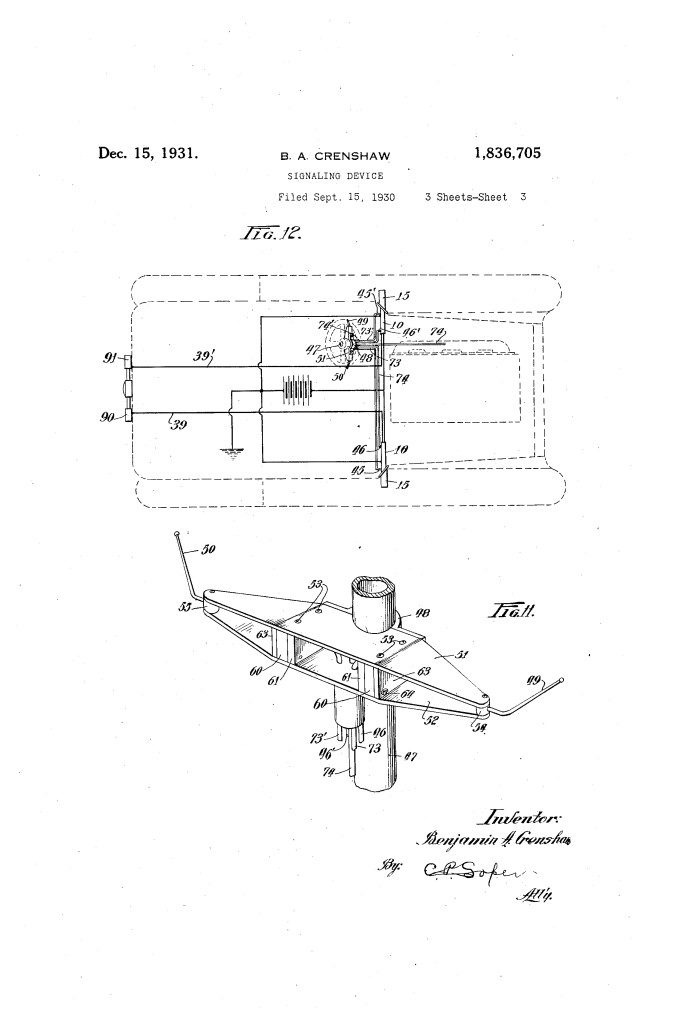
- Control Valves: Two levers (49 and 50) are mounted on the steering post. Moving a lever rotates a valve block (62) that connects the engine’s vacuum line to the appropriate end of the signaling cylinder.
3. Integrated Rear Indicators
A key safety feature of this patent is the synchronization between the front and rear signals.
- Contact Spring (40): At the back of the signaling cylinder, there is a spiral spring that is held compressed when the signal is retracted.
- Automatic Rear Signal: When the signal arm extends, the piston releases this spring, which then touches a pin (41) connected to the battery.
- Rear Pointing Hands: This sends power to a corresponding pair of illuminated pointing hands (90, 91) at the rear of the car. This ensures that a driver directly behind the vehicle sees a signal even if they cannot see the extended arm on the side of the car.
4. Technical Component Summary
| Component | Function |
| Intake Manifold Connection | Provides the “power” (vacuum) for movement without adding a heavy motor. |
| Valve Housing (60) | Directs suction to either extend or retract the signal. |
| Bakelite Insulating Strip (34) | Ensures the signal light is “Off” when the hand is hidden inside the car. |
| Red/Green Lenses | Identifies vehicle orientation (approaching vs. receding) to other drivers. |
Engineering Significance
Crenshaw’s signaling device was a major leap forward in automotive safety during the transition from hand signals to automated indicators.
- Reduced Driver Distraction: The levers on the steering post allowed the driver to signal without taking their eyes off the road or reaching out the window.
- Energy Efficiency: By using engine vacuum, the device placed very little load on the primitive electrical systems (batteries/generators) of 1930s cars.
- 360-Degree Awareness: The combination of side-mounted arms and rear-mounted lights provided comprehensive coverage of the driver’s intentions.
