
🛤️ Advanced Railway Signal Apparatus (David Baker, No. 1,154,163)
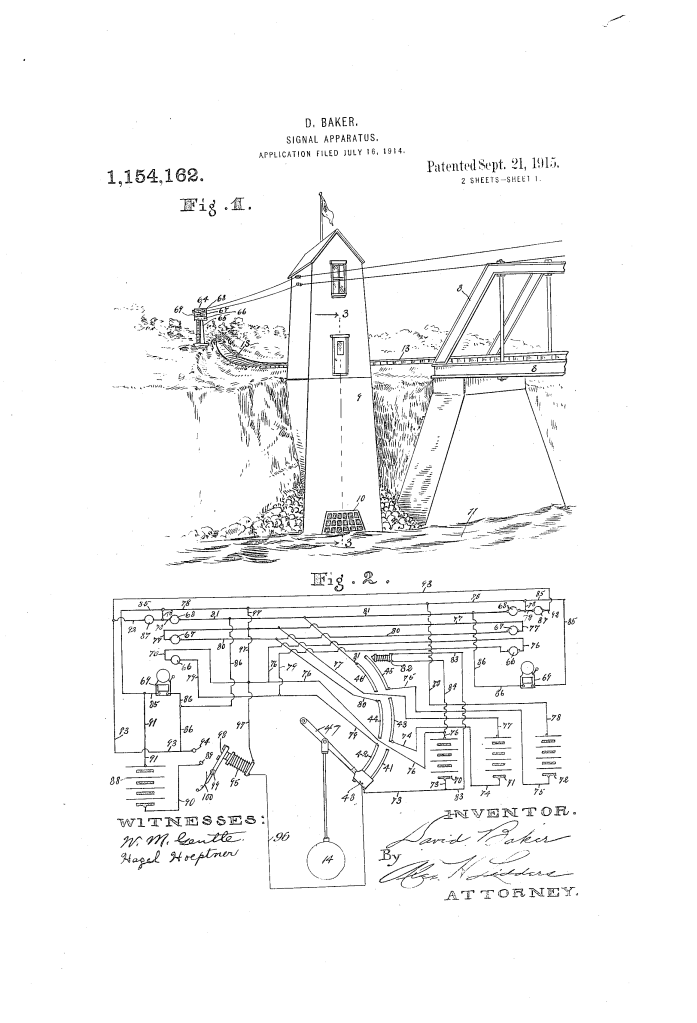
The patent by David Baker of Los Angeles, California, describes an improved Signal Apparatus (Patent No. 1,154,163, 1915). This invention is a highly sophisticated evolution of Baker’s earlier railway safety systems. It is designed to be installed near railway bridges crossing water courses to monitor water levels. Unlike simple binary systems, this apparatus provides a graduated warning (Safe, Caution, and Danger) and includes a critical “fail-safe” warning signal that activates if the main system’s power supply fails.
Inventor Background: David Baker
David Baker was a prominent African-American inventor and engineer based in Los Angeles. This 1915 patent represents his continued dominance in the field of railway safety instrumentation. At a time when flash floods could wash out bridge supports without warning, Baker’s device provided a “smart” solution that combined hydraulic sensing with electrical logic. His commitment to reliability is evident in the inclusion of an auxiliary battery-powered warning signal—an early example of redundant safety systems in civil infrastructure.
Key Mechanical Components & Functions
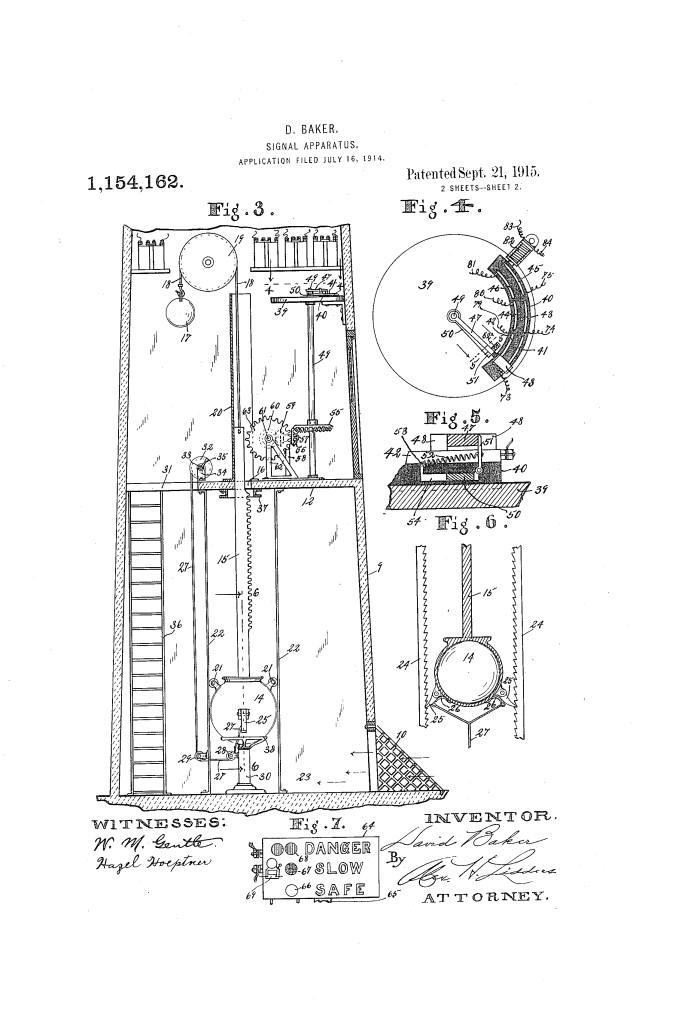
The apparatus is housed in a vertical structure near the bridge and uses a float system to drive an electrical commutator.
1. The Graduated Float System (14, 15, 24)
- Float and Rack Bar: A float (14) rises with the water level, pushing a rack bar (15) upward through the platform.
- Ratchet and Pawl Safety: To ensure the system “remembers” the peak water level even after the water recedes (which might have already weakened the bridge), Baker included ratchet bars (24) and pawls (25).
- Function: These lock the float at its highest point of travel. A technician can later reset the system using a reel (32) and cable to pull the pawls back.
2. The Commutator and Contact Arm (47, 48)
- Geared Transmission: The rack bar (15) drives a series of bevel pinions (56, 59, 60) that rotate a shaft (49).
- Sequential Signaling: This shaft moves a contact arm (47) across three pairs of contact bars (41-46).
- Position 1 (White Signal): Indicates a safe water level.
- Position 2 (Yellow Signal): Indicates a cautionary level.
- Position 3 (Red/Danger Signal): Indicates the bridge is unsafe.
3. The Electromagnetic Hold (82)
- The “Stick” Circuit: When the water reaches the danger level (Red), an electromagnet (82) activates to hold the contact arm (47) firmly in place.
- Safety Logic: This ensures the danger signal stays active even if the float continues to bob or if the water level slightly fluctuates, preventing a “false safe” signal to an oncoming train.
4. The Power-Failure Warning (87, 95) (Key Innovation)
Baker addressed a major flaw in early electrical signals: if the main battery died, the signal would go dark, which an engineer might mistake for a “safe” condition.
- Warning Signal (87): A dedicated lamp powered by an auxiliary battery (88).
- Electromagnetic Switch (95): An electromagnet (95) normally holds a switch (98) open while there is current in the main system.
- Action: If the main current fails, the magnet releases the switch, and a spring (100) snaps it shut, lighting the warning signal. This tells the engineer: “The system is offline; proceed with extreme caution.”
Improvements Over Existing Technology
| Feature | Standard Signal Systems | Baker’s Signal Apparatus |
| Information Depth | Binary (Safe or Danger). | Tri-level (Safe, Caution, Danger). |
| Power Failure | Signal goes dark (False Safe). | Auxiliary warning signal activates automatically. |
| Peak Detection | Resets when water drops. | Ratchet system locks at peak water height for inspection. |
| Mechanical Stress | Float might jam if forced too high. | Yielding spring (52) allows float to rise past the danger limit without breaking the arm. |
Significance to Engineering
David Baker’s 1915 apparatus is a milestone in the history of fail-safe design and remote sensing.
- Redundancy: The use of an auxiliary battery and a “normally-closed” switch logic is a foundational principle of modern aerospace and nuclear safety.
- Visual Data Logic: The use of color-coded graduated signals (White/Yellow/Red) influenced the standardization of traffic control logic that we use on roads today.
- Forensic Capability: By locking the float at its highest point, Baker provided a way for railway inspectors to perform “post-event” analysis, a precursor to modern data logging.
