
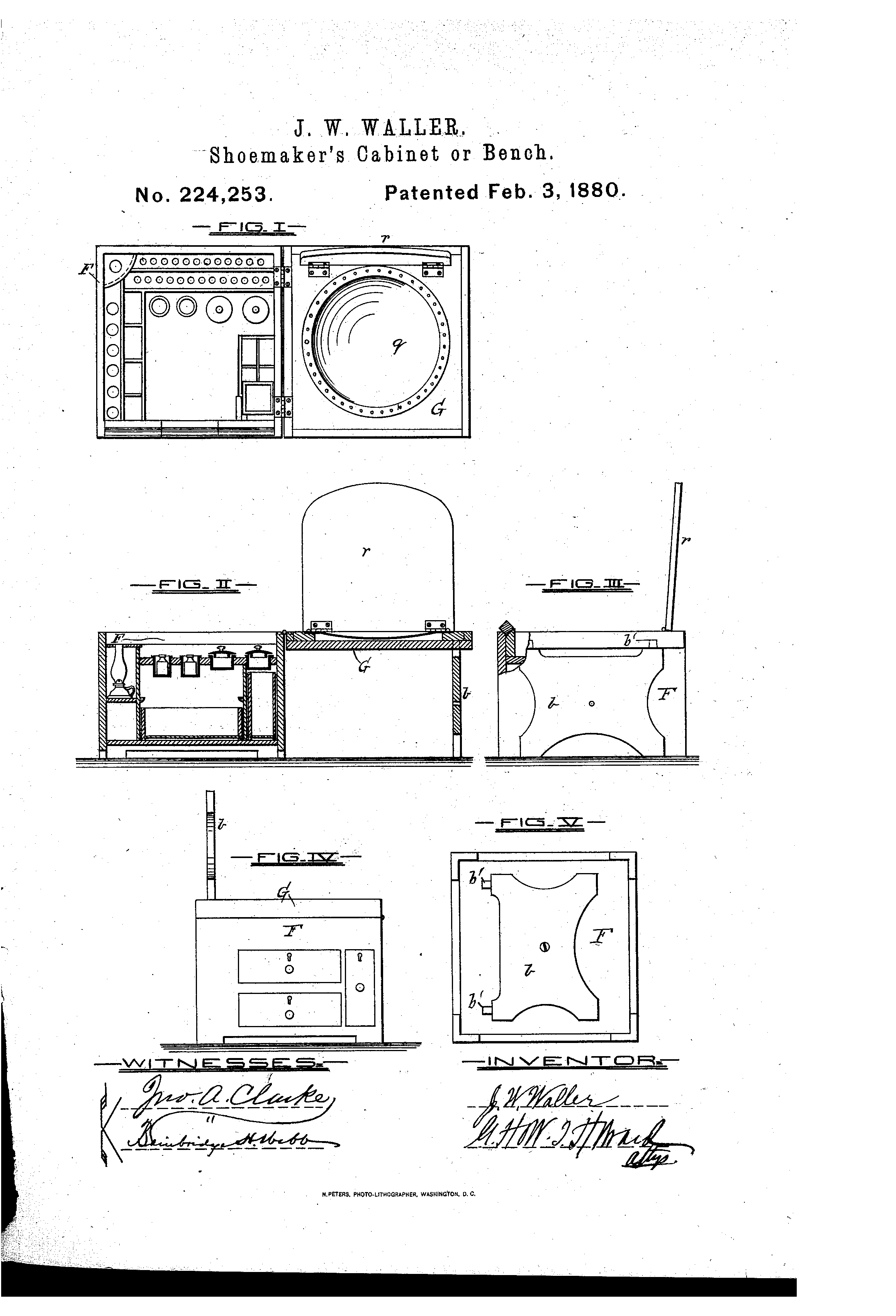
Shoemakers’ Cabinet or Bench (Joseph W. Waller, No. 224,253)
The patent by Joseph W. Waller of Baltimore, Maryland, describes a Shoemakers’ Cabinet or Bench (Patent No. 224,253, 1880). The invention relates to a combined cabinet and seat designed to organize the various tools and materials used by a shoemaker (or cobbler) into a compact, portable, and efficient workstation.
Inventor Background: Joseph W. Waller
Joseph W. Waller was an inventor who focused on creating functional, integrated furniture and utility solutions for specific trades. His invention caters to the shoemaking craft, a common and essential trade in the late 19th century, by consolidating all necessary equipment into a single piece, enhancing organization and workflow.
Invention and Mechanism
The cabinet is a multi-functional box that unfolds to reveal an organized workspace, integrated seating, and storage.
1. The Cabinet and Organization
- Main Portion (F): The body of the cabinet, which is partitioned to include suitable compartments, divisions, boxes, jars, bottles, and pockets for holding the various tools, articles, and substances used by the craft (e.g., thread, nails, polish, wax).
- Integrated Heating: The cabinet is provided with a lamp for heating purposes.
- Sharpening Surface: A grooved edge on the cabinet is provided for receiving one or more stones for sharpening tools.
2. The Seat and Bench Conversion
- Lid (G): The main lid of the cabinet.
- Calf-Skin Seat ($q$): The lid (G) is fitted with an ordinary calf-skin seat ($q$) on its outer side.
- Hinged Back ($r$): A hinged back ($r$) is provided for the seat.
- Support Leg ($b$): A folding leg ($b$) with pins ($b’$) supports the outer end of the hinged lid (G) when it is opened out horizontally to form the bench/seat.
- Function: When opened, the lid (G) serves as the seat, providing the cobbler with a comfortable place to work.
3. Closed/Transport Mode
- When the cabinet is closed, the main lid (G) covers the organized compartments.
- The folding leg ($b$) can be positioned to form a back (backrest $b$ in Fig. IV), and a supplemental ornamental back ($r$) can be attached. The bottom of the cabinet can also be closed for shipping.
Concepts Influenced by This Invention
Waller’s cabinet influenced subsequent furniture and equipment design by pioneering integrated, convertible, self-contained workstations for specialized trades.
- Integrated Portable Workstations: The core concept of a single, self-contained box that folds open to reveal a specialized workstation (including storage, heating, and integrated seating) influenced the design of modern portable tool chests, field desks, and mobile work units for trades like electronics repair, photography, or field mechanics.
- Multi-Functional Components: The design where the primary lid (G) converts into the seat and the support leg ($b$) converts into a backrest influenced the engineering philosophy of convertible and space-saving furniture, maximizing utility from each component.
- Integrated Utility Features: The incorporation of dedicated features like an internal lamp and a grooved sharpening-stone holder directly into the workstation influenced the design of many modern toolboxes and workbenches that feature integrated lighting, charging ports, or utility holders.
- Organizational Systems: The detailed partitioning of the interior (for threads, nails, tools) influenced the design of modern specialized organizers and craft supply storage solutions , where specific compartments are sized and shaped for the materials of a particular hobby or trade.
