

Shampoo Head-Rest (1898)
U.S. Patent No. 612,008, granted on October 11, 1898, to Charles Orren Bailiff, addresses a longstanding ergonomic and practical problem in nineteenth-century personal care: the awkward, uncomfortable process of washing hair in barber, dental, and surgical chairs.
In the late 1800s, receiving a shampoo typically required a customer to move between multiple stations. Part of the service took place in the main chair, while rinsing forced the patron out of the seat to lean awkwardly over an open washbasin. This posture routinely caused water and soap to run over the face and into the eyes, ears, and nose. Bailiff, an inventor based in Kalamazoo, Michigan, engineered an adjustable headrest attachment equipped with an integrated catch basin that allowed an operator to complete the entire washing and rinsing process comfortably in a single seated, reclined position.
The Core Innovation: Chair-Mounted Suspension Basin
The heart of Bailiff’s design is the direct mechanical integration of an adjustable water receptacle with a cushioned head support. Rather than requiring external plumbing or separate wash sinks, the entire drainage and basin assembly mounts directly to the back of the reclining chair.
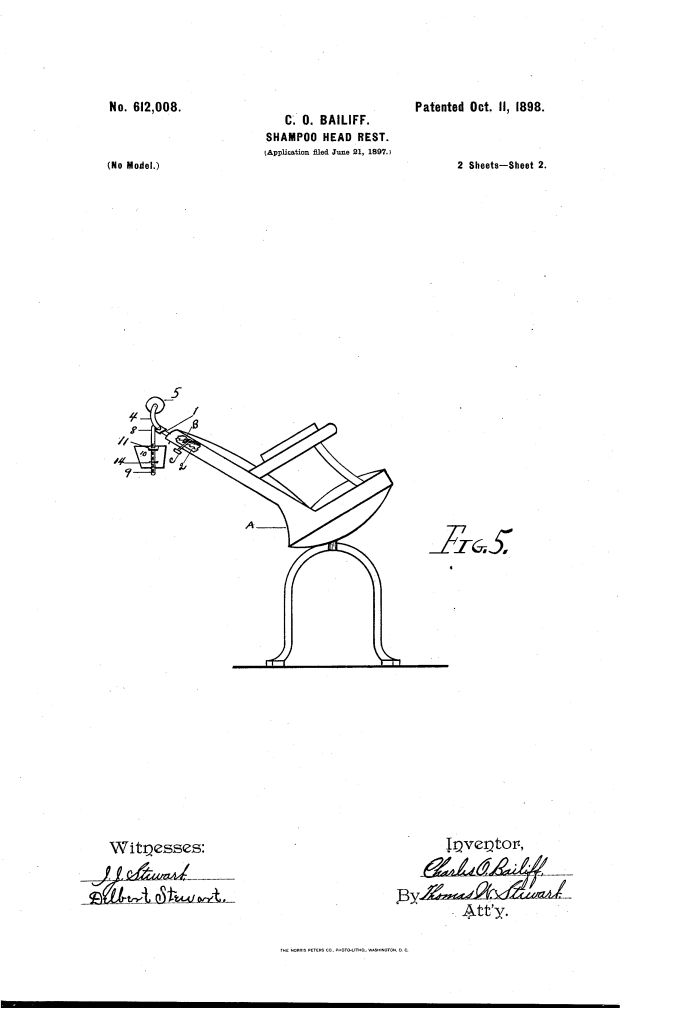
- The Cushioned Head-Support Assembly (3, 4, 5)The upper portion of the standard carries a transverse yoke (3) that branches into two curved arms (4).The terminal ends of each arm feature concave sockets (7) designed to hold conforming hemispherical pads (5).Each pad is molded with an integral mounting tenon (6) that seats directly into the arm socket.Made of soft rubber or yielding elastic material, the concave contour of the pads automatically flexes and conforms to fit any head shape, keeping the neck elevated and comfortable during extended procedures.
- Adjustable Basin Suspension and Anti-Tip System (8, 9, 13, 14)To capture water without tipping under dynamic weight, Bailiff developed a slotted suspension mechanism:The water receptacle (10) hangs from the curved arms (4) via two flexible suspension rods (8) fitted with hooked top ends.Each suspension rod features a series of elongated keyhole slots (9) comprising a wide circular eye and a narrower vertical slot.Horizontally projecting headed lugs (13) on the sides of the basin insert through the circular eye and slide down into the elongated slot, locking the basin firmly at any selected height.To prevent the basin from swinging, rocking, or tipping during the wash, the lower ends of the suspension rods pass loosely through vertical guide loops (14) mounted along the basin walls.Slotted handles (12) integrated into the basin sides allow the rods to seat flush against the container body, preventing lateral displacement.
Technical Components
Standard / Post (1): The vertical backbone of the assembly, slotted into the back of a standard chair (A).
Ratchet Rack (2): A notched track running along the post that meshes with a spring ratchet dog (B) and release push button (C) in the chair frame, enabling smooth vertical height adjustment.
Yoke (3) & Curved Arms (4): The rigid upper frame that supports both the patron’s head and the suspended basin hardware.
Hemispherical Rubber Pads (5): Cushioning elements featuring integral tenons (6) seated in arm cavities (7) to cradle the head without pressure points.
Water Receptacle (10): The main catch basin positioned directly beneath the head to catch wash water and prevent facial runoff.
Suspension Rods (8): Hook-ended hangers with keyhole slots (9) providing multi-point vertical adjustment for basin depth.
Headed Lugs (13) & Guides (14): Interlocking hardware ensuring quick tool-free height setting while locking the basin against accidental tilting.
Operational Sequence
- Seating and Elevation: The patron reclines in chair A; the operator depresses push button C to adjust standard 1 along rack 2, matching the patron’s neck height.
- Basin Attachment: Flexible rods 8 hook directly over curved arms 4.
- Height Calibration: Headed lugs 13 are inserted through slots 9 on rods 8 and locked down to set basin 10 at the proper catch clearance beneath the patron’s hairline.
- Procedure: The operator applies water and lather; all runoff drains directly into receptacle 10, keeping the customer’s face, eyes, and clothing entirely dry.
- Removal and Drainage: After the service, the basin unhooks quickly via rods 8 for emptying and cleaning.
Practical Utility and Impact
Charles Orren Bailiff’s patent bridged the gap between basic utility furniture and dedicated salon hygiene:
Customer Comfort: Eliminated the unpleasant practice of bending forward over sinks, shielding the face and sensory organs from soapy runoff.
Operational Efficiency: Allowed barbers, surgeons, and dentists to execute treatments from a single station without forcing clients to stand or relocate mid-service.
Universal Compatibility: By utilizing an adjustable ratchet post and hook-on basin, the apparatus could adapt to existing commercial chairs without requiring built-in plumbing alterations.
Summary of Claims
The patent explicitly claims:
A headrest featuring padded or cushioned supports, combined with a detachable water receptacle equipped with adjustment hardware that maintains the basin in an upright, stable orientation.
The use of flexible suspension rods, slotted handles, and side guides to secure the basin against tilting or tipping under load.
An adjustable standard with a ratchet mechanism adapted for secure mounting to barbers’, dentists’, and surgeons’ chairs.
