

Shampoo Head-Rest (Charles Orren Bailiff, No. 612,008)
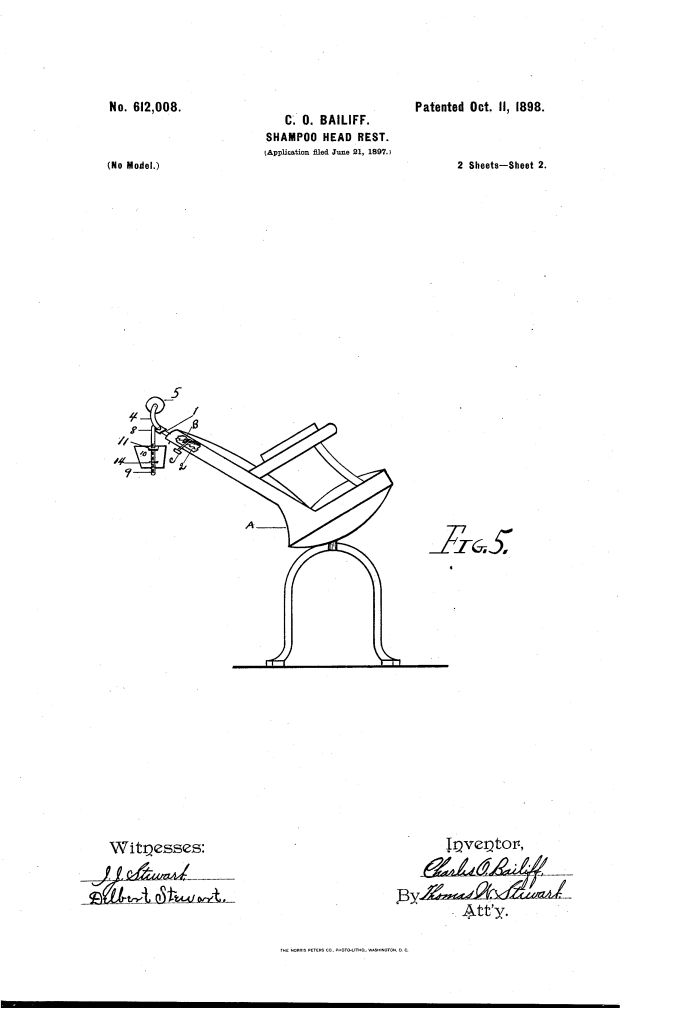
The patent by Charles Orren Bailiff of Kalamazoo, Michigan, describes a Shampoo Head-Rest attachment for barber, surgical, or dental chairs (Patent No. 612,008, 1898). The primary object is to allow the operator to perform a complete and perfect shampoo while the person remains in the chair, avoiding the inconvenience and discomfort of bending over a fixed basin and preventing water from running over the person’s face.
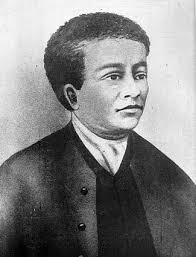
Inventor Background: Charles Orren Bailiff
Charles Orren Bailiff was an inventor who focused on improving the efficiency, comfort, and safety of specialized service environments, particularly the barbering and medical fields. His invention builds upon the concept of the portable basin by adding an integrated, adjustable head-rest and water collection system.
Invention and Mechanism
The device is a combination head-rest and adjustable water receptacle mounted on a standard rack-and-pawl mechanism for vertical adjustment.
1. Standard and Head-Rest Support
- Standard (1) and Rack (2): An ordinary standard post with a ratchet-notched rack (2) designed to be mounted into the existing guides of a barber or surgical chair. A spring ratchet-dog (B) holds the standard at various vertical adjustments (Fig. 5).
- Yoke (3) and Supporting Arms (4): A yoke is secured to the standard (1), from which two curved head-supporting arms (4) extend.
- Pads (5): The ends of the arms (4) receive cushioned, hemispherical pads (5) made of soft rubber or other yielding material. These pads have concave surfaces to comfortably conform to any shape of head.
- Function: The padded arms provide an easy and comfortable head-rest, stabilizing the head for the operation.
2. Water Receptacle and Adjustable Mounting (Key Innovation)
- Receptacle (10): A basin designed to hold water or catch water poured onto the head.
- Flexible Suspension Rods (8): Rods with hook-shaped upper ends that attach to the head-supporting arms (4).
- Adjustable Latch: The rods (8) have a series of elongated holes (9) (a keyhole-shaped slot). Headed post or lug projections (13) on the receptacle (10) pass through the round part of the hole (9) and drop into the elongated slot.
- Function: This simple, latch-and-slot mechanism allows the receptacle (10) to be vertically adjusted quickly and securely relative to the head-rest arms (4), ensuring the basin is in the correct position to catch water without tipping.
- Guides (14): Guides on the side of the receptacle (10) loosely contain the lower ends of the suspension rods (8).
- Function: These guides prevent the receptacle from tilting or tipping from any undue jar.
Concepts Influenced by This Invention
Bailiff’s head-rest influenced subsequent service industry equipment by integrating patient comfort with functional utility and flexible mounting.
- Integrated Utility Mounts: The concept of mounting an accessory (the basin 10) directly onto a primary comfort component (the head-rest) influenced the design of modern dental, surgical, and therapeutic chairs that incorporate light sources, trays, or fluid handling tools near the point of operation.
- Quick-Adjust Keyhole Slots: The use of the keyhole-shaped slot (9) and corresponding headed lug (13) for quick, positive, and vertical adjustment is a robust, simple mechanical solution. This influenced the design of various adjustable mechanisms, such as shelving brackets, monitor mounts, and quick-change tooling fixtures that require rapid, repeatable height changes.
- Ergonomic Cushioning: The design’s emphasis on using hemispherical, cushioned pads (5) that conform to the head influenced the design of medical and styling head-rests, prioritizing stabilizing the patient’s head while maximizing comfort and minimizing pressure points.
- Standardized Mounting: The design’s use of an ordinary standard (1) and rack (2) to fit into the existing guides of a common barber chair (A) influenced the philosophy of accessory design for retrofitting, ensuring that new utility could be added without replacing expensive primary equipment.
