
Sewer or Other Trap (1890)
U.S. Patent No. 426,429, granted on April 29, 1890, to Hugh M. Browne, introduces an advanced automated system designed to prevent “back-water” or floodwater from surging back into buildings through sewer pipes. Hugh M. Browne, a prominent educator and inventor based in Washington, D.C., sought to improve upon contemporary trap designs that were prone to clogging and mechanical failure.
This invention solved a critical sanitation problem: most traps of the era placed mechanical parts directly in the path of sewage, leading to the “lodgment of matter” and rendering the traps useless. Browne’s design moved all operative parts away from the flow, ensuring the system remained clean and functional.
The Innovation: External Hydrostatic Power
Unlike previous traps that relied on the force of the floodwater itself to push a valve shut, Browne’s system utilized the hydrostatic pressure from the city’s clean water mains to provide the closing force.
1. The “Off-Path” Valve
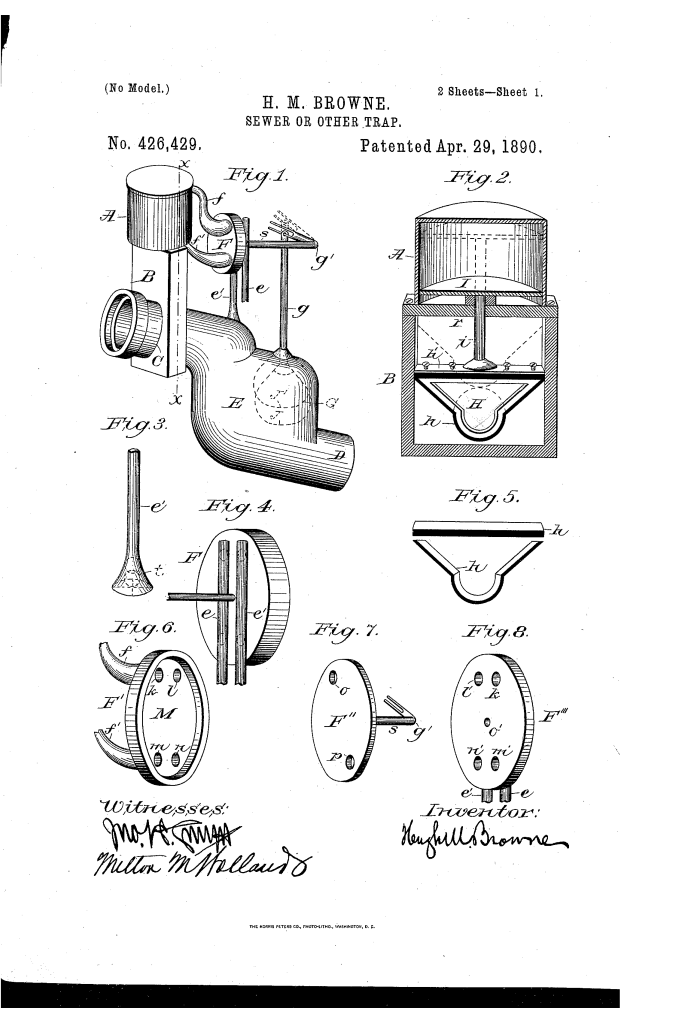
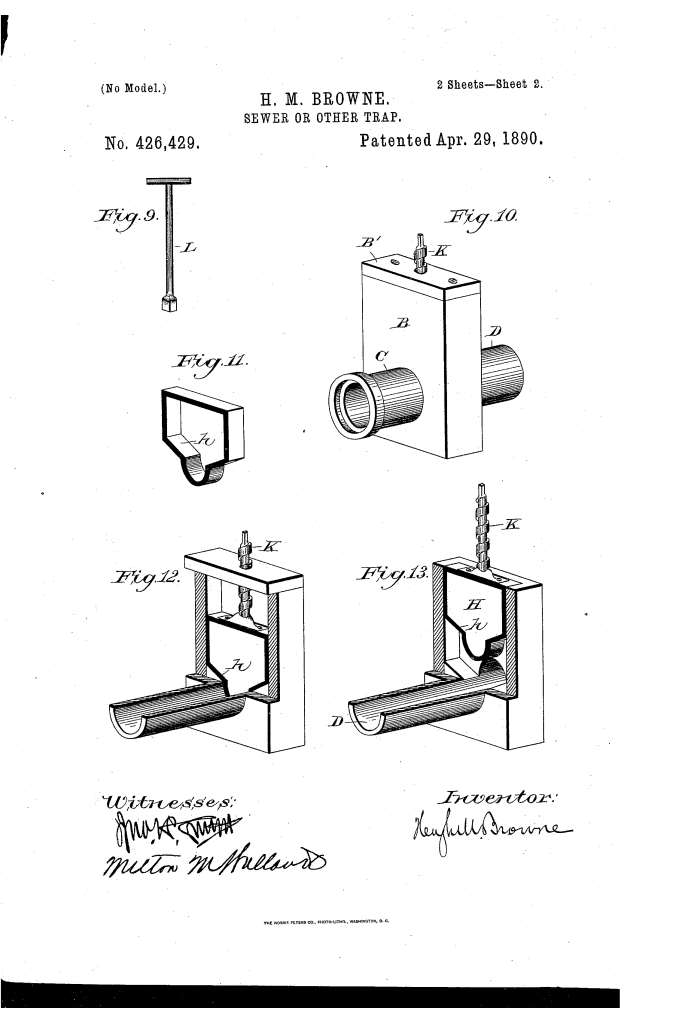
The system uses a vertically sliding valve (H) housed in a casing (B) entirely above the sewage line. Because the valve only descends when a flood is detected, it offers zero obstruction to normal waste flow, preventing the buildup of debris.
2. The Automatic Float Trigger
Inside an enlarged elbow of the discharge pipe, a float (G) monitors water levels. When floodwater backs up into the pipe, the float rises, mechanically tripping a “stop and waste cock” (F) that reroutes water pressure to move a piston.
How the Apparatus Functions
The trap operates through a sophisticated sequence of mechanical and fluid pressure shifts:
| Step | Action | Purpose |
| 1. Normal Flow | The float (G) sits at the bottom; water pressure is directed to the underside of the piston (I). | Keeps the valve (H) raised and the sewer pipe completely unobstructed. |
| 2. Flood Detection | Back-water enters the elbow, causing the float to rise. | Mechanically rotates the valve in the stop-cock (F) to reverse water flow. |
| 3. Hydrostatic Closing | Clean water pressure is diverted to the top of the piston. | Forces the valve down onto its seat with high pressure, sealing the induction pipe. |
| 4. Lateral Expansion | Downward pressure from the piston rod compresses a rubber facing (h). | Causes the rubber to expand laterally, creating a water-tight seal against the casing walls. |
| 5. Recessions | As floodwater recedes, the float sinks. | Redirects pressure to the bottom of the piston, lifting the valve back to the “open” position. |
Key Technical Components
- Hydrostatic Piston (I) & Cylinder (A): The “engine” of the device. It uses domestic water pressure to provide a forceful, reliable seal that gravity or floodwater alone could not achieve.
- Double Stop and Waste Cock (F): A complex four-way valve that manages the intake of pressurized water and the discharge (waste) of water from the cylinder as the piston moves.
- Rubber Expansion Band (h): A specialized seal on the valve that expands under the physical pressure of the piston rod to ensure no “back-water” leaks through the mechanical tolerances of the slide.
- Floating Ball-Valve (t): A secondary safety feature located in the air/waste line to prevent floodwater from backing up into the clean water service pipes.
Historical and Scientific Impact
Hugh M. Browne’s invention represented a significant leap in civil and sanitary engineering:
- Self-Cleaning Design: By removing the valve mechanism from the daily path of sewage, Browne eliminated the primary cause of trap failure (clogging).
- Reliability: Using the city’s water pressure ensured that the valve would close with sufficient force to overcome any minor obstructions, a major advantage over “swing-check” valves of the time.
- Versatility: Browne included a manual override version (using a screw-handwheel) for locations without pressurized water service, demonstrating an early focus on adaptable infrastructure.
About the Inventor: Hugh M. Browne
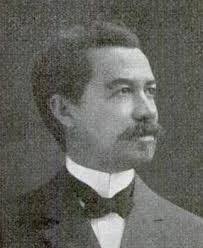
Hugh Mason Browne (1851–1923) was a distinguished African American educator, scientist, and inventor.
- Background: Born in Washington, D.C., he was highly educated, attending Howard University and Princeton Theological Seminary, and later studying at the University of Edinburgh.
- Career: While he is well-remembered for his leadership at the Institute for Colored Youth (which became Cheyney University), his technical mind led him to solve complex urban infrastructure problems.
- Legacy: Browne was a contemporary of Booker T. Washington and W.E.B. Du Bois, and his work on the sewer trap exemplifies the era’s “industrial education” movement—applying high-level scientific principles to solve the practical, everyday problems of a growing industrial society.
Summary of Claims
The patent explicitly claims:
- A trap where the operative parts are located away from the flow of sewage to prevent clogging.
- The use of hydrostatic power from a water-main as the primary force to close the induction pipe.
- A vertically-sliding valve combined with a piston and float mechanism for automatic operation.
- The specific construction of a lateral-expansion rubber band on the valve to ensure a water-tight seal under pressure.
