
Serving Apparatus for Dining-Rooms (James Doyle, No. 659,057)
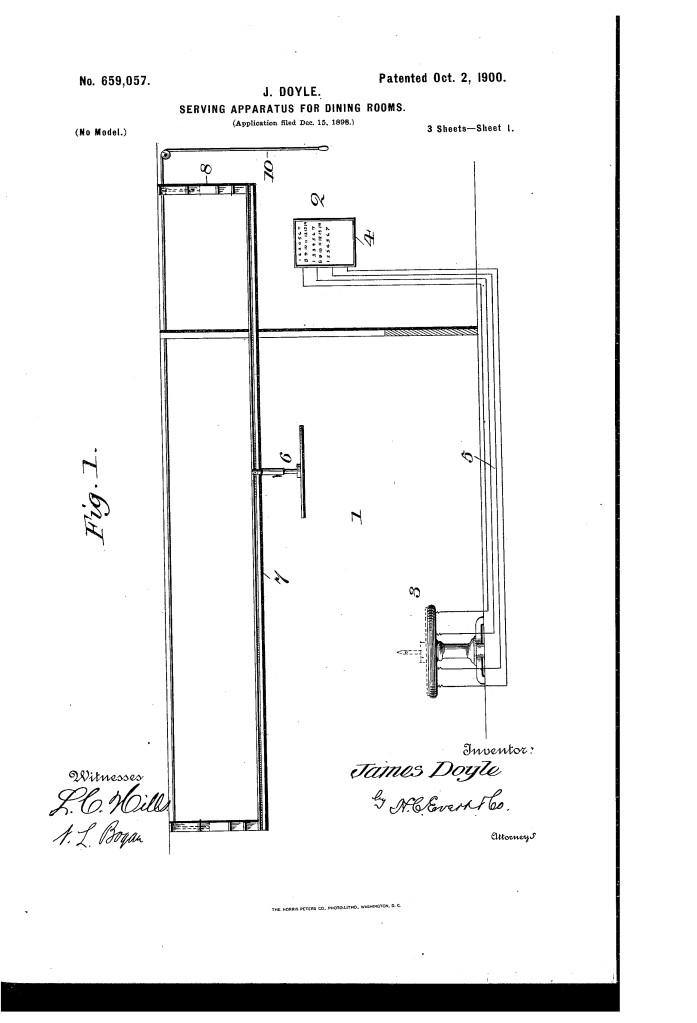
The patent by James Doyle of Pittsburg, Pennsylvania, describes a Serving Apparatus for Dining-Rooms (Patent No. 659,057, 1900). The primary object of the invention is to dispense with the usual waiters and provide an automated system where a guest can indicate the food desired to a chef and receive the ordered food via an improved carrier.
Inventor Background: James Doyle
James Doyle was an inventor focused on automating service and hospitality logistics. His invention is a groundbreaking, early attempt at creating a fully automated restaurant service system, eliminating the human element between the dining guest and the kitchen chef. This concept was highly forward-thinking for the 1900s hospitality industry.
Invention and Mechanism (Simplified)
The system consists of three integrated parts: an electronic ordering system, a motorized track, and a modular dumb-waiter carrier.
1. Automated Ordering System
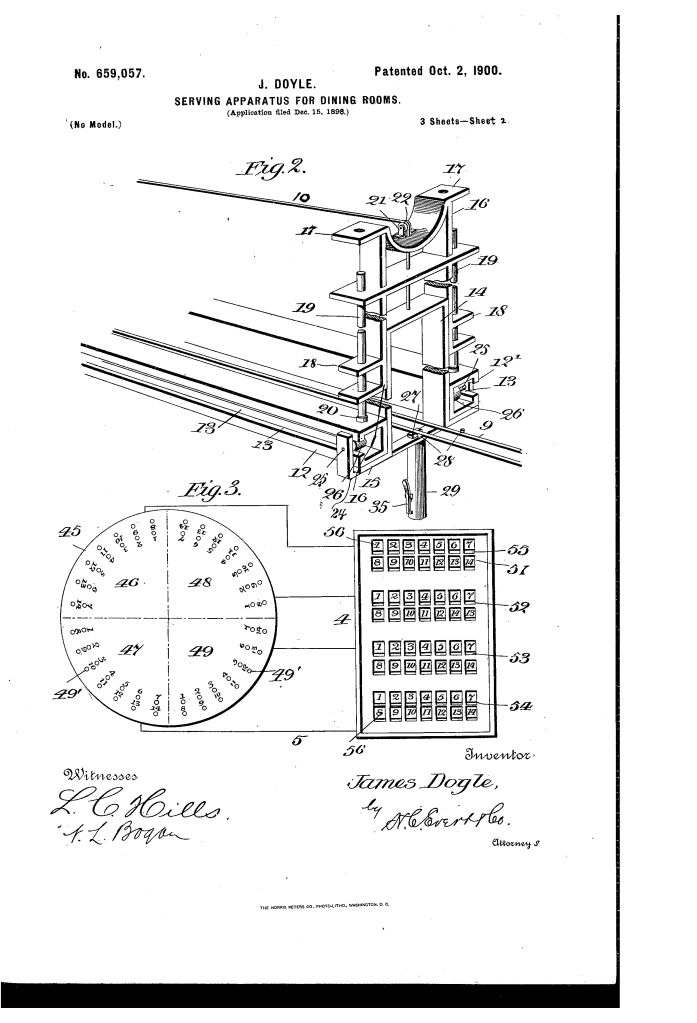
- Dining-Table (3) with Push-Buttons ($49’$): The table is divided into numbered sections, each with a series of push-buttons.
- Annunciator (4): Located in the kitchen (2), this indicator is connected to the push-buttons via wires (5).
- Menu Synchronization: The food items on the bill of fare and the carrying-sections of the dumb-waiter are all numbered to coincide with the buttons and the annunciator disks.
- Function: A guest pushes the button corresponding to the desired food, and the order is instantly displayed to the chef in the kitchen, ready to be prepared.
2. Overhead Track and Cable Drive
- Track (7): Supported by brackets (16) secured to the ceiling. The track can be elevated or lowered via a cord/cable (10) and pulley system (22).
- Endless Cable (9): A continuous cable operates over the track, connected to a suitable power source.
- Dumb-Waiter Hanger (24): A yoke-shaped hanger is supported from the track via antifriction-rollers (26). It has an offset lug (27) engaged by lugs (28) on the endless operating cable (9).
- Function: The cable (9) starts, and the lug (28) engages the hanger (24), moving the dumb-waiter along the track until the proper table is reached.
3. Modular Dumb-Waiter (The Carrier) (Key Innovation)
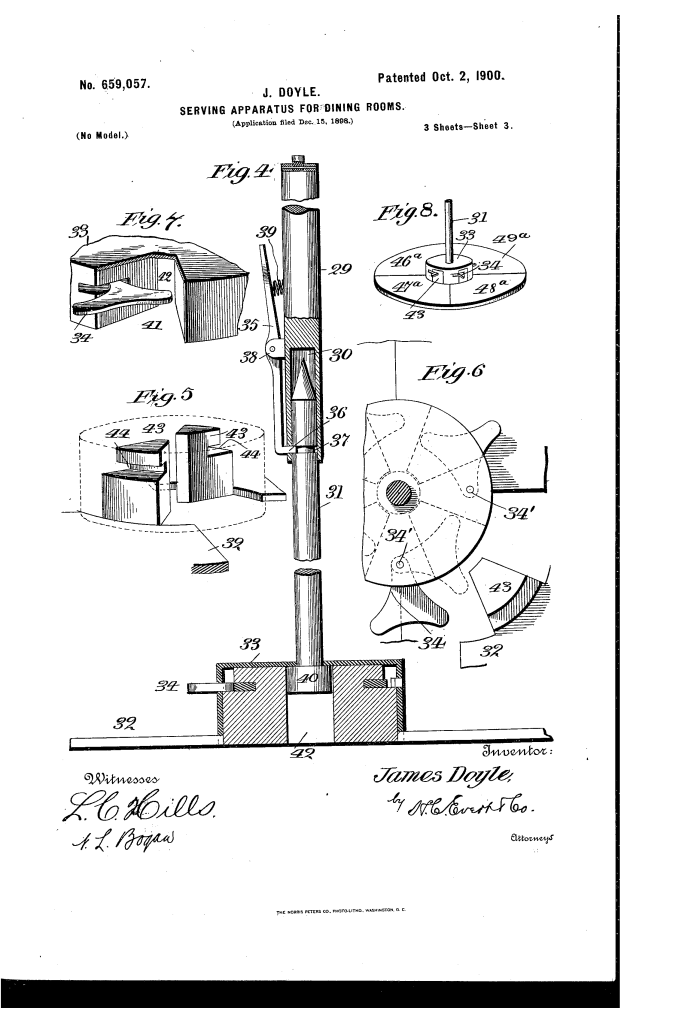
- Carrying-Sections (32): The circular receiving platform of the dumb-waiter is divided into multiple quadrant-shaped sections (32), which are numbered.
- Securing Collar (33): The sections (32) are secured by clamps (34) to a central collar (33) on a supporting rod (31). The collar has V-shaped cut-away portions (41) that match the sections.
- Function: The food order is placed on the numbered section (32) corresponding to the order. At the table, the food can be served either by removing the entire order from the dumb-waiter or by removing the specific carrying-section (32) and the order carried thereby.
Concepts Influenced by This Invention
Doyle’s apparatus influenced subsequent logistics, automation, and hospitality systems by pioneering the integrated electronic-ordering and automated physical delivery model.
- Automated Kitchen-to-Table Delivery: The core concept of using a motorized overhead track (7) and a self-propelled carrier (dumb-waiter 6) to transport goods directly to the point of consumption influenced the design of modern conveyor systems, hospital delivery robots, and automated warehousing systems
.
- Integrated Electronic Ordering System: The use of numbered push-buttons (49′) on a dining table linked to an annunciator (4) in the kitchen is a conceptual precursor to modern point-of-sale (POS) systems, digital restaurant ordering terminals, and call-bell systems.
- Modular Delivery Carriers: The design of the dumb-waiter platform with removable, numbered quadrant sections (32) influenced the design of industrial carriers and trays that require segregated, easily detachable load units for quick unloading and sorting (e.g., mail sorting trays, factory parts feeders).
- Elimination of Human Intermediary: The explicit goal of dispensing with the usual waiters influenced the development of fully automated or semi-automated service models, such as cafeterias, vending machines, and automated ordering kiosks.
