
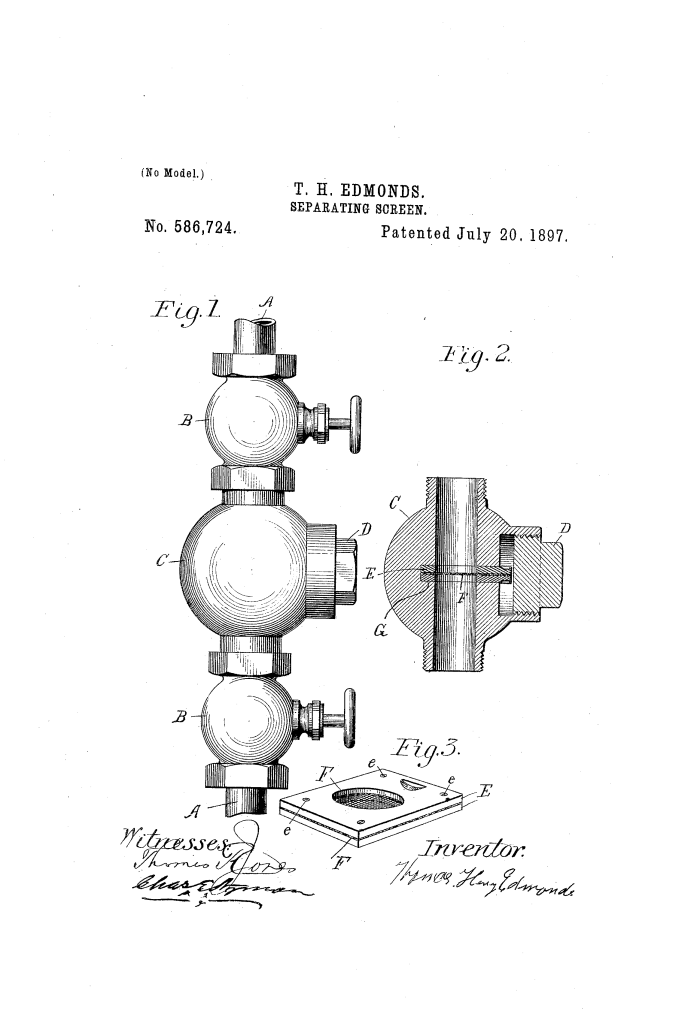
Separating-Screen (1897)
U.S. Patent No. 586,724, granted on July 20, 1897, to Thomas Henry Edmonds, describes an improved separating screen assembly engineered to filter particulate matter from high-pressure water-supply systems. Thomas H. Edmonds, an inventor based in Washington, D.C., designed this apparatus primarily for use in conjunction with automatic valve-regulators and high-stress plumbing lines.
This invention solved a pervasive mechanical failure in 19th-century hydraulic infrastructure: standard in-line filters frequently blew out or dislodged from their mountings when heavy sediment accumulated under intense water pressure. Edmonds introduced a rigid, clamped structural frame that could withstand immense pressure while remaining effortless to service and replace.
The Innovation: The Clamped Apertured-Plate Architecture
In traditional plumbing setups, wire mesh screens were seated loosely or soldered weakly within pipe chambers. When lint, scale, mineral sediment, or shells collected across the mesh, the resulting pressure differential would shear the screen from its fastenings, dumping the accumulated debris directly into sensitive valve mechanisms.
Edmonds bypassed this vulnerability by constructing a self-contained, pre-assembled cartridge:
- Pre-Assembled Clamping: The wire fabric is sandwiched directly between two matching apertured framing-plates and firmly clamped together with screws.
- Unyielding Grip: Because the framing is assembled outside the pipe prior to insertion, uniform mechanical force is applied across the entire perimeter of the wire fabric, preventing it from pulling out under extreme pressure.
- Modular Renewal: If the mesh fabric becomes worn, torn, or fouled over time, the framing plates can be quickly unscrewed to install a fresh sheet of wire fabric.
Key Mechanical Components
The design integrates a modular filter cartridge directly between shut-off controls for continuous operational access:
| Component | Function |
| Water-Supply Pipe (A) | The primary conduit carrying the pressurized fluid stream. |
| Inflow & Outflow Valves (B B) | Dual shut-off valves flanking the filter housing to isolate the chamber during maintenance. |
| Screen-Chamber (C) | The cast housing positioned between the valves to hold the filtration unit. |
| Transverse Recess / Slot (G) | A precision internal seat or groove within the chamber that secures the framed screen assembly. |
| Apertured Framing-Plates (E E) | Dual metal plates with central flow openings that sandwich and grip the filter wire fabric. |
| Clamping Screws (e) | Fasteners that detachably unite the framing plates to create an ultra-solid composite structure. |
| Plug or Bonnet (D) | A heavy threaded cap that seals the chamber access port and locks the screen down into its seat. |
How the Apparatus Functions
The assembly operates through a simple sequence designed for durability and rapid field servicing:
- Cartridge Assembly: Wire filter fabric is positioned between the two apertured framing-plates (E E) and clamped tightly using screws (e).
- Insertion: The assembled screen cartridge is slid down into the transverse recess (G) within the screen-chamber (C).
- Sealing & Retention: The top plug or bonnet (D) is screwed down firmly, which compresses the screen securely in its seat and prevents unfiltered water from bypassing the mesh.
- Maintenance Cycle: When cleaning or replacement is required, the operator closes the inlet valve, unscrews bonnet D, lifts the cartridge out, and clears the debris without dismantling the pipe run.
Historical and Practical Impact
Thomas H. Edmonds’s separating screen provided vital mechanical reliability at a time when municipal water pressure systems and automated industrial valves were expanding rapidly across American cities.
- Valve Protection: It prevented delicate automatic valve-regulators from seizing due to pipe scale, suspended sediment, or fibrous lint.
- High-Pressure Durability: The clamped dual-plate frame prevented screen blowouts, allowing filtration in high-velocity, high-pressure utility pipes.
- Reduced Downtime: Plumbers and engineers could inspect, clean, or completely re-mesh the filter unit in minutes without cutting into the mainline plumbing.
Summary of Claims
The patent explicitly claims:
- In a separating-screen, the combination with a casing having a passage therethrough and provided with a recess transverse to the passage.
- A screen adapted to fit into said recess composed of two apertured framing-plates detachably secured together.
- A wire fabric firmly clamped between the apertured framing-plates to prevent displacement under fluid pressure.
