
Sensitizing Photographic Media (1965)
U.S. Patent No. 3,219,451, granted on November 23, 1965, to James E. LuValle, Gershon M. Goldberg, and John G. Pack (assigned to Technical Operations, Incorporated), addresses a foundational limitation in high-resolution photography: the performance barriers created by conventional gelatin-based emulsions.
Standard photographic film relied on light-sensitive silver halide grains suspended in a gelatin emulsion. This gelatin matrix restricted minimum grain size, slowed chemical development, created vulnerability to ambient moisture and radiation fogging, and limited optical resolving power. While binder-free silver halide layers deposited by vacuum evaporation solved the grain-size and resolution issues, their native light sensitivity was far too low for practical, high-speed photography. LuValle and his team developed methods to drastically enhance the photographic speed of these ultra-thin, binder-free microcrystalline films through precise surface sensitization.
The Innovation: Monolayer Surface Sensitization
The core breakthrough of this patent is the controlled deposition of an ultra-thin sensitizing layer—often approaching a monoatomic coating—directly onto the surface of a continuous, binder-free microcrystalline silver halide stratum.
Instead of distributing sensitizers throughout a thick gelatin carrier, LuValle concentrated the chemical treatment on the outer microcrystalline face (52). The inventors discovered that controlling the surface deposit to approximately 10 to the 13th power to 10 to the 15th power atoms per square centimeter produced standard negative-working photographic materials, while higher concentrations could yield direct-positive (solarized) images.
Why Binder-Free Thin Films?
- Superfine Grain Resolution: Eliminating the gelatin binder enables direct crystal-to-crystal contact, producing a dense, grainless layer capable of resolving exceptionally fine detail.
- Rapid Development: Developing agents do not need to penetrate a gelatin barrier, enabling rapid liquid or even gaseous processing without the risk of image loss.
- Environmental Stability: The resulting medium is virtually insensitive to ionizing nuclear radiation and resistant to moisture-induced fogging during extended storage.
- Optimum Optical Thickness: The layer performs best at thicknesses of 0.1 to 0.5 micron (optimally around 0.3 micron), allowing exposure and development to reach the substrate without lateral spreading or loss of acutance.
Key Sensitizing Techniques and Materials
The patent demonstrates that binder-free microcrystalline media respond to an unusually broad spectrum of sensitizing materials applied via vacuum vapor deposition or solution baths:
| Component / Method | Material Examples | Function |
| Elemental Vapor Deposition | Gold, lead, copper, gallium, zinc, selenium, sulfur, bismuth | Vaporized in near vacuum to deposit an ultra-thin layer (approximately 10 to the 14th power atoms/sq cm) that boosts speed up to ten-fold. |
| Optical Dye Sensitization | Pinacyanol (1,1′-diethyl-2,2′-carbocyanine chloride) | Sublimed in high vacuum below 300°C and conditioned with water to induce dye aggregation for panchromatic/red sensitivity. |
| Alkylene Oxide Condensates | Nonyl phenol ethylene oxide, ethoxylated amides (Amidox, Makon) | Applied in aqueous solution to increase step-wedge speed and sensitivity response. |
| Organic Sulfoxides | Dimethyl sulfoxide (DMSO), diethyl sulfoxide, dibenzyl sulfoxide | Solution bath treatment that enhances overall photographic speed by a factor of at least 2. |
| Inorganic Metal Ions | Cupric chloride, cuprous salts, EDTA complexes | Solution immersion introducing copper ions directly to surface crystals to enhance photolytic response. |
| Alkaline Solutions | Sodium hydroxide (0.04 N), ammonium hydroxide (4%) | Surface hydroxyl treatment that increases overall film speed by a factor of 4. |
Apparatus and Film Structure
The fabrication and sensitization process utilized specialized vacuum deposition systems:
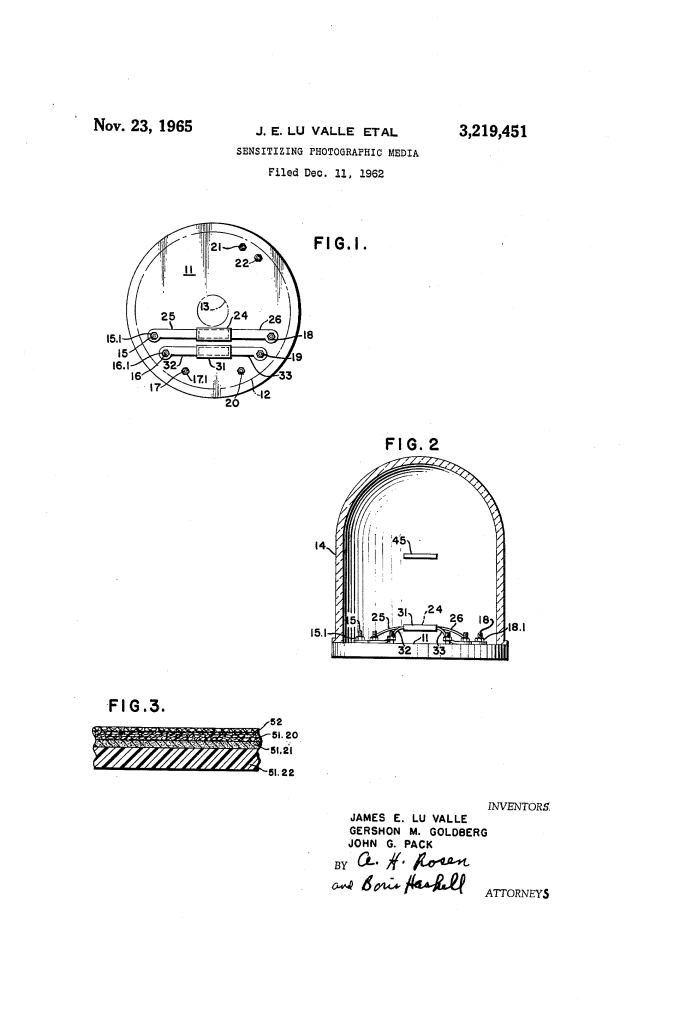
- Vacuum Chamber Table (11) and Bell Jar (14): Maintains an operating pressure between 0.0001 and 0.00001 mm Hg to vaporize high-purity silver halides and sensitizers without oxidation.
- Electrical Terminals (15–20) and Filaments/Boats (24, 31): Independently controlled molybdenum, tantalum, or tungsten heating boats used to melt and evaporate pure silver halides (AgCl, AgBr, AgI) or elemental sensitizers.
- Base Substrate (45, 51.22): A glass plate, paper, or polymeric film (such as subbed polyethylene terephthalate) positioned 3.5 inches above the source filament.
- Subbing Stratum (51.21): An optional thin intermediate layer of shellac or gelatin into which the condensing silver halide crystals slightly penetrate for improved mechanical adhesion.
- Sensitizing Surface (52): The upper monoatomic or thin-phase chemical deposit applied across the top of the condensed silver halide stratum (51.20).
Performance: Photographic Speed Gains
LuValle’s sensitization techniques transformed vacuum-evaporated silver halide layers from laboratory curiosities into functional, high-speed imaging tools:
- Native Evaporated Film: Exhibited ASA speeds of only 0.0001 to 0.01 to white light.
- Elemental Surface Sensitization: Sensitometric testing under 5500 K light demonstrated speeds of ASA 0.10—a tenfold increase over unsensitized control film.
- Lead and Gallium Sensitization: Achieved crisp negative exposures of printed text in 1/5 second at f/4, developing fully in 10 to 30 seconds.
- Chemical Dye Sensitization: Combining gold salt baths with cyanine dyes boosted white-light sensitivity by approximately 1.5 orders of magnitude over gold treatment alone.
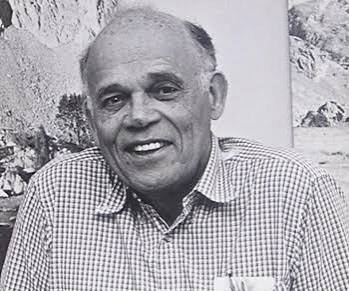
About the Inventor: James E. LuValle
James Ellis LuValle was a world-renowned photochemist, physical chemist, and Olympic athlete.
- Scientific Career: LuValle earned his Ph.D. in chemistry and mathematics under Linus Pauling at the California Institute of Technology (Caltech). He served as Director of Basic Research at Technical Operations, Inc., and later headed research divisions at Fairchild Camera and Instrument.
- Technical Impact: His pioneering research into the photolysis of silver halides, electron transfer, and binder-free microcrystalline systems proved foundational to high-resolution aerial reconnaissance, micro-imaging, and advanced semiconductor lithography.
- Olympic Legacy: Prior to his groundbreaking scientific career, LuValle represented the United States at the 1936 Summer Olympics in Berlin, winning the bronze medal in the 400-meter track and field event.
Summary of Claims
The patent explicitly claims:
- An image recording medium featuring a substrate and a continuous, binder-free layer of vapor-deposited silver halide microcrystals measuring between 0.1 and 0.5 micron in thickness (optimally about 0.3 micron).
- A microcrystalline stratum density of approximately 95% of solid crystalline silver halide.
- Sensitizing the outer surface of the microcrystalline stratum with vapor-deposited elemental materials at controlled concentrations to produce normal negative or direct-positive images.
- Methods of manufacturing sensitized binder-free elements via sequential high-vacuum evaporation and solution-based chemical treatments.
