
Self-Leveling Table (Charles Wm. Allen, No. 613,436)
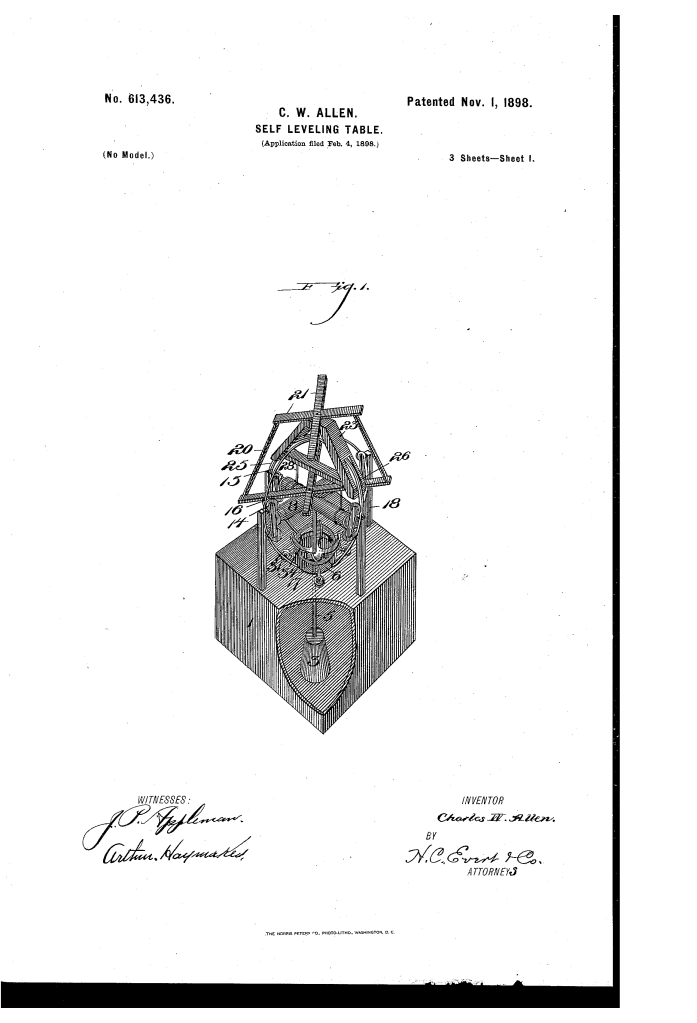
The patent by Charles Wm. Allen of Option, Pennsylvania, describes a Self-Leveling Table (Patent No. 613,436, 1898). The invention is designed to preserve the perfect equilibrium of the table-top without respect to the base upon which the table rests. It is particularly adapted for use upon vessels to prevent dishes from slipping off due to the rocking motion.
Inventor Background: Charles Wm. Allen
Charles Wm. Allen was an inventor who focused on practical mechanical solutions for stabilizing objects in dynamic environments. His table is a classic example of applying the principle of the pendulum (gyroscope) to solve an everyday convenience problem in naval or maritime settings, a common area of technical challenge in the late 19th century.
Invention and Mechanism
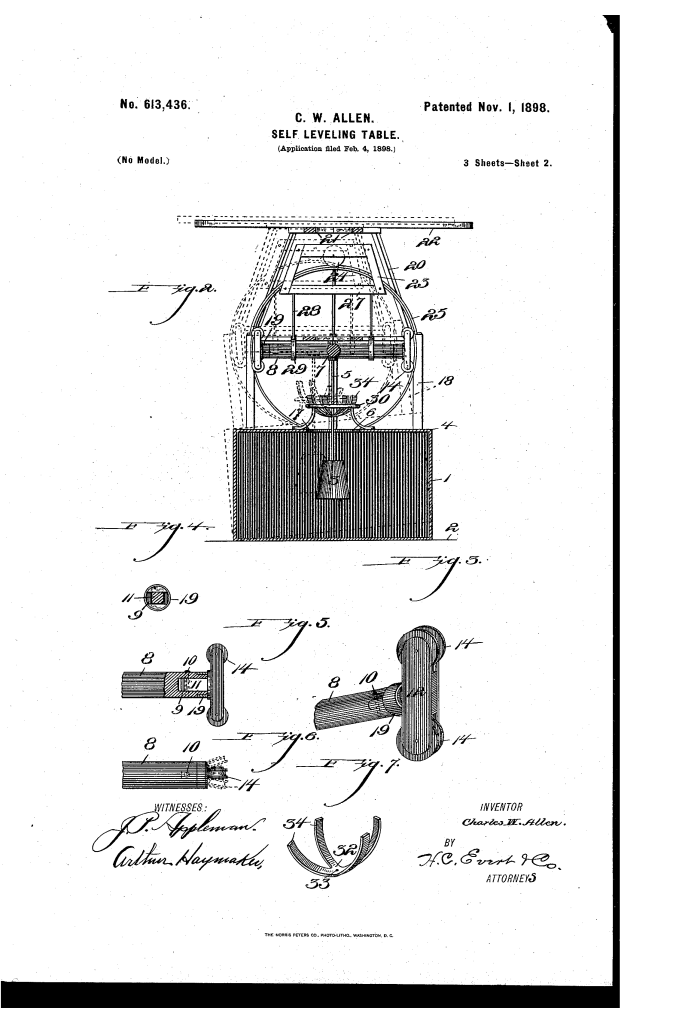
The table utilizes a pendulum-suspended hub combined with a complex system of tracks and rollers to isolate the table surface from the base’s angular motion.
1. Pendulum Stabilization (Key Innovation)
- Weight/Pendulum (3): A heavy weight suspended from a rod (5).
- Hub (7): The rod (5) is secured to a hub (7) at its upper end, and the table-top (22) is supported by a frame (20) secured to this hub.
- Function: The weight/pendulum, always seeking a vertical position, exerts a force on the hub, counteracting any inclination of the base.
2. Self-Leveling Mechanism
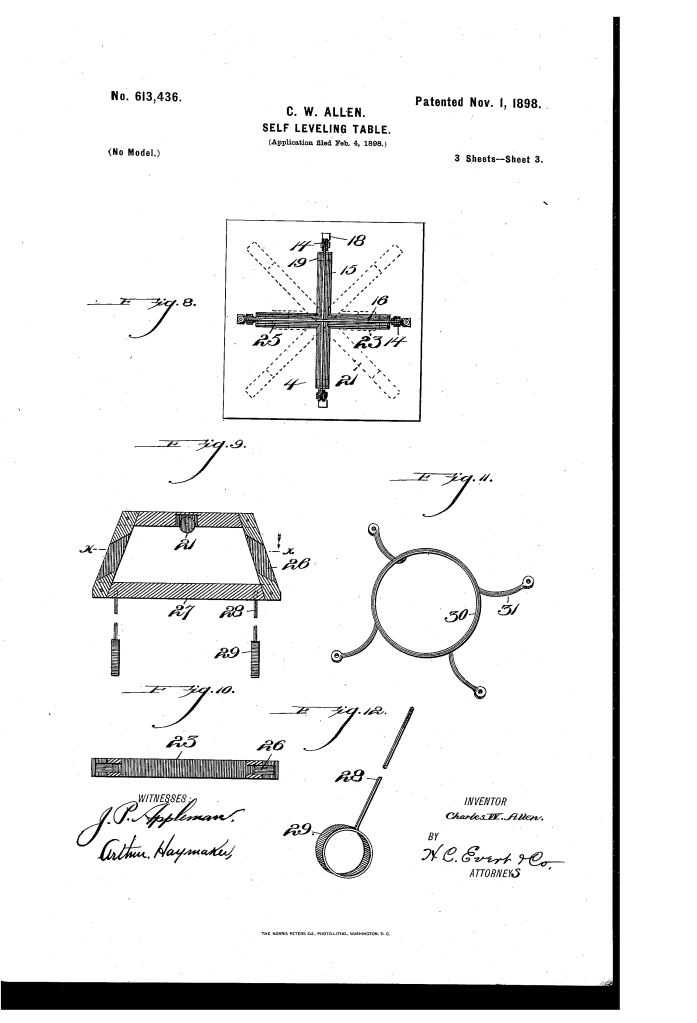
- Circular Tracks (15, 16): Two circular tracks extend over the hub, crossing each other transversely at their highest point. These tracks are supported by standards (18).
- Spokes and Rollers (8, 14): The hub (7) has spokes (8) carrying rollers or double pulleys (14) that engage and travel upon these circular tracks (15, 16).
- Function: As the base/floor inclines, the fixed tracks (15, 16) move relative to the always-vertical hub (7). The rollers (14) allow the entire hub and supporting frame (20) to travel along the tracks, ensuring the hub remains level relative to the gravity vector.
3. Preventing Oscillation (Damping)
- Guide-Plate (32): A plate with screw-threaded adjustment is secured to the pendulum rod (5).
- Guide-Ring (30′): A circular track or guide-ring is arranged directly over the central aperture of the casing cover (4).
- Function: The guide-plate (32), resting upon the fixed guide-ring (
), features diverging concavo-convex fingers (34). This plate helps to dampen oscillation (side-to-side swinging) of the suspended system, preventing excessive movement of the table-top.
Concepts Influenced by This Invention
Allen’s table influenced subsequent stabilization and suspension systems, particularly those related to gyroscopic and inertial leveling.
- Inertial/Pendulum Stabilization: The core principle of using a freely suspended pendulum to automatically maintain the level of a platform influenced the design of early inertial navigation systems, gyroscopic stabilizers for monorails, and stabilized platforms for naval artillery and optics.
- Complex Rollers for Multi-Axis Travel: The use of multiple rollers (14) engaging crossed circular tracks (15, 16) to allow movement in all horizontal directions (pitch and roll) while isolating the vertical element influenced the design of universal joints, gimbals, and multi-axis bearings used in robotics and precision mounting.
- Friction Damping: The inclusion of the guide-plate (32) operating on the guide-ring (
) to prevent oscillation influenced the design of damping mechanisms for suspended or sprung systems, ensuring stability and preventing harmonic swinging (a common problem with simple pendulums).
- Adaptive Seating Systems: The mechanical approach to seating a platform that is completely decoupled from the base’s movement is a conceptual precursor to modern suspension seats in high-speed ferries and commercial vehicles.
