
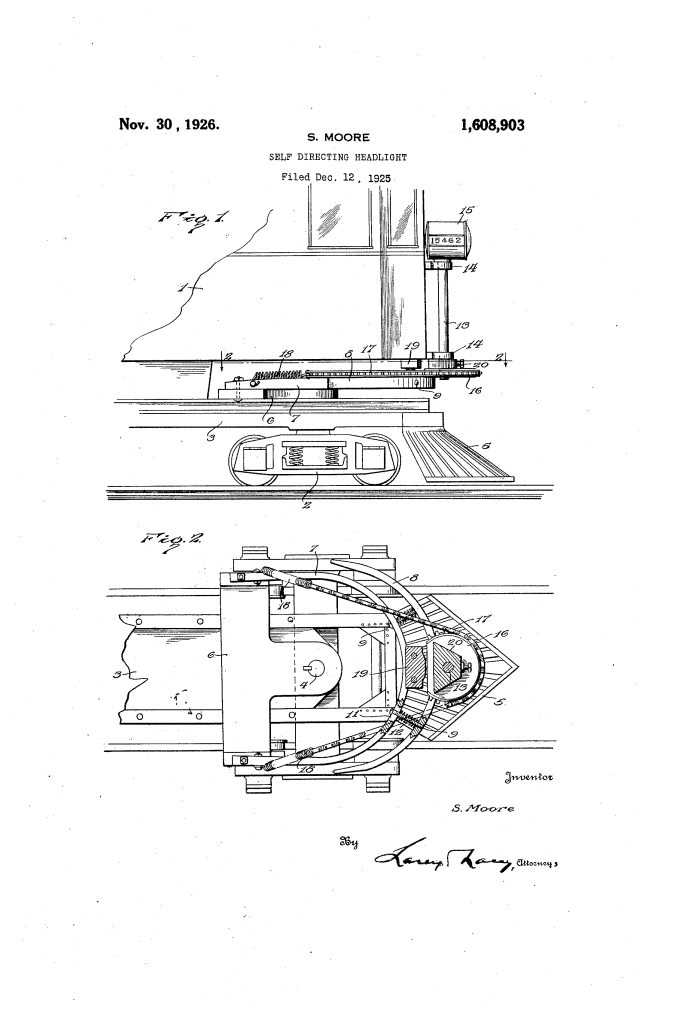
Self-Directing Headlight (Sam Moore, No. 1,608,946)
The patent by Sam Moore of Grant Town, West Virginia, describes an improved Self-Directing Headlight (Patent No. 1,608,946, 1926). This invention is a “dirigible” lighting system designed primarily for interurban and street cars. Moore’s primary objective was to solve a major safety hazard of early rail travel: the inability of fixed headlights to illuminate the track during sharp turns. His innovation uses a yieldable mechanical linkage connected directly to the wheel truck, allowing the headlight to “peek” around corners while protecting the mechanism from over-rotation.
Inventor Background: Sam Moore
Sam Moore was an African American inventor and engineer based in West Virginia during the height of the electric streetcar era. His 1926 patent addressed a critical need for safety engineering in public transit. In the 1920s, interurban cars traveled at significant speeds through wooded or rural curves; a fixed headlight would shine into the trees rather than onto the tracks, leading to frequent collisions with pedestrians or obstacles. Moore’s design provided a mechanical “intelligence” to the car’s lighting, demonstrating a sophisticated use of kinetic energy transfer from the vehicle’s chassis to its safety systems.
Key Mechanical & Safety Systems
The headlight is linked to the car’s steering truck, ensuring that as the wheels turn to follow the track, the light follows the wheels.
1. The King Bolt and T-Member (4, 6)
- The Pivot: The front truck (2) is connected to the car’s substructure by a king bolt (4).
- T-Member (6): A cross-piece is fixed to the top of this king bolt so that it rotates in perfect synchronization with the wheels.
- Function: This serves as the “master controller.” Every degree of rotation the truck makes as it enters a curve is mirrored by the T-member above it.
2. The Sprocket and Chain Linkage (13, 16, 17)
- The Post (13): The headlight (15) sits atop a vertical post mounted in bearings (14) at the front of the car.
- Mutilated Sprocket Gear (16): A gear is fixed to the bottom of the post.
- Sprocket Chain (17): A chain connects the T-member to the gear.
- Function: As the T-member turns, it pulls the chain, which rotates the gear and the post, effectively steering the headlight in the direction of the curve.
3. Yieldable Spring Connection (18) (Key Innovation)
- The Springs (18): The chain is not rigidly attached to the T-member; it is connected via coil springs (18).
- Function: This creates a yieldable connection. If the truck turns sharply, the springs absorb the excess tension, allowing the headlight to move smoothly without jerky motions or snapping the chain.
4. The Stop Mechanism (19, 20)
- The Limiters: A cross piece (19) is fixed to the car body, while a corresponding member (20) is fixed to the headlight post.
- Function: These act as physical “stops.” They limit how far the headlight can turn in either direction. Once the headlight hits the stop, the springs (18) allow the truck to continue turning as needed for the track without forcing the headlight post past its safe limit.
Improvements Over Standard Fixed Headlights
| Feature | Standard Street Car Lights | Moore’s Self-Directing Headlight |
| Visibility | Light points straight, leaving curves in the dark. | Truck-synchronized; illuminates the track ahead in curves. |
| Safety | High risk of hitting obstacles on curved crossings. | Significant reduction in casualties to pedestrians and drivers. |
| Durability | Rigid linkages would snap under stress. | Yieldable spring connection absorbs mechanical shock. |
| Precision | No control over light angle. | Stop members (19, 20) prevent the light from turning too far. |
Significance to Engineering and Public Safety
Sam Moore’s dirigible headlight influenced the development of adaptive lighting systems and dynamic steering linkages.
- Adaptive Driving Beams: Moore’s mechanical logic—linking light direction to the steering angle—is the direct ancestor of the Adaptive Front-lighting Systems (AFS) found in modern luxury automobiles today.
- Yieldable Mechanical Logic: The use of springs to allow “over-travel” in a primary system (the truck) while protecting a secondary system (the light) is a foundational principle in fail-safe mechanical design.
- Interurban Safety: His invention was a critical contribution to the urbanization of America, making night-time public transit safer and more reliable as city rail networks expanded into complex, curved environments.
- Dynamic Illumination: By recognizing that “casualty reduction” was a function of visibility, Moore pioneered the integration of occupational safety into vehicle design.
