
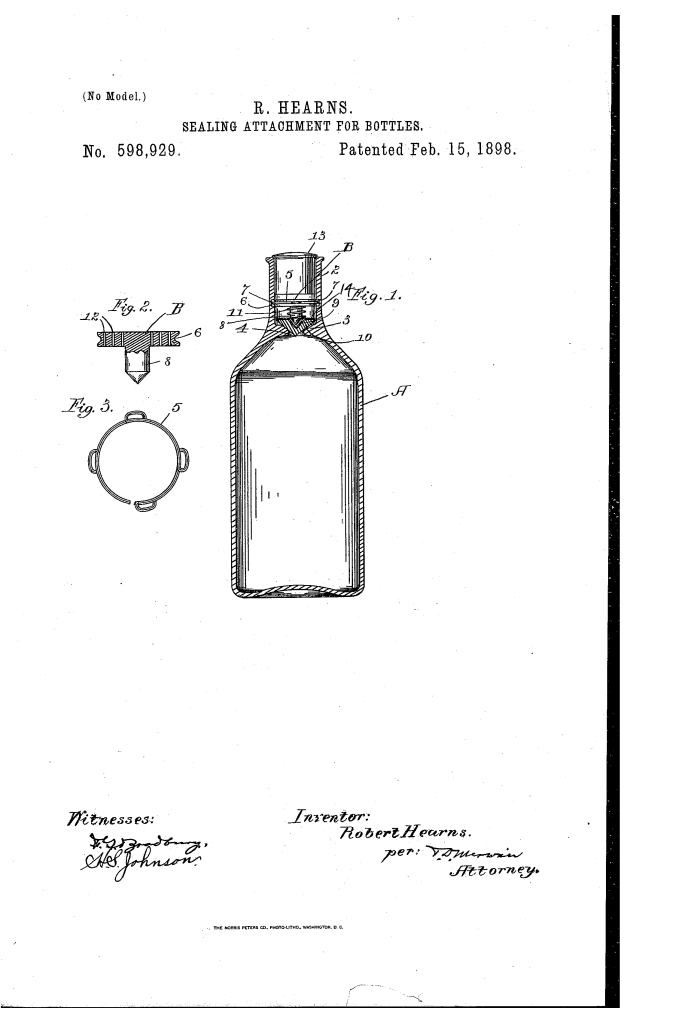
Sealing Attachment for Bottles (1898)
U.S. Patent No. 598,929, granted on February 15, 1898, to Robert Hearns, details a specialized internal sealing attachment designed to prevent the illicit refilling of commercial bottles once their original contents have been emptied. Hearns, an inventor based in St. Paul, Ramsey County, Minnesota, assigned half of the patent rights to Sam Black of the same city.
The invention directly confronted a widespread late-19th-century problem in the beverage, medicinal, and liquor trades: unscrupulous vendors collecting authentic branded bottles, refilling them with inferior or adulterated liquids, and reselling them as genuine products. Hearns engineered an internal valve-and-locking system that allowed liquids to pour out freely when tilted, but permanently barred anyone from forcing liquid back in.
The Innovation: The Irreversible Lock and Gravity-Actuated Valve
Hearns’s mechanism relies on an internal, tamper-resistant locking assembly permanently seated within the neck of the bottle. Once installed at the bottling plant, the assembly cannot be removed without destroying the bottle itself.
The Locking Ring Mechanism
The bottle neck features an internal annular groove (7). The matching guard-disk (B) carries a corresponding circumferential groove (6). When assembled, a split spring-ring (5) snaps simultaneously into both channels, locking the entire mechanism irreversibly in place without requiring threads, glue, or external fasteners.
The One-Way Valve System
Beneath the locked guard-disk sits a movable valve (10) seated directly against a constricted throat (4) formed by an inward flange (3) at the base of the neck. When the bottle is upright, a light coil spring (11) keeps the valve tightly closed. When inverted, the hydrostatic weight of the liquid overcomes the light spring tension, sliding the valve open along a central guide stem (8) and letting liquid exit through vertical discharge ports (12).
Technical Components and Functions
| Component | Function |
| Guard-Disk (B) | The non-removable capstone of the internal assembly; anchors the mechanism in the neck and features discharge ports (12) for the outflow of liquid. |
| Spring-Ring (5) | An expanding metal ring seated between grooves (6 and 7) that permanently locks the guard-disk into the bottle neck. |
| Valve (10) | A non-metallic plug seated in the throat (4) that seals the passage against incoming fluids. Contains a socket (9) to receive the guide stem. |
| Central Stem (8) | A downwardly projecting guide post attached to the guard-disk that centers the valve and limits its travel distance. |
| Coil Spring (11) | Surrounds the stem; holds the valve closed against refilling attempts, yet compresses easily under the weight of the liquid during pouring. |
| Metallic Sheathing (14) | A protective armor cap over the valve body that prevents tampering with wires or sharp tools poked through the openings (12). |
| Throat Flange (3) | An internal constriction at the base of the neck that forms the valve seat. |
How the Mechanism Functions
- Initial Filling and Assembly: The bottle is filled with liquid at the factory. The valve (10), spring (11), and guard-disk (B) are inserted into the neck (2). The spring-ring (5) snaps into the neck groove (7), permanently securing the internal assembly. A conventional cork (13) seals the top for shipping.
- Dispensing: The consumer removes the cork and inverts the bottle. The weight of the liquid compresses the coil spring (11), lifting the valve along the stem (8). Liquid flows around the valve body and exits through the openings (12).
- Anti-Refill Lockout: When the bottle is righted or liquid is introduced from the outside, the coil spring (11) snaps the valve shut against the seat (3). Any external fluid pressure pushes downward, reinforcing the seal.
- Anti-Tamper Defense: If someone inserts a stiff wire or tool through the discharge openings (12) to force the valve down, the metallic armor plate (14) shields the valve body from being punctured, snagged, or manipulated.
About the Inventor: Robert Hearns
Robert Hearns was an inventor working in St. Paul, Minnesota, at the close of the 19th century. During this era of rapid industrialization, consumer packaging transitioned toward mass-market bottling, creating an urgent commercial need for fraud prevention and tamper-evident packaging. Hearns’s mechanical solution protected brand reputation and consumer safety by leveraging basic fluid mechanics and irreversible physical fasteners.
Summary of Claims
The patent explicitly claims:
- The combination of a bottle neck featuring a constricted internal throat flange and a seated valve.
- A guard-disk locked into the bottle neck using a spring ring seated in matching circumferential grooves between the neck and disk.
- A downwardly extending guide stem that travels within a socket in the valve to direct movement and contain a coil spring.
- A protective metallic sheathing positioned over the valve to block physical tampering via instruments inserted through the disk openings.
