
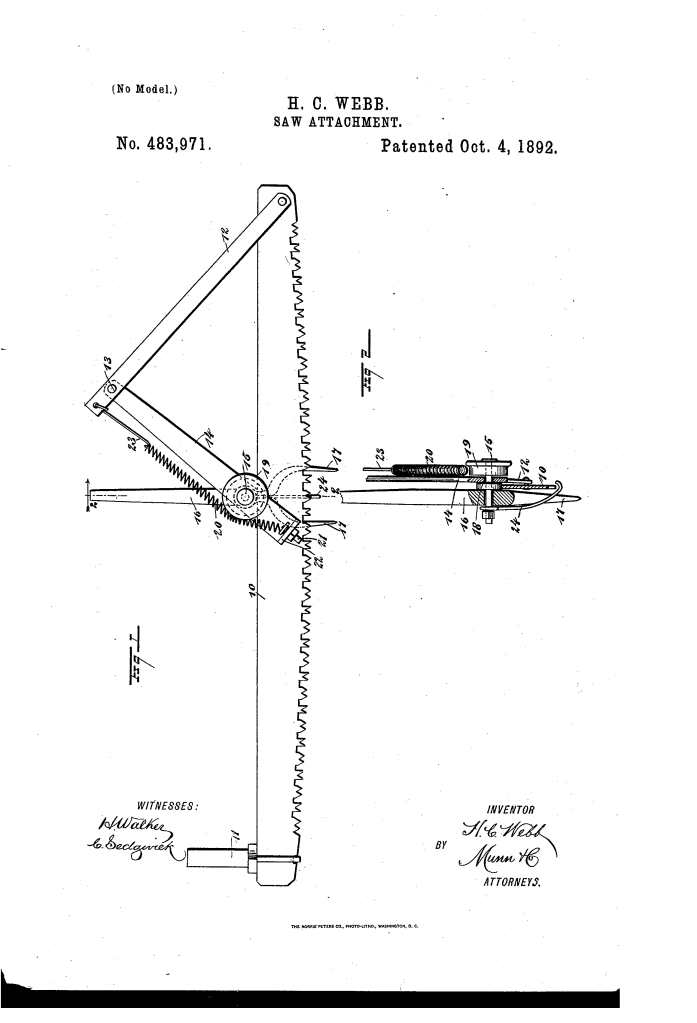
Saw Attachment (1892)
U.S. Patent No. 483,971, granted on October 4, 1892, to Henry C. Webb, introduces a mechanical assist for traditional crosscut or drag saws. Henry Webb, a resident of Russiaville, Indiana, designed this attachment to solve a fundamental labor problem of the late 19th century: the necessity of having two people to operate a large crosscut saw effectively.
This invention transformed a two-man tool into a one-man machine by using a specialized toggle-lever and spring system that mimics the “push” of a second sawyer, allowing a single person to cut through heavy logs and timber with ease.
The Innovation: The Toggle-Lever Assist
The core of Webb’s invention is a mechanical linkage that stores and releases energy. Traditionally, a single person using a crosscut saw struggles because they can only effectively pull the blade; the push stroke often causes the long, flexible blade to buckle or requires awkward body positioning.
Webb’s design utilizes a toggle-lever system composed of two primary arms:
- Lever 12: Pivoted directly to the end of the saw blade opposite the handle.
- Lever 14: Pivoted to a stationary supporting post and connected to the first lever.
As the operator pulls the saw handle toward themselves, these levers “double up,” stretching a heavy-duty spiral spring (20). When the operator finishes the pull stroke, the spring’s tension pulls the levers back into a straight line, automatically “pushing” the saw blade back through the log.
Key Mechanical Components
The apparatus is built for durability and field use, consisting of several interactive parts:
| Component | Function |
| Supporting Post (16) | The anchor of the system; equipped with prongs (17) that bite into the log to keep the assembly stable. |
| Spiral Spring (20) | The “engine” of the device; it stores energy during the pull stroke to power the return stroke. |
| Rolling Pulley (19) | Acts as a rolling fulcrum for the spring, reducing friction so the operator doesn’t feel extra resistance. |
| Lever 12 & 14 | The toggle mechanism that converts the spring’s tension into linear motion for the saw. |
| Locking Hook (24) | A safety and transport feature that engages the saw teeth to lock the mechanism in place when moving it. |
Performance: The “Automatic” Return
The brilliance of the Webb attachment lies in its spring-action fulcrum. By mounting the spring on a rolling pulley (19), Webb ensured that the tension remained consistent without making the saw “pull harder” for the operator.
- Manual Phase: The operator pulls the handle (11). The levers fold, and the spring stretches.
- Automatic Phase: The operator relaxes their grip. The spring reacts, straightening the toggle levers and driving the saw blade forward through the wood.
- Result: A continuous, rhythmic sawing motion that maintains speed while significantly reducing physical exhaustion.
The Manufacturing and Setup
The attachment was designed to be “simple, durable, and cheap,” making it accessible to farmers and loggers. The setup process involves:
- Securing the Post: Driving the prongs into the timber to be cut.
- Aligning the Pivot: Ensuring the bolt (15) is secure to provide a stable axis for the main lever.
- Tensioning the Spring: Hooking the spiral spring between the offset ends of the two levers to create the necessary “snap-back” force.
About the Inventor: Henry C. Webb
Henry C. Webb was an American inventor from Russiaville, Indiana. During the post-Civil War era, Indiana was a hub of agricultural and timber production. Inventors like Webb focused on “labor-saving” devices that allowed small family farms and independent loggers to compete with larger industrial operations. His work on this saw attachment is a prime example of 19th-century mechanical ingenuity—using basic physics (levers and potential energy) to solve a grueling manual task.
Summary of Claims
The patent explicitly covers the unique combination of parts that make the one-man saw possible:
- A dual-lever system where one lever is attached to the saw and the other to a fixed post.
- The inclusion of a pulley mounted on the post-lever to act as a frictionless guide for the spring.
- The specific arrangement of a spring connecting the short ends of the two levers to provide the mechanical advantage necessary for the return stroke.
