
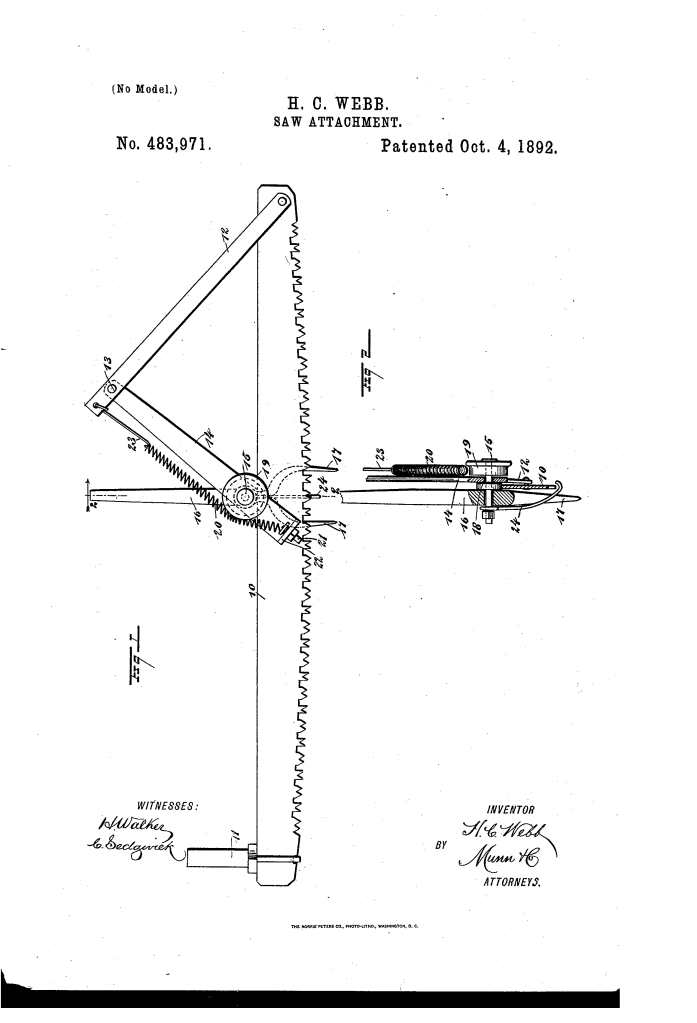
Henry C. Webb’s patent for a “Saw Attachment,” No. 483,971, describes a device designed to make a crosscut saw easier to operate for a single person. Patented on October 4, 1892, the invention consisted of a system of levers and a spring that attached to one end of the saw and a log.
The key components were:
- A supporting post with prongs at the bottom, which was driven into the log to be sawed.
- A system of toggle levers pivoted to the post and to one end of the crosscut saw.
- A spiral spring connecting the short ends of the two levers.
The attachment worked by using the spring to provide the return stroke for the saw. When the operator pulled the saw toward themselves, they would compress the spring. When they released the handle, the spring would pull the saw back, thus assisting the sawing action and reducing the labor required. The system effectively acted as a “second man” for the saw.
Societal Impact
Webb’s saw attachment was a practical invention that addressed a common labor problem in rural America. It was part of a larger trend of innovations aimed at simplifying and mechanizing everyday tasks.
- Improved Efficiency for Labor: Logging, farming, and construction in the late 19th century were physically demanding jobs. By reducing the effort required to use a crosscut saw, Webb’s invention made it possible for a single person to perform a task that traditionally required two. This improved efficiency and productivity, particularly for small-scale loggers and farmers.
- A Glimpse of the Past: The invention shows how technology was developed to solve real-world problems in an era before gas-powered chainsaws. It demonstrates the kind of pragmatic ingenuity that was a hallmark of American innovation.
- The Inventor’s Legacy: The patent record for Henry C. Webb does not provide further details about his life beyond his residence in Russiaville, Indiana. However, his work stands as an example of the thousands of inventors who created devices that, while not world-changing, made a direct and tangible improvement to the lives of working people.
