
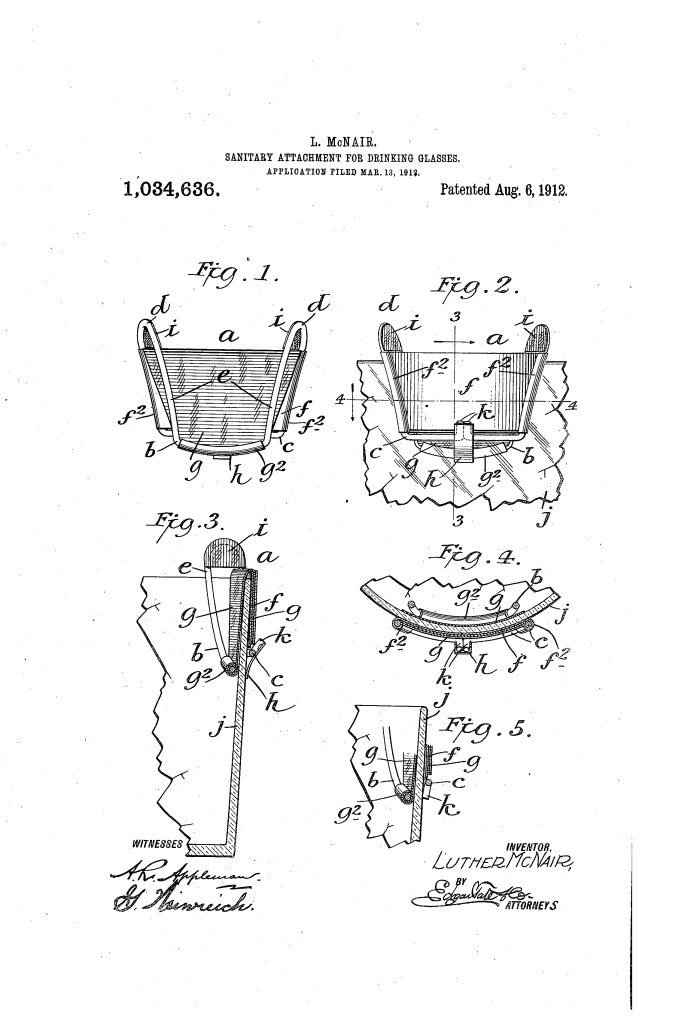
Sanitary Attachment for Drinking Glasses (Luther McNair, No. 1,034,636)
The patent by Luther McNair of Brooklyn, New York, describes a Sanitary Attachment for Drinking-Glasses (Patent No. 1,034,636, 1912). The invention is a clip-on device for cups, glasses, and goblets designed to prevent the drinker’s lips or mouth from coming into direct contact with the rim of the vessel. This was intended as a hygiene measure to protect against germs or contaminants on shared or improperly cleaned glassware.
Inventor Background: Luther McNair
Luther McNair was an African-American inventor living in Brooklyn during the early 20th century. His invention arrived during a period of heightened public awareness regarding “germ theory” and the spread of communicable diseases. At this time, the “common cup”—a shared drinking vessel found in public places like schools, trains, and parks—was being phased out by law because it was a known vector for tuberculosis and other illnesses. McNair’s device offered a personal, portable solution for individuals who wanted to ensure a sanitary drinking experience regardless of the vessel provided.
Invention and Mechanism (Simplified)
The attachment is a spring-loaded frame that holds a flexible barrier over the edge of a glass.
1. The Spring Frame (b, c)
- Yoke-Shaped Members: The device is built around a frame made of spring wire or rod. It features an inner (front) yoke ($b$) and an outer (back) yoke ($c$).
- Side Loops (e): These two yokes are connected at the top to form side loops ($e$) that open downward.
- Function: These loops act as a spring clamp that slides over the rim of the glass ($j$), holding the device securely in place through tension.
2. The Sanitary Barrier (g, i)
- Flexible Sheet (g): A sheet made of rubber or other flexible, waterproof material is stretched between the front and back members.
- Transverse Plate (f): The sheet is attached to a metal plate ($f$) on the back and a tubular plate ($f’$) at the bottom.
- Function: When in use, the sheet (g) covers the inner rim of the glass, while the plate (f) rests on the outside. This creates a barrier so that the drinker’s upper lip touches the clean rubber sheet and the bottom lip touches the plate, rather than the glass itself.
- Side Shields (i): Additional flexible sheets ($i$) are placed in the side loops to guard the corners of the mouth.
3. Stabilization Features
- Spring Tongue (h): In the primary version, a central spring tongue (h) extends downward on the outside of the glass.
- Function: This tongue provides extra gripping force to prevent the attachment from sliding or wobbling while the user is tilting the glass to drink.
Concepts Influenced by This Invention
McNair’s sanitary attachment influenced the development of personal hygiene products and food-safe mechanical interfaces.
- Portable Sanitation: The core concept of a personal, reusable barrier for public utilities influenced the development of products like individual travel cups, straw-hole lids, and disposable sanitary covers.
- Ergonomic Mouth-Guards: The design of the side shields ($i$) and the contoured rubber sheet ($g$) anticipated the ergonomics of modern “sippy cups” and sports bottle nozzles, which are designed to control liquid flow while maintaining a seal with the lips.
- Spring-Tension Clamping: The use of a continuous wire frame to create both structural support and clamping force is a fundamental principle in consumer product design, seen today in everything from bag clips to phone mounts.
- Consumer-Side Hygiene Solutions: McNair’s invention represented a shift toward individual responsibility for health, a precursor to the modern market for personal protective equipment (PPE) and travel-sized sanitizing products.
