
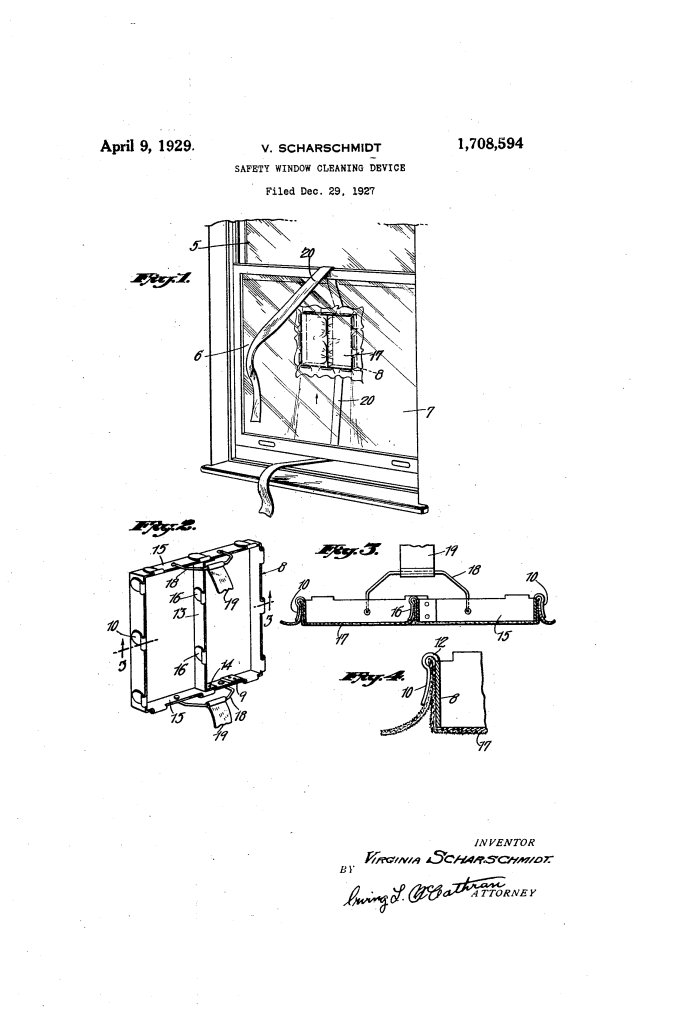
Safety Window Cleaning Device (Virginia Scharschmidt, No. 1,712,408)
The patent by Virginia Scharschmidt of New York, N.Y., describes a Safety Window Cleaning Device (Patent No. 1,712,408, 1929). This invention is a specialized mechanical cleaning tool designed to allow residents of high-rise buildings to wash the exterior of their windows from the safety of the interior room. Scharschmidt’s primary objective was to eliminate the extreme danger faced by housewives and professional cleaners who often had to sit on window sills or lean precariously out of windows at dangerous heights. Her innovation features a tension-based frame and manipulating tapes that use the window sash itself as a fulcrum to apply cleaning pressure.
Inventor Background: Virginia Scharschmidt
Virginia Scharschmidt was an African American inventor and entrepreneur living in New York City during the late 1920s. At a time when New York’s skyline was rapidly ascending with skyscrapers and high-rise apartments, window cleaning accidents were a frequent and often fatal occurrence. Scharschmidt, applying a practical engineering lens to a domestic hazard, designed a device that prioritized active safety and mechanical advantage. Her work is a significant example of the “Home Safety” movement, where inventors sought to modernize household tasks to reduce physical risk and labor.
Key Mechanical & Safety Systems
The device operates on a principle of reciprocating motion, using long tapes to transfer power from the user inside to the frame outside.
1. The Towel Holding Frame (8, 9, 13)
- Construction: The frame (8) is a rectangular strip of sheet metal with overlapping ends (9) riveted together.
- Structural Brace: A center piece or brace (13) is secured midway between the sides.
- Function: This lightweight metal skeleton provides the necessary rigidity to hold a cleaning cloth flat against the glass, ensuring even contact across the entire surface of the pane.
2. The Overturned Grip Clips (10, 12, 16) (Key Innovation)
- Bulged Clips: The frame is punched to create integral clips (10 and 16).
- The Bulge (12): The upper extremities of the clips are bulged outward.
- Function: This creates a specialized “imprisonment” space for the toweling (17). A user can quickly push an absorbent cloth under these clips, where it is frictionally gripped. This allows for rapid replacement of dirty cloths without needing separate fasteners or tools.
3. The Tension Brackets and Tapes (18, 19, 20)
- Wire Brackets (18): Rigid wire handles are secured to the ends (15) of the frame at right angles.
- Manipulating Tapes (20): Long straps or tapes are attached to the brackets.
- Action: To use the device, the frame is placed outside the window. One tape is passed over the top of the sash (6) and the other under the bottom.
- Pressure Logic: By pulling the tapes from inside the room, the right-angled brackets force the frame (8) firmly against the exterior glass. As the user pulls the tapes up and down, the frame reciprocates across the pane, “swabbing” and polishing the surface with the same pressure a human arm would apply.
Improvements Over Manual Window Cleaning
| Feature | Manual Exterior Cleaning | Scharschmidt’s Safety Device |
| Physical Risk | High; required sitting on exterior ledges. | Zero risk; operator remains inside the room. |
| Pressure | Dependent on the reach/strength of the arm. | Bracket leverage ensures high cleaning pressure. |
| Ease of Use | Difficult to reach the top/center of sashes. | Tapes (20) allow for full-pane coverage. |
| Time | Slow and physically exhausting. | Rapid reciprocation cleans the pane quickly. |
Significance to Industrial and Domestic Design
Virginia Scharschmidt’s safety cleaner influenced the development of remote cleaning tools and high-rise maintenance hardware.
- Leverage via Tension: The logic of using flexible straps and rigid brackets to create perpendicular pressure against a vertical surface is a principle found in modern skyscraper window-washing rigs and specialized pulley systems.
- Integral Fastening: Scharschmidt’s “punched-clip” design for the frame anticipated the modular tool heads used in modern mop and squeegee systems, where cloths are held by friction rather than complex clamps.
- Urban Hazard Mitigation: By identifying a specific urban danger (falling from windows) and creating a mechanical workaround, Scharschmidt practiced preventative engineering, a cornerstone of modern consumer product safety.
- Ergonomics of Reach: The device acknowledged the physical limits of the human body, using simple mechanics to “extend” the user’s reach across a barrier (the window pane) while maintaining structural control.
