

Safety System for Operating Railroads (William H. Dammond, No. 823,513)
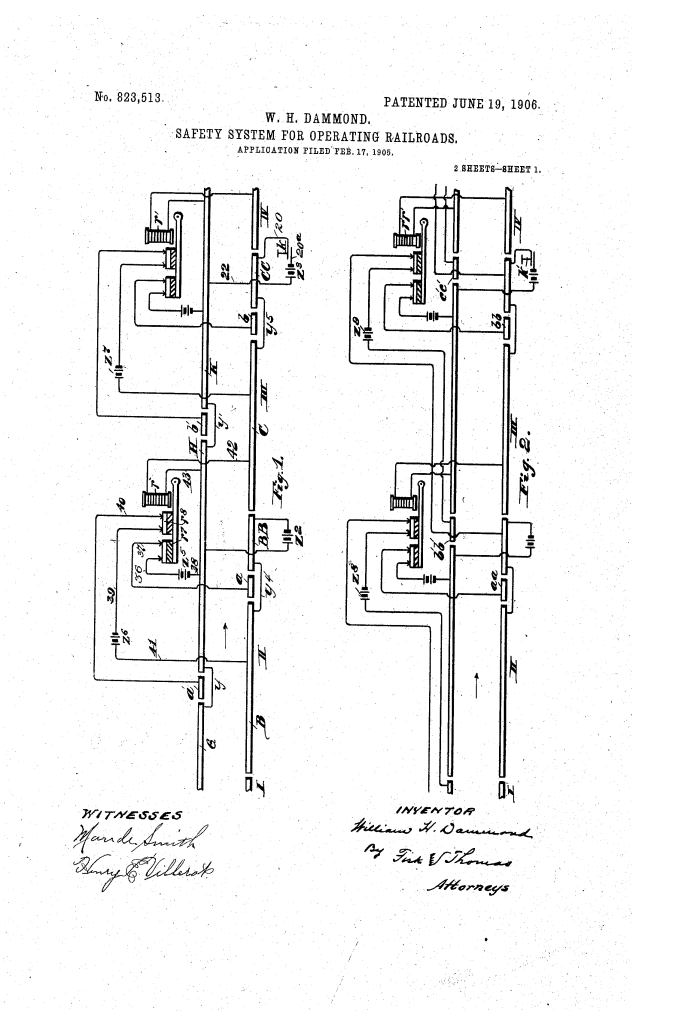
The patent by William H. Dammond of Detroit, Michigan, describes a Safety System for Operating Railroads (Patent No. 823,513, 1906). The primary object is to produce distinct signal results on a car, train, or locomotive—clear, caution, and danger—that correspond to the track conditions ahead, effectively providing an on-board block signal system.
Inventor Background: William H. Dammond
William H. Dammond was an African-American inventor and civil engineer (1873–1936) whose work was pivotal in railroad safety.
- Education and Profession: Dammond earned a degree in Civil Engineering from the University of Pittsburgh and subsequently worked as a civil engineer for the Pittsburgh & Lake Erie Railroad, specializing in bridges, tunnels, and track infrastructure. He later taught Civil Engineering at Virginia State University.
- Context of Invention: His experience on the railroad gave him firsthand knowledge of the safety issues that plagued the industry. This patent was his major contribution, designed to overcome the limitations of fixed trackside signals (obscured by fog or snow) by providing continuous, direct signaling in the locomotive cab.
Invention and Mechanism (Simplified)
The system uses track-side insulated rail sections and relays to transmit electric signals to contacts on the locomotive, which then activate a visual indicator corresponding to the safety status ahead.
- Trackside Signaling (Block System): The track is divided into sequential insulated blocks. Insulated sections of the track rails act as receiving points (home and distant). Track relays are located in each block, powered by a track battery. The state of the block (occupied or clear) controls which signal is sent to the receiving points in the block behind it.
- Onboard Mechanism (The Receiver):
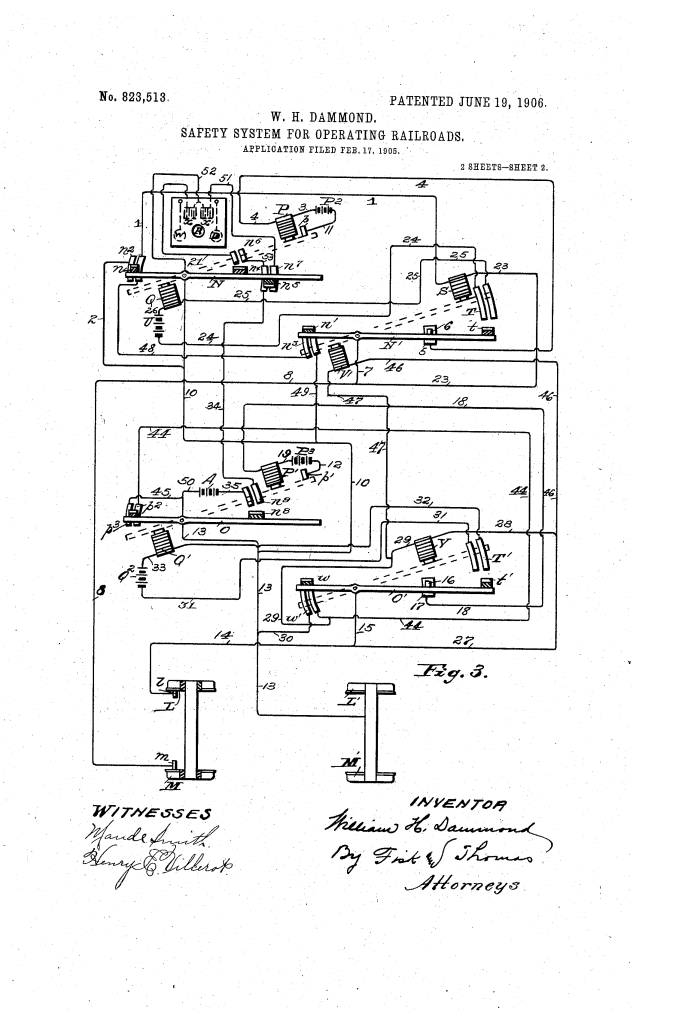
- Insulated Contacts: The locomotive carries a home contact (L) and a distant contact (M) that travel on the rails. These contacts engage the track’s insulated receiving points.
- Operating Instrument: Located in the cab, this instrument contains electromagnets that control armatures (N, O) and three visual indicators: R (Red – Danger), D (Yellow – Caution), and W (White – Clear).
- Safety Logic (Key Innovation: Sequential Signaling): The system uses the sequence of contacts (Distant then Home) to determine the signal:
- Clear Track Ahead: Both distant and home contacts receive a signal, and the electromagnets activate the White (Clear) indicator (W).
- Obstruction One Block Ahead: The system receives a signal from the distant contact but not the home contact. This triggers the mechanism to display Yellow (Caution) indicator (D).
- Obstruction Two Blocks Ahead: If the distant contact signals danger, the Red (Danger) signal (R) is displayed.
- Automatic System Integrity (Fail-Safe): Retaining electromagnets (P) are used to hold the armatures in their clear positions. The complex circuit logic ensures that upon any circuit failure, the system automatically defaults to the Red (Danger) display, a critical principle of fail-safe engineering.
Concepts Influenced by This Invention
Dammond’s safety system influenced subsequent railway and control systems by establishing principles for on-board, predictive signaling and multi-state logic.
- Cab Signaling and Control: The most significant influence is the core concept of transmitting track safety conditions directly to the engineer in the cab via electrical contacts, rather than relying solely on fixed trackside lights. This is foundational to modern Cab Signaling (CS) and Positive Train Control (PTC) systems .
- Multi-State Predictive Logic: The system’s use of Home and Distant receiving points to signal three distinct conditions (Clear, Caution, Danger) based on the status of multiple blocks ahead influenced the design of sophisticated sequential control logic in transport and automation.
- Non-Contact Data Transfer: The use of insulated rail sections and insulated wheels/contacts for signal transmission influenced the development of modern transponder and communication systems that rely on short-range wireless or non-contact methods embedded in the infrastructure.
- Fail-Safe Biasing: The reliance on retaining electromagnets (P) and complex circuit logic to ensure the system defaults to the danger (Red) state upon any circuit failure is a critical principle of fail-safe engineering.
