
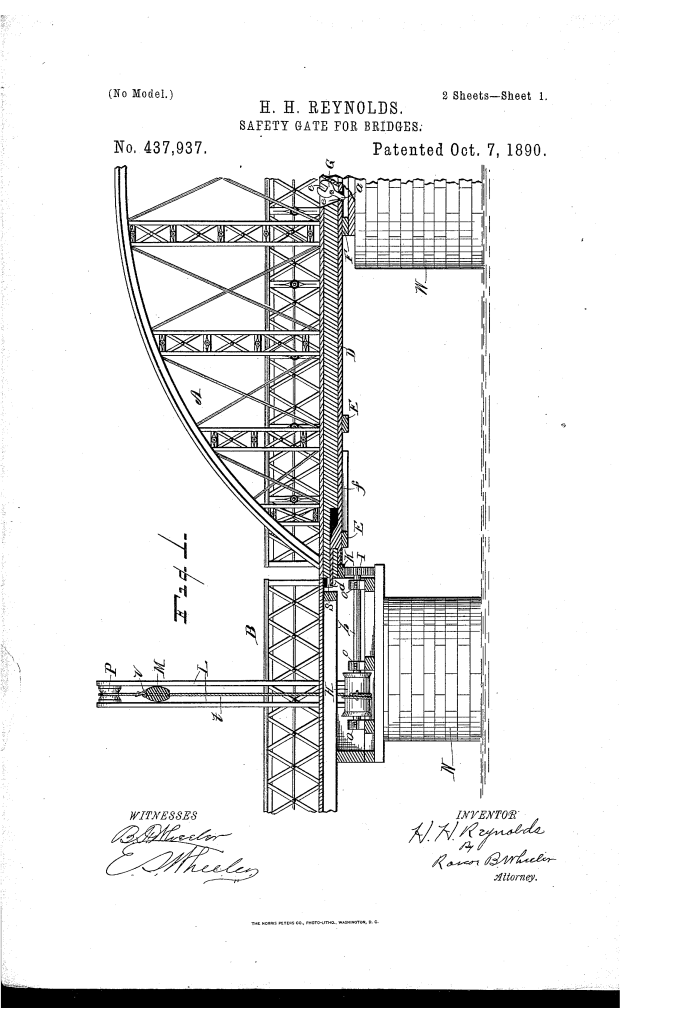

Safety-Gate for Bridges, Humphrey H. Reynolds, Patent No. 437,937
The patent by Humphrey H. Reynolds of Detroit, Michigan describes a Safety-Gate for Bridges (Patent No. 437,937). This invention is an automated mechanical barrier system designed to synchronized the opening and closing of protective gates with the movement of a drawbridge or swing-section bridge. It ensures that the roadway is physically blocked to pedestrians and vehicles before the bridge section begins to rotate, and automatically clears the path once the bridge is safely locked back into position.
The “Why”
In the late 19th century, the rapid industrialization of cities like Detroit led to increased traffic on both waterways and roads. Drawbridges were manual, dangerous, and prone to human error. If a bridge tender began swinging the section before the roadway was cleared, or if a horse-drawn carriage approached an open span in the dark, the results were often fatal. Reynolds sought to eliminate this “pain point” by creating a fail-safe interlocking mechanism that forced the gates into a protective position as a prerequisite to the bridge moving.
Inventor Section: Humphrey H. Reynolds
While historical records from 1890 often obscured the full biographies of Black inventors, Humphrey H. Reynolds stands as a testament to the Black mechanical ingenuity that fueled the post-Reconstruction Industrial Revolution. Operating in Detroit—a rising hub of machinery—Reynolds’ engineering philosophy centered on integrated automation. Rather than relying on a human to remember to lower a gate, he believed the motion of the bridge itself should do the work. His work reflects a sophisticated understanding of kinetic energy transfer and synchronized linkages, overcoming the era’s systemic barriers by providing indisputable technical solutions to public safety problems.
Key Systems Section
1. The Kinetic Actuation Rack (Modern: Rack and Pinion Drive)
- At the heart of the system is a curved segment-rack (K) mounted on a sliding frame under the bridge.
- As the bridge swings closed, this rack engages a gear-wheel (I) on the approach.
- This converts the horizontal rotational energy of the bridge into rotational torque to drive the lifting drums.
2. The Cable-Sheave Transmission (Modern: Pulley Lift System)
- The gear-wheel is connected to a drum (H).
- Steel cables (referred to as “cables $t$”) pass over sheaves (P) (pulleys) located at the top and base of the gate uprights.
- This system translates the drum’s rotation into a vertical lift for the heavy safety bar ($M$), utilizing mechanical advantage to ensure smooth movement.
3. The Oscillating Head & Lock-Bolt (Modern: Integrated Safety Interlock)
- A manual lever operates a pivoted head (G) which slides a lock-bolt (d).
- This serves a dual purpose: it unlocks the bridge so it can swing and simultaneously retracts the rack to “release” the gate, allowing gravity to lower the barrier instantly.
4. The Bi-Directional Winding System
- The drum is designed so that a revolution in either direction winds the cables.
- This ensures that regardless of which way the bridge swings to close, the gate will always rise—a vital feature for 360-degree swing bridges.
Comparison Table
| Feature | Standard Methods (1890) | Reynolds’ Innovation |
| Operation | Manual chain-pulling by a tender. | Automatic synchronization via bridge motion. |
| Safety | Relies on human vigilance. | Mechanical Interlock; bridge cannot unlock without gate engagement. |
| Power Source | Human muscle. | Kinetic energy from the moving bridge span. |
| Fail-Safe | No physical barrier if tender forgets. | Gravity-drop; gate falls automatically when the rack is retracted. |
Significance Section
- Precursor to Automated Level Crossings: The logic of using the approaching vehicle (or bridge) to trigger a barrier is the foundation of modern railroad crossing gates.
- Safety Interlocking: This is an early example of “Interlock Design” (making it physically impossible to perform Task B until Task A is complete), a cornerstone of modern industrial safety.
- Urban Infrastructure: Reynolds’ design helped make dense 19th-century cities safer for the transition from horse-and-buggy to early automotive traffic.
