
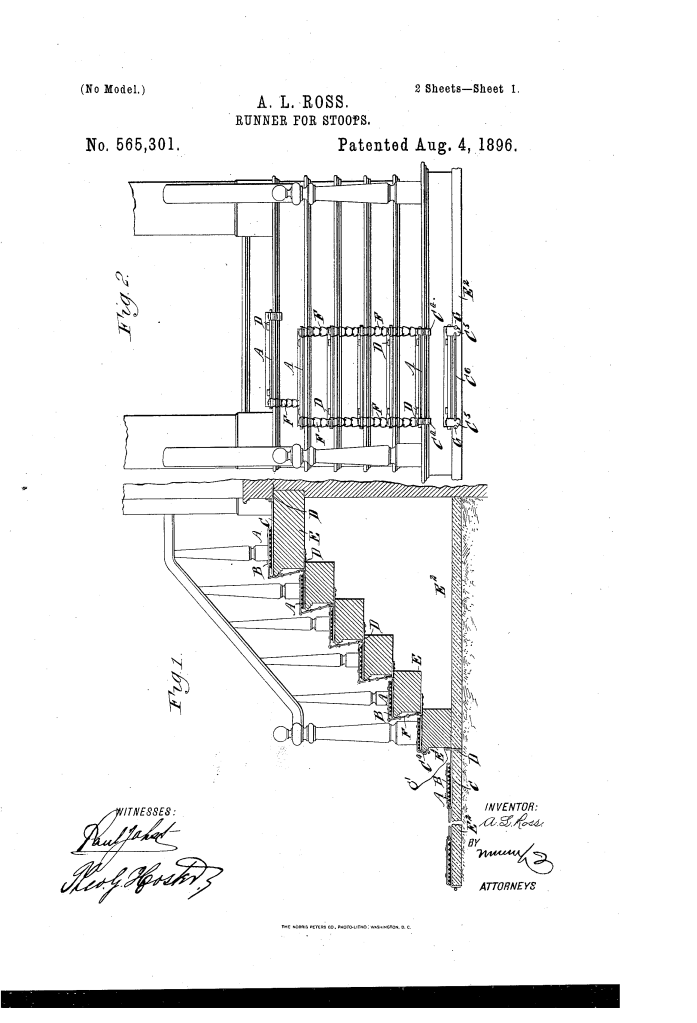

Runner for Stoops (1896)
U.S. Patent No. 565,301, granted on August 4, 1896, to Archia L. Ross, describes a flexible, interlocking mat system designed to cover brownstone stoops and sidewalks. Archia Ross, an inventor based in New York City, designed the system to give pedestrians a safe, non-slip foothold on icy stone steps during harsh northeastern winters.
This invention addressed a common cold-weather hazard in dense urban areas: the accumulation of slick ice and snow on high-traffic building entrances, which made ascending or descending stoops perilous for residents and visitors.
The Innovation: Flexible, Interlocking Modular Mats
Existing rubber mats were often loose, prone to slipping off stone steps, or cumbersome to store when winter passed. Ross developed a linked system of individual, fluted rubber mats that anchored directly to the steps without damaging the masonry, while remaining easy to fold up and store in a compact stack.
Key Features
- Non-Slip Tread: Each mat is made of heavy rubber featuring longitudinal fluting to provide firm traction under foot.
- Permanent Concealed Anchors: Thin metal hooks are driven directly into the mortar joints between steps, providing a permanent, flush anchor point that requires no structural alteration to the stoop.
- Flexible Chain Connections: Short chains link adjacent mats together, allowing the full assembly to conform to the precise geometry of the staircase and sidewalk while folding neatly for off-season storage.
How the Runner Functions
The system uses a sequential hook-and-latch mechanism to keep the entire runner taut and aligned against the staircase:
| Step | Action | Structural Purpose |
| 1. Hooking the Rear | Openings C2 in the rear strip C1 slip over the step hooks D. | Prevents the mat from slipping forward or sliding laterally off the tread. |
| 2. Securing the Nose | Curved spring-hooks C4 grip the front edge of the step tread E. | Keeps the front edge of the mat flush against the lip of the stair. |
| 3. Linking the Flight | Chains F connect top strip B of one mat to flange C3 of the mat below. | Maintains uniform spacing down the entire flight of steps. |
| 4. Sidewalk Anchor | Notched flanges C5 on the lowest mat engage fixed sidewalk pins G. | Locks the bottom of the runner in place against wind and heavy foot traffic. |
Technical Components
- Rubber Tread Mats (A): The primary non-slip surface, ribbed longitudinally to shed water and channel melt.
- Top and Bottom Binding Strips (B, C): Lateral metal reinforcement strips riveted along the top and bottom edges of each mat to ensure structural rigidity.
- Longitudinal Rear Frame (C1): A metal strip spanning the rear of each mat, incorporating an upturned flange C3 and keyhole openings C2 for mounting.
- Step Anchors (D): Thin metal hooks driven into the mortar joints beneath step treads E, providing a secure, hidden mounting point.
- Optional Spring-Loaded Lock (H, I): A dual-sliding bolt mechanism held apart by a central spring I, clamping the mat frame directly to the hooks D to prevent unauthorized removal or accidental detachment.
Historical Context and Urban Impact
Archia L. Ross’s design directly reflected the architectural realities of late 19th-century New York City, where high-stoop row houses and brownstones dominated residential streets.
- Masonry Preservation: By utilizing thin metal anchors driven into mortar joints rather than drilling into the stone itself, the system preserved the expensive facade of urban residences.
- Adaptable Positioning: The runner could be deployed across the full width of a stoop or aligned along a single handrail, leaving room for deliveries or secondary access.
- Off-Season Storage: The chain-linked construction meant the entire multi-step assembly could be folded accordion-style into a compact bundle and stored in a basement or closet during summer months.
About the Inventor: Archia L. Ross
Archia L. Ross was an inventor working in New York City during the late 19th century. His work focused on practical mechanical solutions for urban infrastructure and home convenience, tailoring designs to withstand the rigorous wear and tear of city life.
Summary of Claims
The patent explicitly claims:
- A stoop and sidewalk covering composed of a series of flexible, chain-connected rubber mats.
- Rear binding strips featuring upturned flanges and anchor openings designed to engage fixed step hooks.
- A concealed mounting hook system anchored within the mortar joints between adjacent steps.
- Terminal spring hooks and notched locking flanges to secure the top and bottom ends of the runner assembly against stone steps and sidewalk flagstones.
