
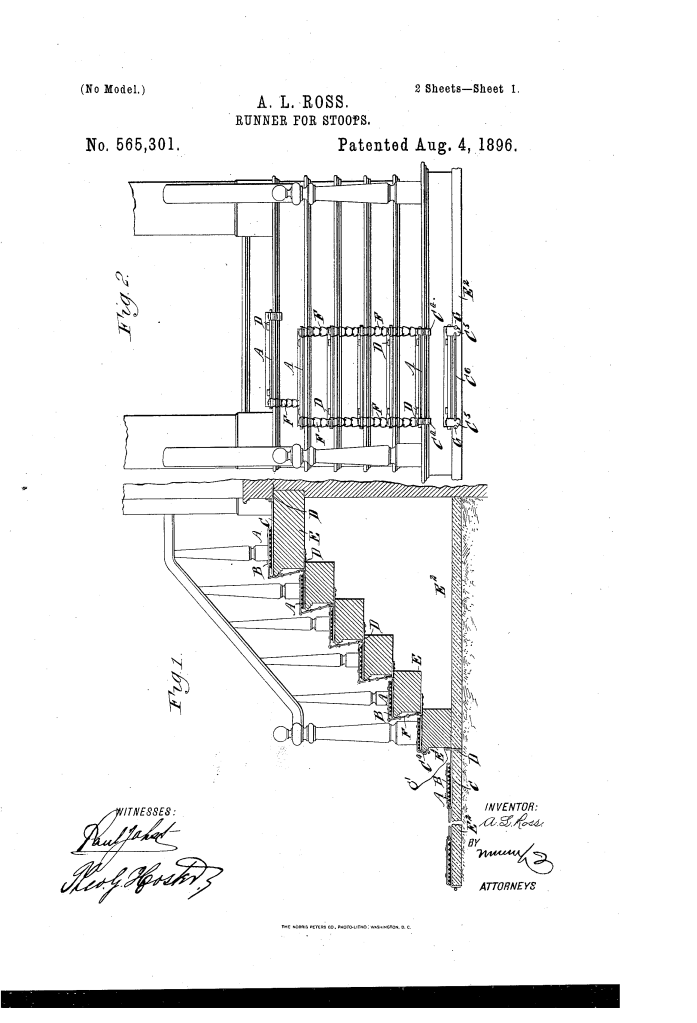

Runner for Stoops (Archia L. Ross, No. 565,301)
The patent by Archia L. Ross of New York, N.Y., describes a new and improved Runner for Stoops and Sidewalks (Patent No. 565,301, 1896). The object is to provide a removable, yet secure, covering for steps and sidewalks that prevents people from slipping and falling in icy weather. The runner is designed to be easily applied, removed, and folded for storage.
Invention and Mechanism
The runner is a modular system of flexibly connected mats that hook onto permanent fixtures on the steps and pavement.
1. Mat Construction and Traction
- Mats (A): Made of rubber or like material, and preferably fluted longitudinally to permit a secure foothold in slippery conditions.
- Binding Strips: Each mat is bound at its ends by lateral top (B) and bottom (C) strips.
2. Securing and Modular Connection (Key Innovations)
- Permanent Hooks (D): Hooks made of thin metal are permanently secured to the underside of the steps (E) or the edge of the sidewalk flagging.
- Hooking Strips ( and ): The inner ends of the mat’s bottom strips (C) are connected by a longitudinal strip (
), which has an upturned flange () formed with openings ().
- Function: To apply the mat, the strips (
) are simply hooked upon the permanent hooks (D). This prevents lateral and longitudinal movement of the mats on the steps.
- Function: To apply the mat, the strips (
- Flexible Connections (Chains F): The front ends of the top strips (B) of one mat are flexibly connected by chains (F) to the flange (
) of the next mat below.
- Function: This chain linkage ensures that when the runner is not in use, the several mats can be readily folded one on top of the other to be stored in a small space.
- Sidewalk Anchoring: The outermost mat uses notched, downwardly-bent flanges (
) to engage permanent pins (G) in the sidewalk, and can be swung to securely hold the runner in place.
3. Optional Locking
- Locking Device (Fig. 5): An optional device consisting of sliding bolts (H) and a spring (I). When applied, the bolts slide in front of the hooks (D) to clamp them against the flange (
), providing extra security.
Historical Significance and the Inventor
Archia L. Ross’s 1896 patent is a classic example of an invention addressing the hazards of urban infrastructure during seasonal changes.
- Urban Safety: Icy steps and sidewalks were a pervasive danger in cold-weather cities like New York. The invention provided a reliable, high-traction surface for “stoops” (doorsteps) and walkways, reducing the liability and risk of injury associated with city life.
- Temporary Utility: The key significance is the design for temporary, modular use. The runner was easily applied when icy conditions began and easily removed and stored when the weather improved, making it a practical solution for homeowners and building managers.
- The Inventor (Archia L. Ross): Ross contributed a practical, consumer-oriented safety product to the urban market.
Concepts Influenced by This Invention
Ross’s runner influenced the design of subsequent modular covers and temporary security systems by pioneering a quick, semi-permanent attachment method.
- Modular, Quick-Connect Surfaces: The concept of using flexibly connected mats (A) that fold for storage is the basis for modern interlocking garage floor tiles, temporary safety matting, and folding gym mats , which combine portability with large-area coverage.
- Quick-Hook/Semi-Permanent Fastening: The system of using openings () to hook onto permanent anchors (D) is a robust, tool-less connection method. This principle is used in modern hardware like safety fence sections, quick-mount snow guards, and commercial display racks where a rigid connection is needed for utility but must be easily removable.
- Traction Surface Integration: The fluted rubber matting is an early form of integrated safety surfacing. This influenced the design of modern anti-slip stair treads and abrasive surface strips that are permanently or semi-permanently mounted to high-risk areas.
