
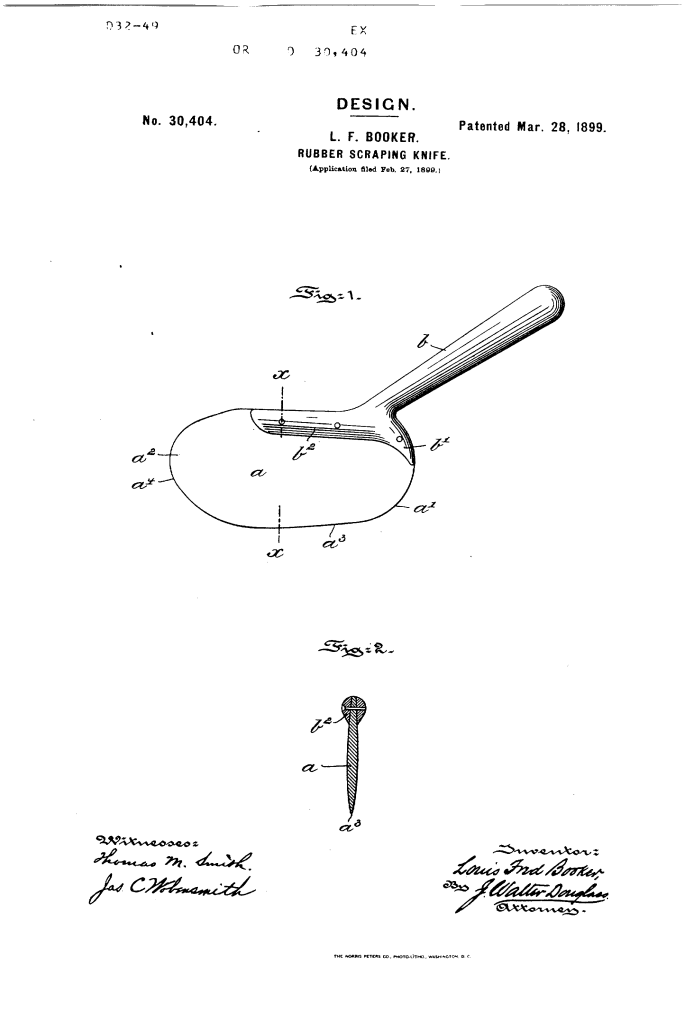
Design for a Rubber Scraping-Knife (Louis Fred Hooker, No. 30,404) 🔪
This document analyzes the Design Patent (No. 30,404) granted on March 28, 1899, to Louis Fred Hooker of Philadelphia, Pennsylvania, for the ornamental configuration of a Rubber Scraping-Knife.
Inventor Background: Louis Fred Hooker
Louis Fred Hooker was an inventor residing in Philadelphia, whose contribution focused on the aesthetic and ergonomic design of a specialized cleaning tool. His work shows a specific interest in creating a functional, user-friendly shape for a delicate task.
Design Description
The leading feature of the design is the unique, curved, and beveled configuration of the rubber blade and handle for a scraping knife intended for fine china, glassware, and the like.
Key Aesthetic and Functional Features
- Rubber Blade: The blade is designed for non-abrasive contact:
- Overall Form: The blade is oval in shape.
- Curvature: The rear end has a slight curve, while the forward end has a greater degree of curvature.
- Beveling: Both the lower edge and the forward end are beveled, creating functional edges for efficient scraping and contouring.
- Handle: The handle transitions between grip and function:
- Grip: The rear portion is rounded for comfortable holding.
- Clamping: The forward portion is clamp-shaped and beveled toward the blade surfaces, serving as the integrated point where the handle applies force.
Concepts Influenced by This Invention
Hooker’s design influenced subsequent tool design by emphasizing integrated rubber blades with contoured, ergonomic shapes for non-abrasive cleaning.
- Integrated Rubber Blade Geometry: The reliance on a non-metal, beveled, and specifically contoured blade (oval with differential curvature) influenced the design of modern cleaning tools used for delicate surfaces. This shape provides the necessary flexibility and precise edge contact for non-scratch cleaning.
- Ergonomics of Contoured Grip: The transition from the rounded grip to the clamp-shaped working end influenced the design of spatulas, squeegees, and specialized kitchen/laboratory scrapers where the handle’s shape must support both comfortable gripping and precise force application.
- Specialized Scrapers for Delicate Surfaces: This design is an early precursor to modern tools like silicone spatulas, specialized kitchen scrapers, and automotive detailing squeegees where the working edge material (rubber/silicone) and its shape are critical to the task (scraping without scratching).
