
Rotary Engine (Andrew Beard, No. 478,271)
The patent by Andrew Beard of Woodlawn, Alabama, describes an improved Rotary Engine (Patent No. 478,271, 1892). This invention is a steam-powered motor where the driving force is generated by revolving piston heads rather than the back-and-forth motion of a traditional piston rod. Beard’s primary objective was to create a “balanced” engine that was cheap to manufacture and efficient to operate. By admitting steam to the inside of the piston heads rather than the outside, he ensured the pressure was equalized on all sides, preventing the shaft from being forced against its bearings and reducing mechanical wear.
Inventor Background: Andrew Beard
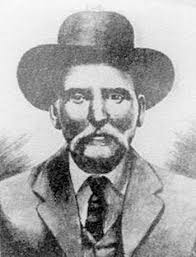
Andrew Beard (1849–1921) was a prolific African American inventor born into slavery in Alabama. He was a self-taught master of mechanics who famously invented the “Jenny Coupler” (an automatic railroad car coupler) which saved countless lives in the rail industry. His 1892 Rotary Engine patent showcases his deep understanding of thermodynamics and kinetic energy. At a time when steam engines were the primary drivers of American industry, Beard sought to simplify their design. His work is a hallmark of industrial-era engineering, focused on making heavy machinery safer and more cost-effective.
Key Mechanical & Steam Systems
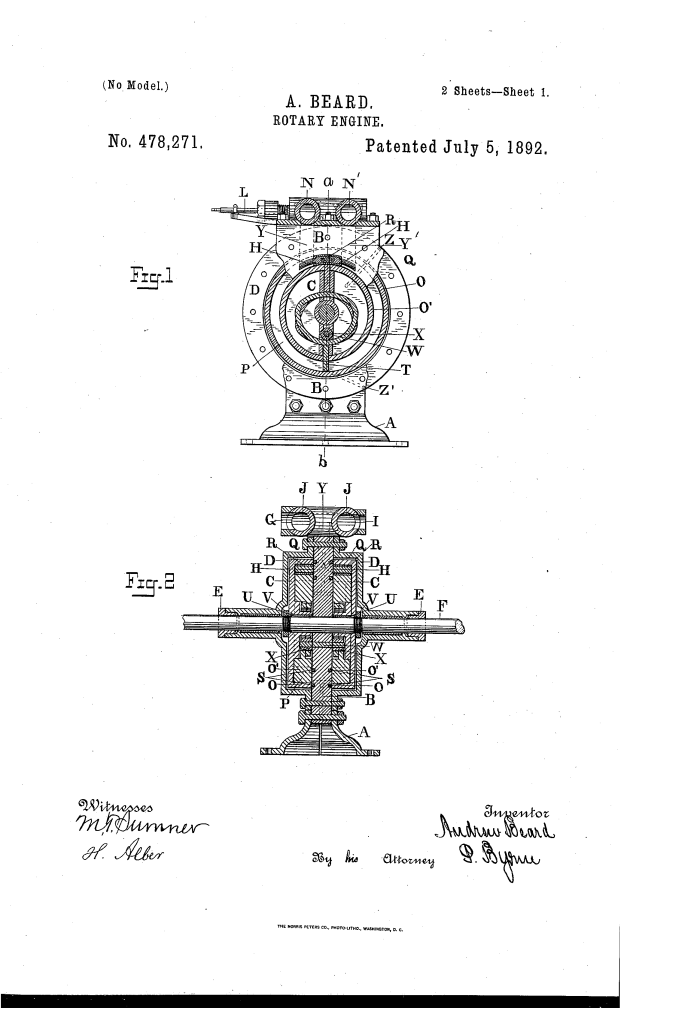
The engine consists of two revolving heads divided by a central partition, all housed within a rigid casing.
1. The Balanced Piston Heads (C, O, P)
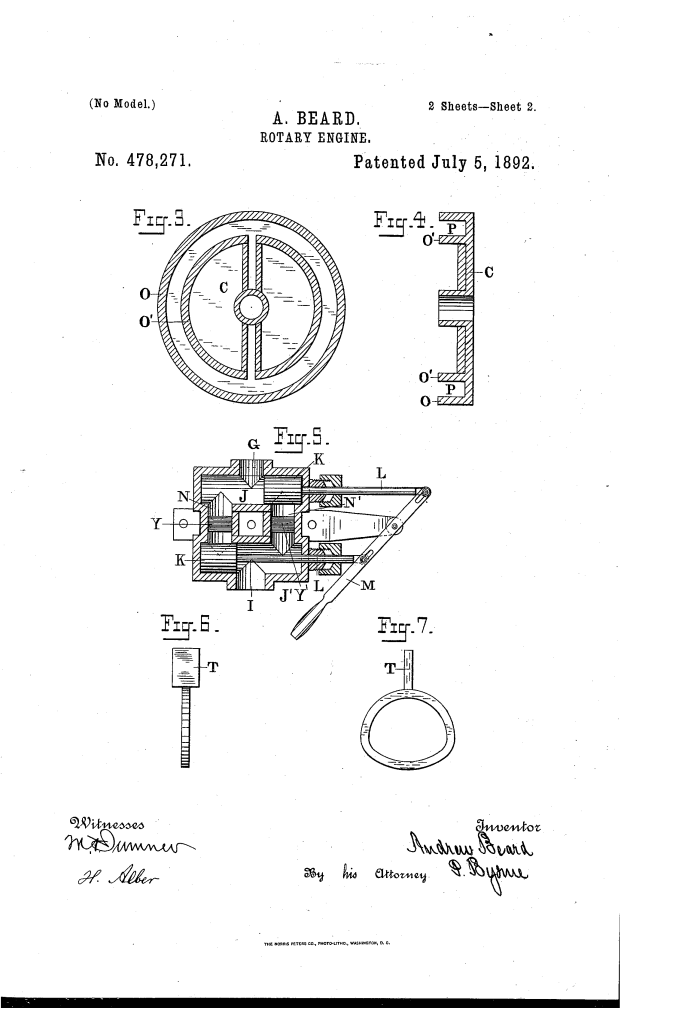
- Internal Steam Admission: Each head (C) features two sets of annular (ring-shaped) walls (O, O’).
- The Steam Space (P): Steam enters through ports (H) into the space P between these internal walls.
- Function: Because the steam acts from the center outward, it “presses equally on all sides.” This balances the running parts, ensuring the driving shaft (F) rotates smoothly without lopsided friction.
2. Reciprocating Pistons and Cam Action (T, W, X)
- The Pistons (T): Each head carries two pistons that slide in and out of grooves.
- The Cam Mechanism: The inner ends of the pistons have cam-loops that work against rollers (X) mounted on studs (W) fixed to the central partition.
- Action: As the head revolves, the cams force the pistons outward against the casing wall during the power stroke (the lower half of the revolution). On the upper half, the cams withdraw the pistons inward.
- Purpose: Withdrawing the pistons allows them to pass the steam-abutments (Q) and lets the exhaust steam escape, maintaining continuous rotation.
3. The Reversing Steam-Chest (J, K, M)
- Hand-Lever (M): A convenient lever operates plungers (K) within the steam cylinders (J, J’).
- Directional Control: By moving the lever, the operator can switch the steam flow between the two vertical passages (Y, Y’).
- Function: This makes the engine “easily reversed.” What was previously the inlet becomes the exhaust, instantly changing the direction of the shaft’s rotation.
Improvements Over Standard Reciprocating Engines
| Feature | Standard Piston Engines | Beard’s Rotary Engine |
| Motion | Reciprocating (back-and-forth). | Continuous Rotary (circular). |
| Vibration | High; caused by the piston changing direction. | Low; balanced internal steam pressure. |
| Complexity | Required heavy flywheels and crank-arms. | Simplified direct-drive shaft. |
| Reversibility | Often complex and dangerous to reverse. | Simple hand-lever (M) control for instant reversal. |
Significance to Power Engineering
Andrew Beard’s rotary engine influenced the development of compact power plants and fluid-drive mechanics.
- Centrifugal Balance: Beard’s focus on a “balanced” head is a foundational principle in modern turbine engineering, where symmetrical force distribution is required to prevent catastrophic failure at high RPMs.
- Internal Pressure Management: By moving the working fluid to the center of the mechanism, he anticipated the design of modern hydraulic motors and certain types of rotary pumps.
- Operational Versatility: The engine was designed to be both “efficient and cheap,” making it accessible for smaller industrial shops that couldn’t afford a massive stationary steam plant.
- Safety Through Design: The simple reversing appliance reduced the risk of operator error during critical maneuvers, a theme that carried over into his later work with railroad safety.
