
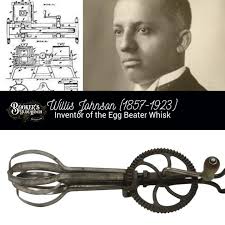
Inventor: Willis Johnson Patent Number: 292,821 (US-0292821-A) Date of Patent: February 5, 1884 Invention: Rotary Egg Beater (more accurately described as an early mechanical mixing machine)
Description of the Invention (from Patent and Historical Accounts): Willis Johnson’s 1884 patent for an “Improved Egg-Beater” was a significant advancement in kitchen appliances, designed to mix a wider range of ingredients beyond just eggs, including batter and other confectionary ingredients. It was essentially an early mechanical mixing machine aimed at providing a more intimate and expeditious mixing process than manual methods.
Key features and components of his design:
- Double-Acting Machine with Two Chambers: A defining feature was its ability to operate with two separate chambers or cylinders. This allowed for two different ingredients to be mixed simultaneously, or for one chamber to be cleaned while the other continued mixing, significantly boosting kitchen productivity.
- Main Frame and Driving Mechanism: The machine consisted of a main frame within which a driving-wheel and a pinion or pulley were journaled. Power could be transmitted to the driving-wheel via a crank or other means.
- Detachable Beater Shafts and Stirrers: Horizontal shafts from the pinion or pulley terminated in clutches or sockets. These engaged with non-circular arbors at the ends of beater-shafts. These beater-shafts were armed with suitable blades, beaters, dashers, paddles, or stirrers (G).
- Cylinders in Detachable Racks: The beater-shafts were journaled within cylinders that occupied detachable trays or racks (N N L). These racks could be readily applied to opposite sides of the main frame and secured with hooks and staples or other convenient devices.
- High-Speed Rotation: The design ensured a very rapid revolution of the beater-shafts once power was applied, leading to thorough beating or mixing of the ingredients.
- Hopper for Ingredients: A hopper (V) was provided for charging the cylinders with ingredients.
The invention provided a versatile and efficient solution for mixing a variety of ingredients, greatly reducing the manual labor involved in baking and cooking.
Personal Significance (Willis Johnson): Willis Johnson (born around 1858) was an African American inventor from Cincinnati, Ohio. While detailed biographical information about his life is somewhat limited, available accounts suggest he may have been born into slavery and worked as a house slave, where he would have been responsible for cooking and other kitchen duties. This background likely provided him with firsthand experience of the arduousness of manual food preparation, inspiring his invention.
After the Civil War, he became a master chef. His “Rotary Egg Beater” stands as a testament to his ingenuity and practical problem-solving skills. As an African American inventor in the late 19th century, Johnson’s ability to secure a patent for such a significant kitchen appliance speaks to his talent and perseverance in a period marked by profound racial discrimination and limited opportunities for Black Americans. His invention had a direct, positive impact on household and professional kitchens.
Historical Significance: Willis Johnson’s “Rotary Egg Beater” holds significant historical importance within the context of kitchen technology, domestic efficiency, and African American innovation:
- Revolutionizing Kitchen Work: Before mechanical egg beaters, tasks like whipping egg whites to a stiff meringue could take up to 90 minutes of strenuous hand-whipping. Johnson’s invention, along with other rotary beaters of the era, dramatically reduced this time and effort (e.g., to as little as 5 minutes), transforming baking and cooking from a laborious chore into a more manageable task.
- Early Mechanical Mixer: Johnson’s device was more than just an egg beater; it was one of the earliest forms of the mechanical mixer. Its design, with multiple chambers and a robust gear mechanism, laid conceptual groundwork for more advanced hand mixers and eventually electric stand mixers that would become ubiquitous in 20th-century kitchens.
- Increased Productivity: For professional bakers and confectioners, the machine’s ability to mix large quantities of ingredients rapidly and efficiently significantly boosted productivity, contributing to the growth of food industries.
- Labor-Saving Appliance: The invention represented a major labor-saving device for cooks and homemakers, particularly for women who traditionally bore the brunt of household chores. This contributed to improving daily life in homes across America.
- African American Contribution to Domestic Technology: Johnson’s patent is an important example of an African American inventor contributing significantly to household technologies and improving daily life. His work highlights the crucial, often overlooked, role of Black innovators in shaping American domesticity and industry.
Johnson’s “Rotary Egg Beater” was a groundbreaking invention that fundamentally changed how food was prepared, making kitchen tasks easier and more efficient for millions. Sources
