
Rotary Dining Table & Adjustable Chairs | Daniel Johnson | Patent No. 396,089
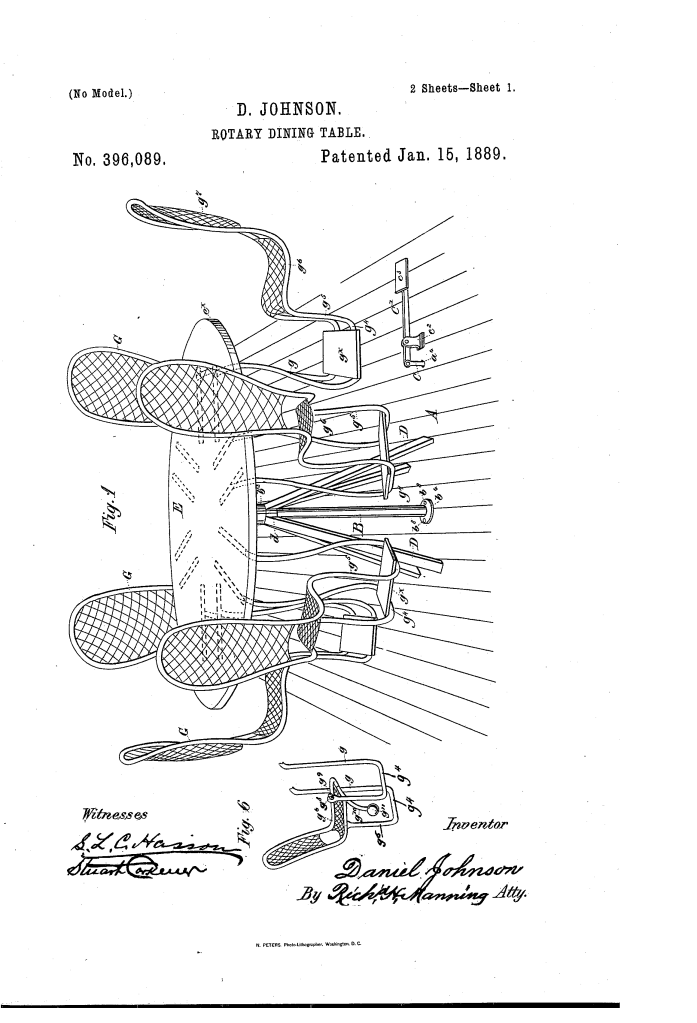
The patent by Daniel Johnson of Kansas City, Missouri, describes a Rotary Dining Table (Patent No. 396,089), issued on January 15, 1889. This invention is a mechanically driven, rotating furniture system integrated with suspended, adjustable seating designed specifically for the turbulent environments of sea-going vessels and high-traffic dining saloons.
The “Why”
In the late 19th century, dining on steamships was a logistical nightmare. As vessels pitched and rolled, waitstaff had to navigate unstable floors to serve passengers, risking injury and spills. Conversely, passengers in fixed chairs struggled to reach food or be served efficiently. Johnson sought to solve the “pain point” of unstable service and dining mobility by creating a system where the table and chairs rotated in unison toward a single, stationary “base of supply,” allowing one server to remain in a fixed, safe position while the diners moved toward the food.
The Inventor: Daniel Johnson
While historical records from the late 1880s are often sparse regarding the personal lives of Black inventors, Daniel Johnson’s work reflects the engineering philosophy of “Integrated Efficiency.” Operating in Kansas City during the post-Reconstruction era—a time of intense racial stratification—Johnson’s patent demonstrates a sophisticated understanding of mechanical linkages and industrial power transmission. His design wasn’t just a piece of furniture; it was a structural modification to the building or vessel itself, showcasing an ambitious vision that bridged the gap between carpentry and civil engineering.
Key Systems Section
Central Power Transmission & Governance
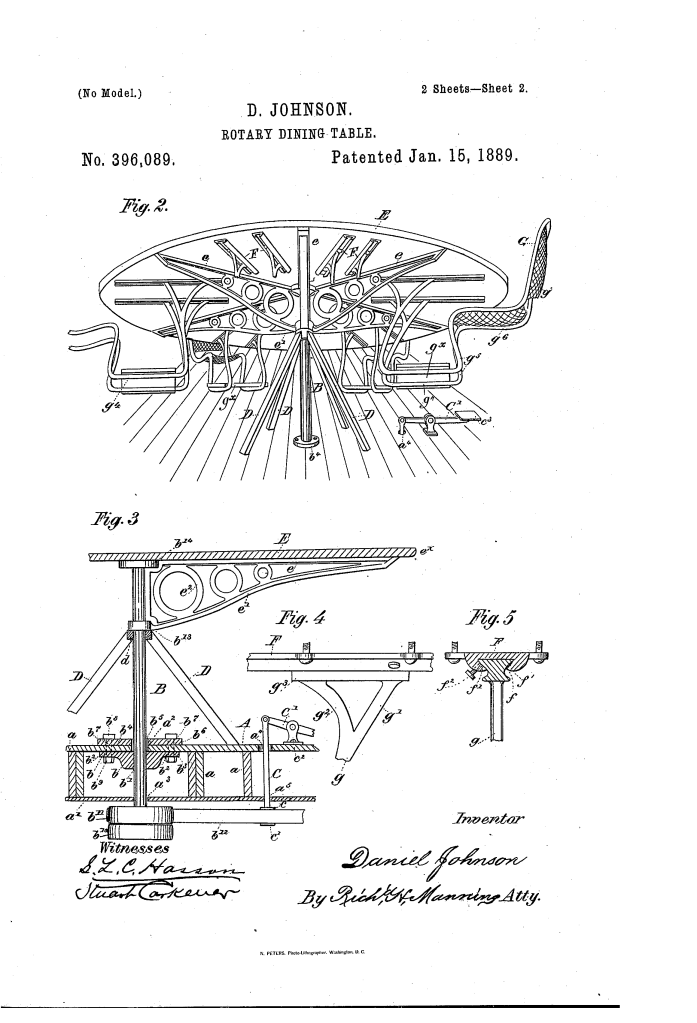
- Vertical Drive Shaft: A robust cylindrical shaft ($B$) extends through the floor ($A$), supported by twin journal bearings ($b, b’$) bolted through the floor joists.
- Belt-Drive Logic: Power is delivered via a steam engine or external motor to a fixed pulley ($b^1$). A “loose pulley” ($b^2$) serves as an idle state, allowing the table to remain stationary even while the engine is running.
- The Foot-Lever Governor: A manual foot-lever ($C$) acts as a clutch, allowing an operator to shift the drive belt from the idle pulley to the drive pulley, precisely controlling the table’s rotation.
Suspension & Radial Support
- Trussed Bracing: To prevent the table from “racking” or wobbling under heavy loads, Johnson utilized upwardly inclined braces ($D$) and radial supporting bars ($e$).
- Load Distribution: The table is secured by a circular flange ($D^1$) that rotates against a stationary collar ($d$), distributing the $Z$-axis (vertical) force across a wider surface area to reduce friction on the main shaft.
Self-Leveling Seating (The “Vibrating” Chair)
- Dovetail Slotted Guides: Chairs are suspended from the underside of the table via wedge-shaped bars ($g^2$) that slide into dovetail grooves ($f$). This allows diners to adjust their proximity to the table.
- Gravity Pendulum System: For sea-going use, the chairs feature a pivot ($g^3$) and a heavy counterweight ($g^7$).
Shutterstock Explore
(Visualization: A weighted pendulum mechanism maintaining verticality despite the tilt of the supporting plane.)
Comparison: 19th Century Dining vs. Johnson’s Innovation
| Feature | Standard Methods (Circa 1889) | Johnson’s Rotary System |
| Service Logic | Server walks the perimeter of the table. | Table rotates to the stationary server. |
| Seating Type | Heavy, bolted-down or loose chairs. | Suspended, adjustable “floating” chairs. |
| Stability | Diners tilt with the ship’s pitch/roll. | Weighted chairs maintain a vertical plumb line. |
| Power Source | Manual/Gravity. | Mechanical (Steam/Belt-driven). |
Significance
- Precursor to the “Lazy Susan”: While smaller rotating trays existed, Johnson scaled the concept to an entire architectural system.
- Early Ergonomics: The use of adjustable “dovetail” sliders for seating is a direct ancestor to modern adjustable office chair tracks.
- Marine Engineering: The weighted, self-leveling seat anticipated modern gimbaled systems used in high-end maritime furniture and stovetops.
- Industrial Automation: Moving the consumer to the product, rather than the worker to the consumer, is a foundational principle of the modern assembly line and “sushi train” restaurants.
