
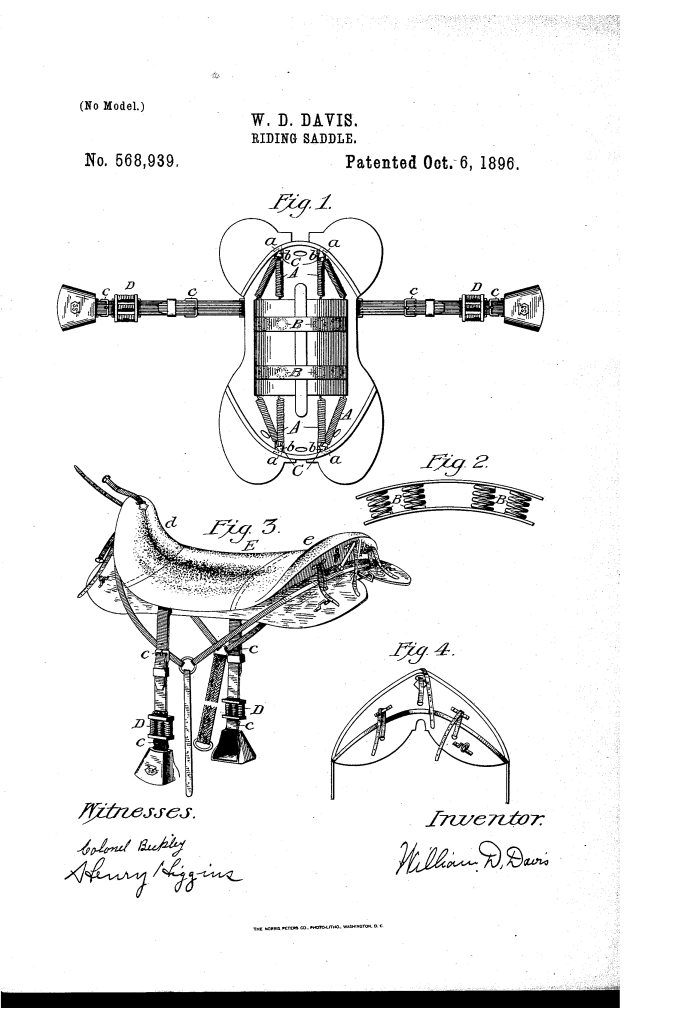
Military Spring-Seat Riding-Saddle (1896)
U.S. Patent No. 568,939, granted on October 6, 1896, to William D. Davis, describes an innovative mechanical upgrade to traditional equestrian gear: a specialized spring-absorbing seat and stirrup system designed for military cavalry, cowboys, and long-distance riders. Operating out of Fort Assinniboine, Montana, Davis sought to improve the endurance and comfort of riders facing long hours on rough terrain.
This specific invention solved a persistent problem for horse-mounted soldiers and laborers: the punishing, downright jolting impact of riding a hard-trotting horse over long distances, which frequently caused severe physical pain, soreness, and long-term medical disorders for cavalrymen.
The Innovation: The Dual-Action Suspension System
The brilliance of the Davis riding saddle is its combination of two distinct types of springs working in tandem to absorb shock from multiple directions. Rather than relying solely on a rigid wooden tree or simple leather padding, Davis introduced a mechanical suspension system built directly into the framework of the saddle.
- Horizontal End Springs (A): Flat, close-spiral steel springs that pass through the pommel and the rear of the saddle. These work horizontally to give elasticity and adjustment across the length of the seat space.
- Vertical Bottom Springs (B): Open, spiral coil springs measuring about 1.5 to 1.625 inches in height and 1.375 inches in diameter. Positioned three inches apart, these operate vertically to cushion the direct downward impact of the rider’s weight.
- The Overlapping Leather Solution: To ensure the mechanical components could move freely without pinching the rider or binding up, Davis designed an independent solid leather seat covering (E) that is overlapped by outer leather layers (d and e), allowing the springs full liberty to compress and expand.
Key Technical Components
The saddle architecture transforms a standard saddle tree into an active shock absorber:
| Component | Function |
| Horizontal End Springs (A) | Anchored into deep grooves ($a\ a$) in the pommel and cantle to provide longitudinal elasticity and tension. |
| Vertical Bottom Springs (B) | Mounted between top and bottom metal plates screwed to the wood base to absorb vertical downward shocks. |
| Pommels & Back Notches (C) | Specialized slots that secure iron fasteners (b\b), providing structural support to the frame and ensuring a uniform leather fit. |
| Stirrup-Strap Springs (D) | Flat springs housed in receptacles four inches above the stirrup, paired with adjustable buckles (c\ c) to reduce leg strain. |
| Independent Leather Seat (E) | A multi-layered leather covering that moves dynamically with the underlying spring grid. |
How the Apparatus Functions
The design functions continuously while the horse is in motion, splitting the kinetic energy of a trot between the seat and the feet:
| Step | Action | Mechanical Purpose |
| 1. Downward Compression | Rider settles weight into the saddle during a heavy stride or trot. | The vertical spiral springs (B) compress to eliminate hard bottoming-out. |
| 2. Horizontal Counter-Flex | The vertical compression pulls on the saddle ends. | The horizontal end springs (A) flex inward, providing structural give and lateral stability. |
| 3. Stirrup Absorption | Rider stands or braces weight into the stirrups. | The flat stirrup springs (D) extend, protecting the rider’s knees and ankles from jarring forces. |
| 4. Independent Return | The horse changes stride or removes impact pressure. | The combined steel spring matrix instantly resets the leather seat to its original posture. |
Historical and Scientific Impact
William D. Davis’s invention arrived during the twilight of the American frontier, a time when the U.S. Army Cavalry was still heavily reliant on horses for mobility.
- Cavalry Fatigue Reduction: By focusing explicitly on the “cavalry-men and all others who travel long distances,” Davis addressed military efficiency, as reducing rider fatigue directly correlated to greater operational range and combat readiness.
- Ergonomic Progression: The design advanced the frontier-era understanding of rider ergonomics, moving away from static, rigid saddles toward dynamic machinery capable of protecting the human spine from chronic trauma.
About the Inventor: William D. Davis
William D. Davis was an inventor based at Fort Assinniboine, Montana—a sprawling military post established in the late 19th century to maintain peace on the northern frontier. During the mid-1890s, Fort Assinniboine notably garrisoned units of the 10th Cavalry Regiment, the legendary “Buffalo Soldiers.” Davis’s focus on solving the rigorous, real-world physical ailments of long-distance military riders reflects the direct, practical innovations born out of the frontier garrison experience.
Summary of Claims
The patent explicitly claims:
- In a spring-seat saddle, the structural combination of a dynamic spring seat utilizing horizontal end springs (A A) passing through the pommel to both sides of the saddle.
- The integration of rear springs passing directly through the rear end of the seat frame to provide targeted shock absorption at the cantle.
- A specialized multi-layered leather covering system secured over the spring matrix at designated fastening points (C C) to facilitate unobstructed mechanical movement.
