
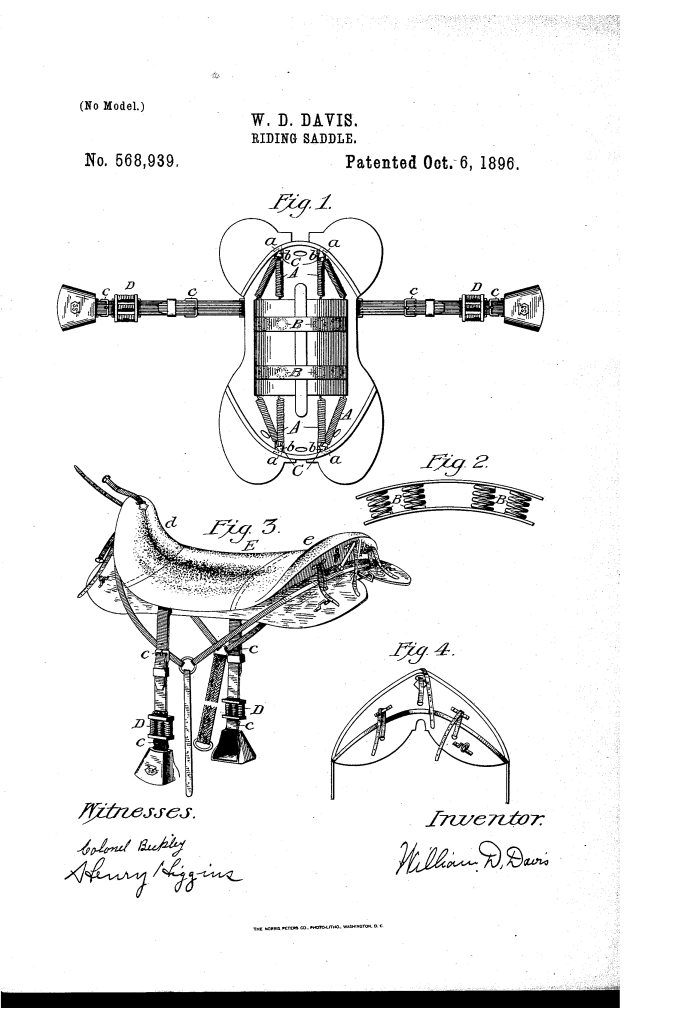
The patent by William D. Davis of Fort Assinniboine, Montana, describes a new and useful Military Spring-Seat Riding-Saddle (Patent No. 568,939, 1896), including improved springs for the seat and stirrups. The invention is designed for cavalry, light artillery, cowboy, and general riding saddles.
Invention and Mechanism
The core of the invention is a spring suspension system for the saddle seat, which combines horizontal and vertical springs to absorb the shock of riding.
1. Spring-Seat Mechanism
- Combination of Springs: The design combines end springs (A, A), which operate horizontally, with bottom springs (B, B), which operate vertically.
- End Springs (A, A): These are flat and close spiral steel springs, positioned at the front (pommel) and back of the saddle. They pass through grooves (
) in the pommel and rear of the saddle.
- Function: They work primarily horizontally to provide elasticity and help the seat move fore and aft. They are reinforced by long fasteners (
) that extend from top to bottom of the pommel and back to provide stability.
- Function: They work primarily horizontally to provide elasticity and help the seat move fore and aft. They are reinforced by long fasteners (
- Bottom Springs (B, B): These are flat, round, open, spiral steel springs, positioned under the seat. They are slightly taller in the rear (
inches) than in the front (
inches) to provide the proper seat depth.
- Function: They operate vertically to absorb the up-and-down jolting motion of the horse.
- Seat Covering (E): The leather seat covering (E) is an independent solid piece, designed to overlap the springs and move freely up and down with their assistance.
2. Spring-Stirrups
- Stirrup-Strap Springs (D, D): Flat springs applied with two straps and buckles (
) that are located approximately four inches above the stirrup.
- Function: This provides shock absorption in the stirrup straps, further reducing the impact transmitted to the rider’s legs and back.
3. Purpose and Benefits
The inventor states the primary goals are to:
- Render riding easy and comfortable, especially when the horse is in a trot.
- Avoid downright jolting, which causes pain, soreness, and “many other disorders” resulting from hard-trotting horses.
- Provide a durable saddle suitable for cavalrymen and others who travel long distances.
Historical Significance and the Author
William D. Davis’s 1896 patent is significant within the context of both military logistics and Western culture.
- Military Needs: The late 19th century still relied heavily on cavalry. Long-distance riding was a necessity, but the standard military saddle often led to physical issues for the soldier. This invention was a direct effort to improve the comfort and durability of equipment for the U.S. Cavalry (Davis was located at Fort Assinniboine, Montana).
- Improving the Western Saddle: The patent explicitly mentions its use for “cowboy” and “gentlemen riding-saddles.” In the harsh terrain of Montana and the American West, a spring-seated saddle that mitigated jolting offered a massive improvement in comfort and endurance for riders who spent days at a time in the saddle.
- The Inventor (William D. Davis): Davis, located at a U.S. military post in Montana, was an inventor directly addressing the practical needs of frontier life and military service, likely drawing on real-world experience with the grueling effects of hard riding.
Core Concepts Utilized Today
The saddle’s mechanism for shock absorption is a precursor to modern suspension and seating systems.
- Multi-Axis Suspension: The combination of springs working horizontally (A) and vertically (B) to isolate the rider from both the lateral and vertical forces of a rough trot is the conceptual basis for modern dual-rate and multi-axis suspension systems in vehicle seats (especially those for off-road or heavy equipment) and high-performance mountain bikes.
- Ergonomic Seating: The goal of reducing vibration, preventing jolting, and mitigating long-term physical disorders is the driving force behind modern ergonomic seating designs, including specialized chairs, motorcycle seats, and vehicle cabins that use springs, hydraulics, or foam technologies to distribute pressure and damp vibrations.
- Integrated Suspension in Footrests: The concept of spring-stirrups (D) to damp vibration is a direct precursor to suspension footpegs and floorboards used on modern motorcycles, ATVs, and off-road vehicles to reduce rider fatigue and improve control by isolating the feet from engine and terrain vibrations.
