
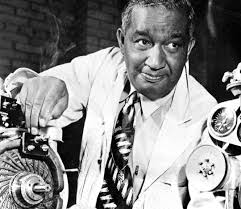
Removable Cooling Unit for Compartments, Frederick M. Jones, Patent No. 2,336,735
The patent by Frederick McKinley Jones, filed in 1941 and granted in 1943, describes the first successful Removable Cooling Unit (U.S. Patent No. 2,336,735) for long-haul transport vehicles. This invention, which became the foundation for the company Thermo King, revolutionized the global food supply chain. Jones engineered a self-contained, gasoline-powered refrigeration system that could be mounted into the front wall of a truck or trailer, allowing for the transport of perishable goods—meats, fruits, and vegetables—over thousands of miles regardless of outside temperatures.
The “Why”
Before Jones’s invention, shipping perishables was a gamble. “Refrigerator cars” on railroads relied on massive, heavy blocks of ice that melted quickly and required constant replenishment. For trucks, there was no viable mechanical cooling system that was light enough to carry or small enough to leave room for cargo. The pain point was that food often spoiled before reaching its destination, and long-distance trucking was restricted by the weather. Jones sought to create a “plug-and-play” unit that was light, powerful, and independent of the truck’s engine.
Inventor Section: Engineering Philosophy
Frederick M. Jones was a master of Modular Thermal Isolation. His philosophy for this unit was to treat the refrigerator not as a modified room, but as a dual-chamber machine. He understood that the biggest enemy of cooling was the heat generated by the cooling machine itself. His “split-system” design ensures that the engine and compressor (the heat producers) stay completely outside the truck, while only the cooling coils reside inside. This absolute separation of thermal zones is what allowed such a small unit to achieve industrial-grade cooling.
Key Systems Section
1. The Dual-Chamber Unitary Casing
The entire system is housed in a single “L-shaped” frame (18) divided into two thermally isolated sections.
- Front Chamber (32): Located outside the truck. It houses the gas engine (75), the compressor (77), and the condenser (90). Numerous grills (33, 34) allow outside air to pull heat away from these components.
- Rear Chamber (46): Projected through an opening in the truck’s front wall (54). It contains the evaporator coils (123) and the blower (92).
- The Barrier: A heavily insulated wall (41) separates the two, ensuring no engine heat leaks back into the food compartment.
2. The Vortex Air Distribution System
Jones didn’t just cool the air; he engineered its movement to prevent “hot spots” in the cargo.
- The Air Trunk (110): A long duct runs along the ceiling of the truck.
- The Vortex Effect: Cooled air is forced out of side vents (115) toward the walls. It flows down the walls, across the floor, and is sucked back into the center of the unit.
- Function: This creates a “cold envelope” that surrounds the cargo, effectively “insulating” the food with a moving shield of refrigerated air.
3. The Two-Speed Thermostatic Control
To save fuel and reduce wear, Jones designed a sophisticated mechanical “brain” for the gas engine.
- The Mechanism: An expansion thermostat (158) is placed in the path of the returning air (the warmest air).
- The Logic: If the air is cold enough, an aneroid bellows (63) moves a lever to set the engine to “idling speed.” As the air warms, the bellows contracts, and a magnet (173) snaps the throttle back to “high speed” for maximum cooling.
- Engineering Insight: Using the return air as the trigger ensures the system only works hard when the entire compartment has begun to warm up.
4. Humidity and Defrost Management
Standard refrigeration often “dries out” food. Jones turned a waste product—defrost water—into a feature.
- The Evaporator Pan (151): Water from defrosting coils is collected in a pan containing mineral wool (157).
- Function: The return air passes over this wet wool, picking up moisture. This maintains a high-humidity environment, preventing meats and vegetables from dehydrating during transport.
Comparison Table: Ice-Based Cooling vs. The Jones Unit
| Feature | Ice-Bunker Transport | The Jones Removable Unit |
| Weight | Extremely heavy (tons of ice). | Lightweight (Self-contained). |
| Duration | Limited by ice melt rate. | Unlimited (as long as there is gas). |
| Temperature | Inconsistent (warms as ice melts). | Strictly controlled by thermostat. |
| Cargo Space | Ice bunkers take up ~15% of space. | Zero floor space used (Top-mounted). |
| Installation | Permanent modification. | Removable as a single unit (53). |
Significance
Frederick M. Jones’s cooling unit was the “engine” of the Global Cold Chain:
- Economic Impact: It allowed farmers to sell produce to distant cities, creating the modern supermarket where fruits from California can be eaten in New York in the winter.
- WWII Contribution: A version of this unit was used to transport blood plasma and medicine to soldiers in the field, saving countless lives.
- Technological Legacy: Every refrigerated truck (Reefer) on the road today is a direct descendant of this 1941 design. Jones was the first African American to be awarded the National Medal of Technology (posthumously) for this work.
