
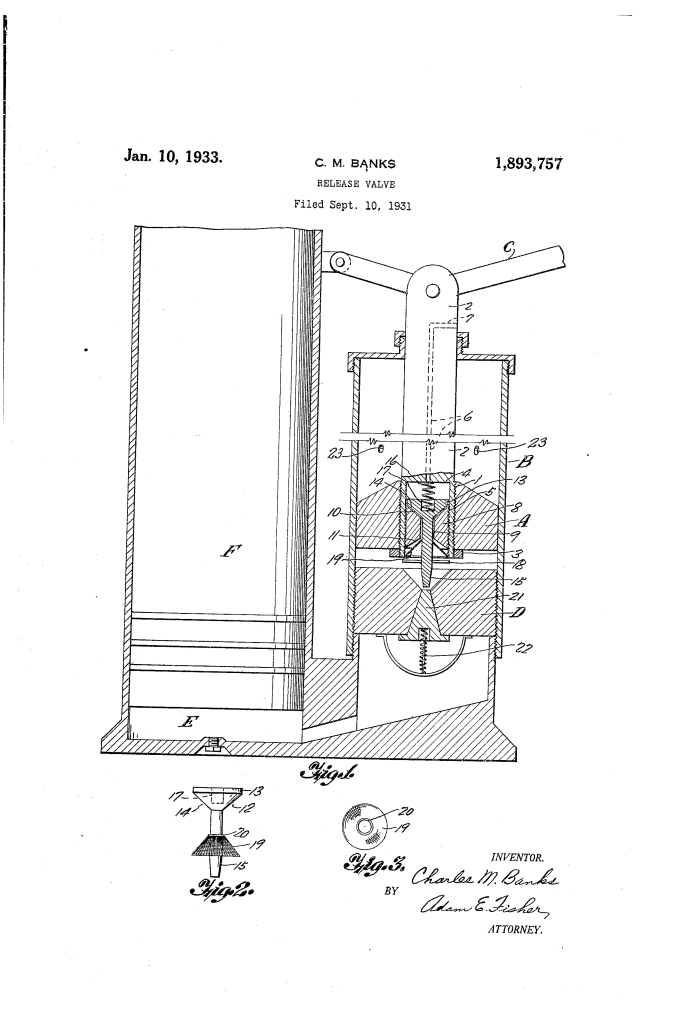
Release Valve for Hydraulic Jacks, Charles M. Banks, Patent No. 1,893,757
The patent by Charles M. Banks of Philadelphia, Pennsylvania describes a Release Valve (Patent No. 1,893,757). This invention is a dual-action mechanical bypass valve integrated into the piston of a hydraulic jack. It allows the operator to raise a load through normal pumping and then trigger the descent of the jack by simply pushing the handle to its “greatest extent,” using a single control path for both lifting and lowering.
The “Why”
Before Banks’ innovation, hydraulic jacks often required two separate operations: one to pump the jack up and another (usually a manual screw or separate lever) to release the pressure and let the jack down. This was cumbersome and could be dangerous if the release was too sudden. Banks sought to solve the “dual-control” pain point by creating a valve that remains closed during high-pressure pumping but “realizes” it needs to open when the piston reaches a specific physical limit. He also addressed the “oil mist” problem, where high-pressure air escaping the valve would carry off vaporized hydraulic fluid, eventually drying out the jack.
Inventor Section: Charles M. Banks
Charles Banks was an expert in fluid power and mechanical leverage. His engineering philosophy focused on functional integration—the idea that a single part should perform multiple duties. Living in a high-intensity industrial era, Banks designed his tools for durability and “positive” action (meaning the mechanism either works fully or not at all, leaving no room for halfway failures). His release valve transformed the hydraulic jack from a two-handed tool into a streamlined, handle-operated machine.
Key Systems Section
1. Over-Travel Actuation Stem
The core of the “automatic” feature is a long valve stem (15) that hangs from the piston.
- Modern Engineering Term: End-of-stroke mechanical override.
- During normal pumping, the stem never touches the bottom. However, when the operator pushes the handle all the way down, the stem hits the inlet valve head (21). This physical contact forces the valve to crack open, bypassing the hydraulic seal.
2. Calibrated Spring-Loaded Head
The release valve is held shut by an expansion coil spring (16).
- Modern Engineering Term: Differential pressure relief spring.
- This spring is specifically tensioned to stay closed during the “lift” stroke (resisting the pressure of the pump). It only yields when the combined force of the stem hitting the bottom and the back-pressure from the load overcomes its tension.
3. Oil Retainer “Mist” Screen
A unique truncated cone screen (19) is mounted on the valve stem.
- Modern Engineering Term: Coalescing oil-mist eliminator.
- As air and oil vapor rush through the valve during the release, they hit this reticulated mesh. The screen catches tiny oil droplets (coalescence), causing them to reform into liquid and drip back into the reservoir rather than being lost to the atmosphere.
4. Integrated Air Escape Passage
The piston rod itself is not solid; it contains an axially aligned escape passage (6).
- Modern Engineering Term: Vented piston rod.
- This passage creates a dedicated “exhaust pipe” for the escaping pressure. By routing the air through the center of the rod and out a radial port (7) near the top, Banks ensures that the escaping high-pressure air is directed away from the operator’s face.
Comparison: Standard Release vs. The Banks Integrated Valve
| Feature | Standard Hydraulic Jack (1931) | The Banks Release Valve |
| Operation | Separate screw/valve to lower. | Single-handle operation (over-travel). |
| Fluid Loss | Oil vapors escape during release. | Retainer screen captures and recycles oil. |
| Safety | Requires two hands to control. | One-handed control; hold handle down to lower. |
| Design | Exterior plumbing/valves. | Internalized within the piston and rod. |
Significance
- Precursor to Integrated Control Valves: Modern hydraulic cylinders often feature “internal cushions” or “end-of-stroke bypasses” that mirror Banks’ mechanical logic.
- Fluid Conservation: His focus on preventing “oil vaporization” was an early step toward modern closed-loop hydraulic systems that prioritize zero fluid loss.
- Durability Engineering: By using a tubular shell (8) for the valve seat, Banks made the high-wear part of the jack easily replaceable, a hallmark of sustainable industrial design.
