

Regulating Radiator Valve: Crosthwait, Hesmer, & Brennan (Patent No. 2,114,139)
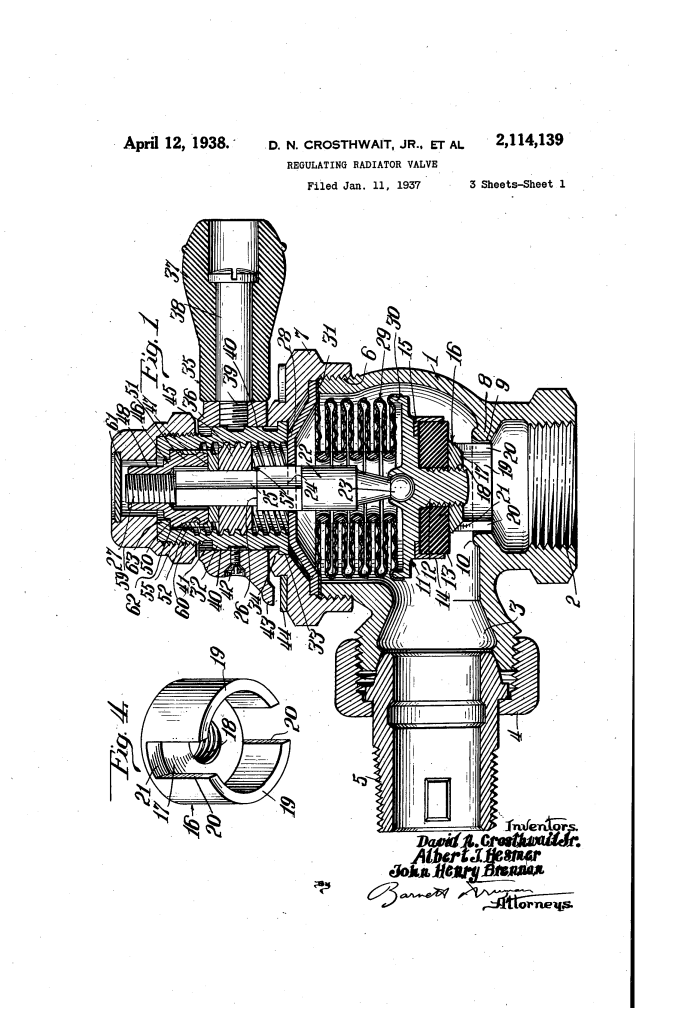
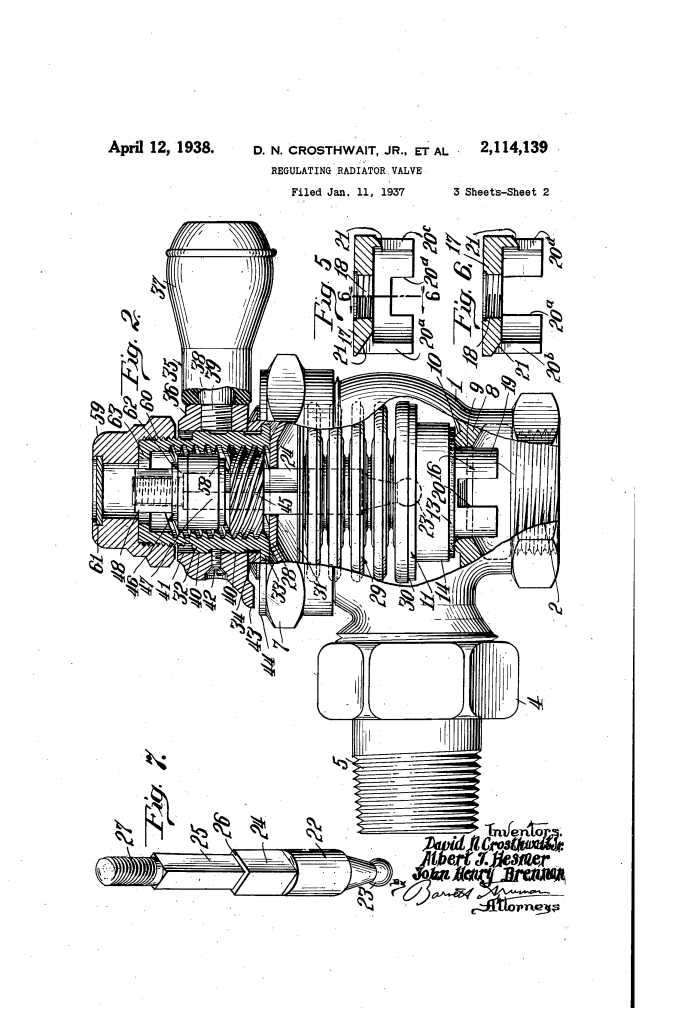
The patent by David N. Crosthwait, Jr., Albert J. Hesmer, and John Henry Brennan describes a Regulating Radiator Valve (Patent No. 2,114,139), granted on April 12, 1938. This invention is a dual-purpose control device designed for steam radiators. It functions not only as a standard manual “on/off” switch for room occupants but also as a “metering” device that allows building engineers to lock in a specific maximum steam flow. By integrating a “lost-motion” mechanical adjustment and a slotted metering sleeve, the inventors provided a way to balance entire heating systems—ensuring that radiators close to the boiler don’t “starve” those further away.
The “Why”
In large 1930s heating systems, a major “pain point” was the uneven distribution of steam. Radiators near the steam source would get too hot, while those at the end of the line stayed cold. Previously, this was solved by installing separate “orifice plates” inside the pipes, which were difficult to change. The inventors sought to combine user control and engineering calibration into a single unit. They wanted a valve that felt like a normal handle to the resident but acted as a precision-tuned gate for the building’s efficiency.
Inventor Section: David N. Crosthwait, Jr. et al.
David N. Crosthwait, Jr., working alongside Hesmer and Brennan at the C. A. Dunham Company, was a master of systemic equilibrium. His engineering philosophy was centered on proportionality. He believed that every increment of a handle’s turn should correspond to a mathematically predictable increase in heat. This patent reflects his expertise in “packless” design, using flexible metal bellows to ensure that the internal adjusting mechanisms never touched corrosive steam, thereby extending the tool’s life indefinitely.
Key Systems Section
1. The Slotted Metering Sleeve (16)
Attached to the bottom of the movable valve disk is a hollow cylindrical skirt with vertical slots (20).
- Modern Term: Characterized Flow Trim / Metering Plug.
- As the valve is lifted, the area of the slots exposed to the steam increases. The slots are beveled (21) so that the steam flow increases by equal, predictable increments for every millimeter the valve rises.
2. The Lost-Motion Adjusting Nut (46)
The internal operating nut (45) is not fixed to the stem but slides between two stops.
- Modern Term: Adjustable Mechanical Deadband.
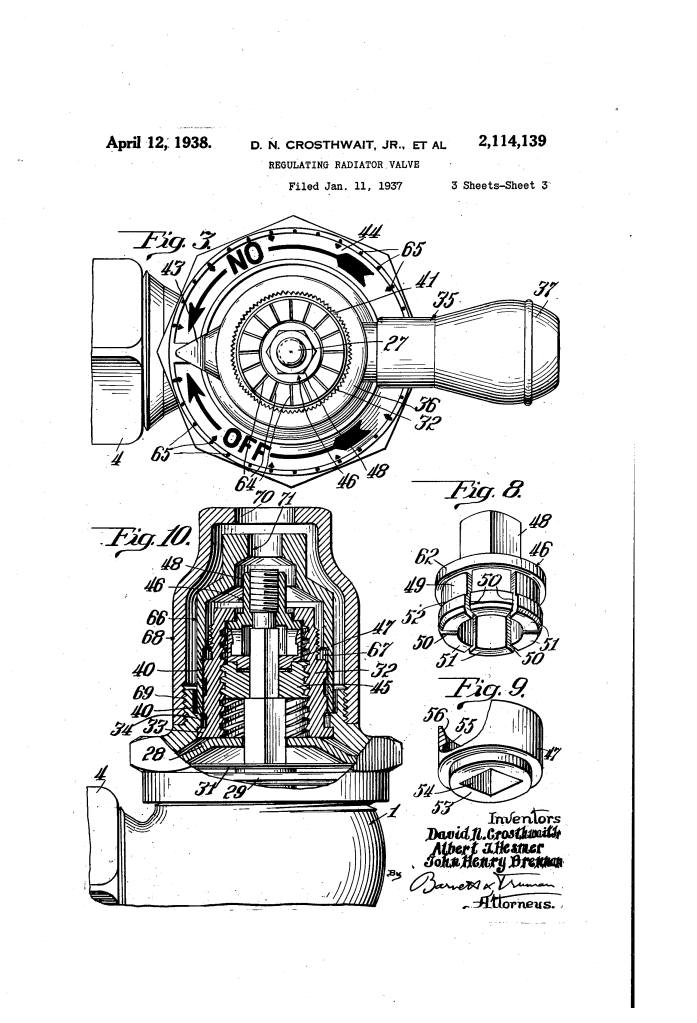
- By turning the “adjusting nut” (46), a technician can increase or decrease the “slack” (lost motion) in the handle. If there is a lot of slack, the handle will turn significantly before it even begins to lift the valve, effectively limiting how far the valve can open.
3. The Packless Bellows Seal (29)
To prevent steam leaks around the handle stem, the valve uses a flexible metal bellows rather than traditional rope packing.
- Modern Term: Bellows-Sealed Valve Stem.
- This creates a permanent, airtight barrier. It allows technicians to remove the top cap (59) and adjust the valve’s maximum flow while the system is fully pressurized without any steam escaping.
4. The Fine-Tooth Handle Coupling
The handle (35) is attached to the internal drive nut via a series of fine vertical teeth (41).
- Modern Term: Splined Interface.
- This allows the “pointer” (43) to be recalibrated and set to a specific zero-point, ensuring that the visual dial (44) accurately reflects the internal mechanical setting.
Comparison Table
| Feature | Standard Radiator Valve (1930s) | Crosthwait’s Regulating Valve |
| Flow Control | All or Nothing (Standard Gate/Globe). | Modulated and metered via slots. |
| System Balancing | Requires external orifice plates. | Built-in, adjustable maximum flow. |
| Maintenance | Requires frequent repacking (leaky). | Packless bellows (Zero-leakage). |
| Adjustability | Inaccessible once installed. | Adjustable under pressure via “lost-motion.” |
Significance Section
- Systemic Optimization: This valve allowed for “Hydronic Balancing,” a concept critical to modern HVAC where flow is restricted at the source to ensure distant terminals receive adequate energy.
- User vs. Admin Control: It introduced the “hidden setting” concept, where a resident can turn the heat down, but only the engineer can determine the maximum “up” setting.
- Linear Flow Characteristics: The beveled slots ensured that the valve followed a “Linear Flow Profile,” meaning a 50% turn equaled exactly 50% steam flow—a major leap in precision engineering.
- Durability in Sub-Atmospheric Systems: Designed specifically for the vacuum-heating systems Crosthwait pioneered, where preventing air leaks (via the bellows) was essential to maintaining the vacuum.
