
Refrigerator (1891)
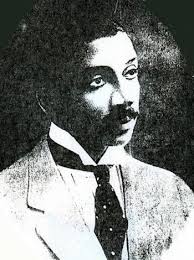
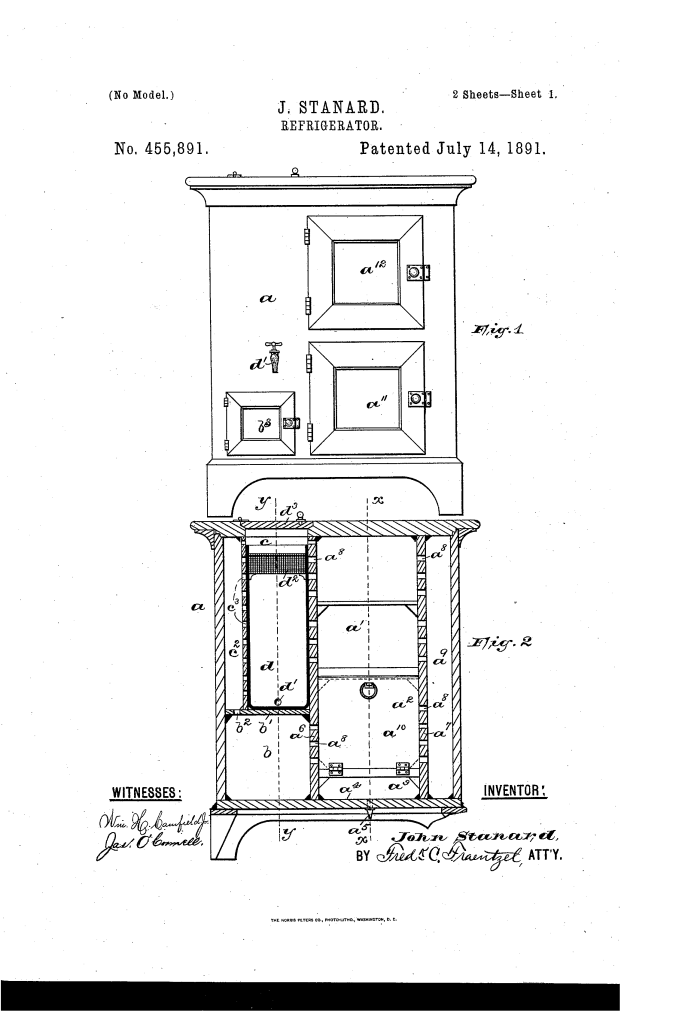
U.S. Patent No. 455,891, granted on July 14, 1891, to John Stanard, represents a significant leap in the design of household cold storage. John Stanard, an African American inventor from Newark, New Jersey, sought to improve the “icebox” by creating a multi-chambered system that prioritized sanitation, air circulation, and the integration of a dedicated water-cooling system.
Before Stanard’s invention, most refrigerators were simple wooden boxes where food and ice were placed in the same compartment, often leading to cross-contamination and soggy, unappetizing meals.
The Innovation: The Multi-Chambered System
Stanard’s refrigerator was not just a box, but a sophisticated thermal management system. It divided the interior into specific zones to ensure that different types of perishables were kept at their optimal temperatures without interfering with one another.
1. The Circular Air Flow
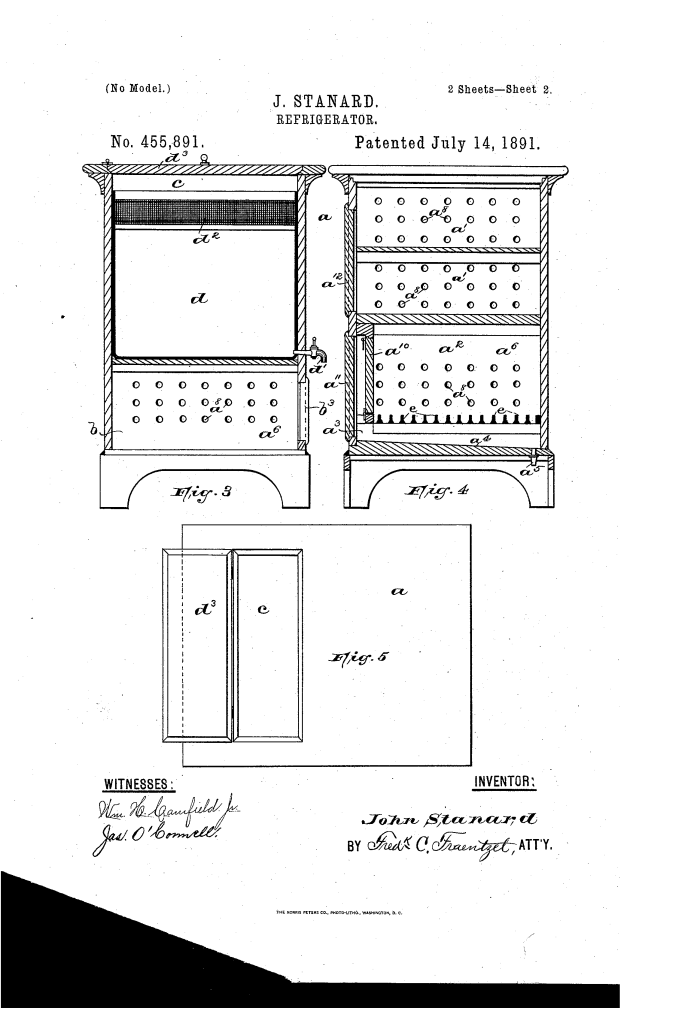
The invention utilizes a series of perforated partitions (a8) and cold-air ducts (a9).
- Cold air from the central ice-chamber (a2) is allowed to circulate through these perforations into the adjacent food compartments.
- This constant movement of air prevents stagnant pockets of warmth and ensures that the cooling effect of the ice is distributed evenly throughout the entire unit.
2. The Protective Ice-Grate
One of the most practical mechanical features of the patent is the ice-grate (e). Stanard designed the bars of the grate to be tapered—narrower at the top than at the bottom.
- This design prevents large chunks of ice from falling through and breaking glass bottles stored in the drip chamber below.
- It allows the melting “drip” to fall freely while trapping debris and solid ice pieces.
The Integrated Water Cooler
A standout feature of the Stanard Refrigerator is the built-in water-receptacle (d), typically made of earthenware for better thermal retention.
- The Filter Cradle: The receptacle includes a “cradle” ($d^2$) filled with charcoal-dust and fine gravel to filter the water as it is poured in.
- External Faucet: Users could dispense cold, filtered water via a faucet (d1) on the outside of the machine without ever opening the doors and letting the cold air escape.
Key Components and Compartments
The refrigerator is divided into several specialized zones:
| Compartment | Function |
| Ice-Chamber (a2) | The thermal heart of the unit; holds the ice block on a specialized grate. |
| Food Chambers (a,b) | Perforated zones designed to hold dry goods and perishables, cooled by circulating air. |
| Bottle Chamber (a3) | Located beneath the ice; uses the cold “drip” water to keep wine or liquor bottles chilled. |
| Water Chamber (c) | Houses the earthenware water tank and the charcoal/gravel filtration system. |
| Drip Pan & Outlet (a4, a5) | An inclined bottom that directs melt-water toward a drain pipe to prevent pooling. |
Performance: Efficiency and Hygiene
Stanard’s design solved two major problems of 19th-century food storage:
- Thermal Conservation: By including a dedicated door for the water tank and a separate door for the bottle chamber, the user could access liquids without exposing the main ice supply to the outside air.
- Contamination Prevention: By separating the food chambers from the ice and the drip-water, the invention kept the food dry and reduced the risk of bacteria growth common in damp, unventilated iceboxes.
About the Inventor: John Stanard
John Stanard was an innovative designer who focused on improving daily household life. In addition to his 1891 Refrigerator patent, he also received a patent for an improved Oil Stove in 1889. His work reflects a transition in the late 19th century toward more scientific and sanitary methods of domestic engineering.
Summary of Claims
The patent explicitly claims:
- A refrigerator comprising an ice-chamber with a specialized grate of tapered bars.
- The arrangement of a water cooler situated above the food chambers, integrated with a faucet and a charcoal filter.
- A system of perforated partitions that facilitate a constant, circulating cold-air duct system between all internal compartments.
