
Refrigerating Apparatus and Process: David N. Crosthwait, Jr. (Patent No. 1,972,704)
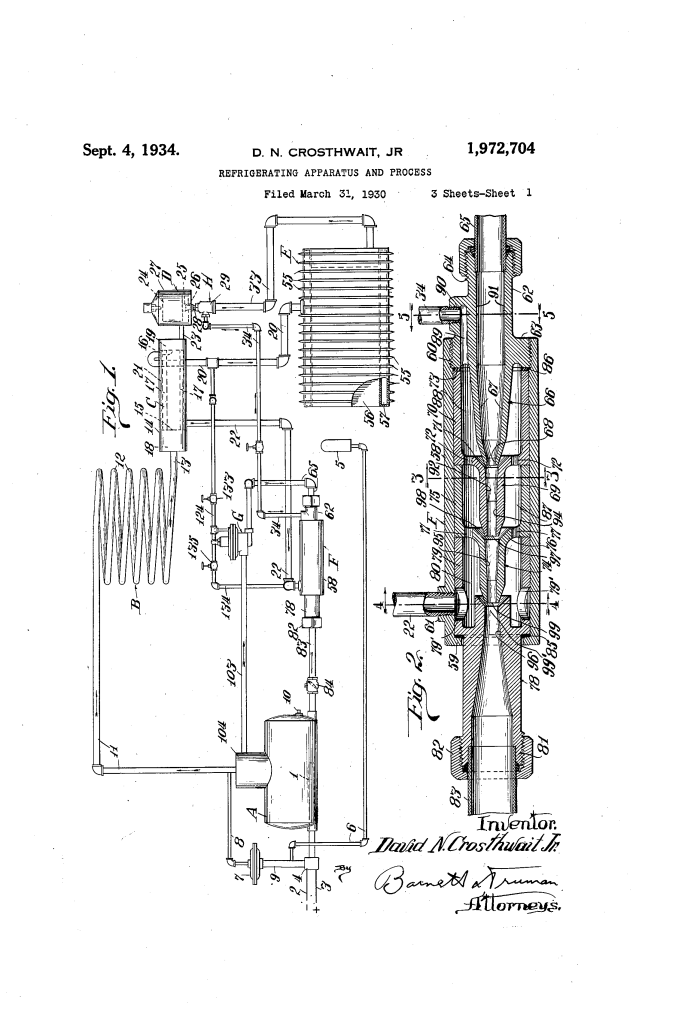
The patent by David N. Crosthwait, Jr. of Marshalltown, Iowa (assigned to C.A. Dunham Company) describes a Refrigerating Apparatus and Process (Patent No. 1,972,704), issued on September 4, 1934. This invention is a thermodynamic cooling system that utilizes a high-velocity vapor jet to compress and return refrigerant to its source, effectively creating a refrigerator with no mechanical moving parts.
The “Why”
In the early 1930s, mechanical refrigeration was in its infancy and plagued by noise, vibration, and maintenance issues. Reciprocating compressors required pistons, crankshafts, and seals that frequently leaked expensive or toxic refrigerants. Crosthwait sought to solve these “pain points” by creating a solid-state mechanical system. His goal was to use the internal energy of the refrigerant itself—driven by a simple heat source—to circulate the fluid, making the unit silent, durable, and ideal for domestic use.
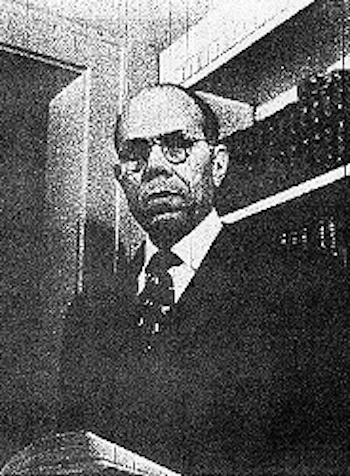
Inventor Section: David N. Crosthwait, Jr.
David N. Crosthwait, Jr. was a master of vacuum-stream technology. His engineering philosophy was defined by “elegant simplicity”—achieving complex industrial results (like cooling) through the manipulation of pressure and temperature rather than brute-force mechanical motion. As a Black engineer in the Jim Crow era, Crosthwait’s ability to secure nearly 40 patents was a testament to his undeniable technical genius. This patent represents his peak work in miniaturizing industrial thermal logic for the American home.
Key Systems Section
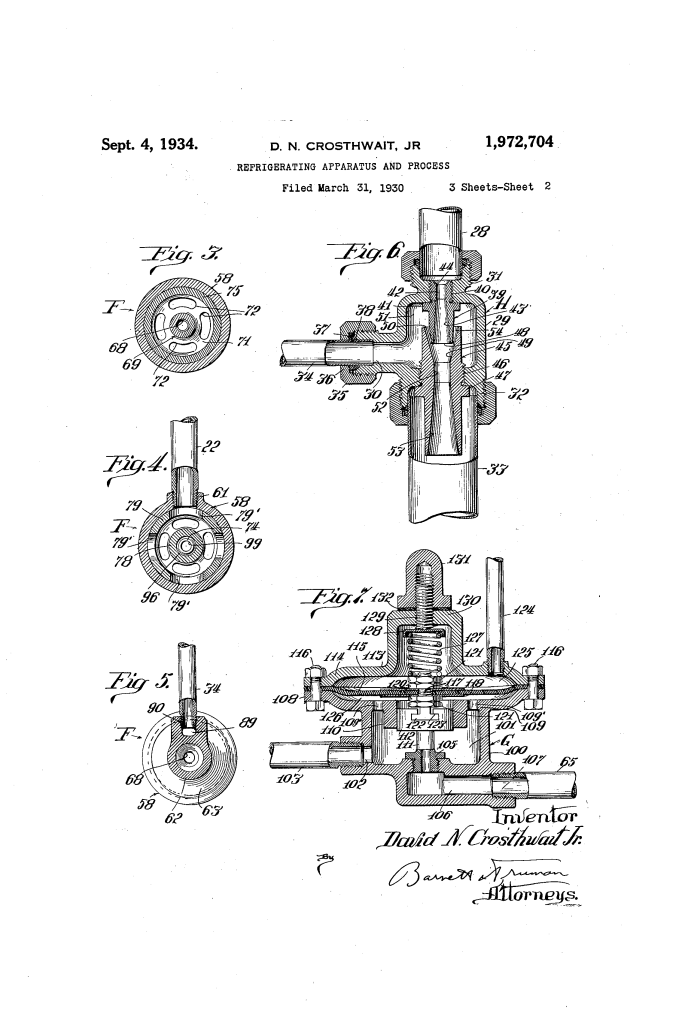
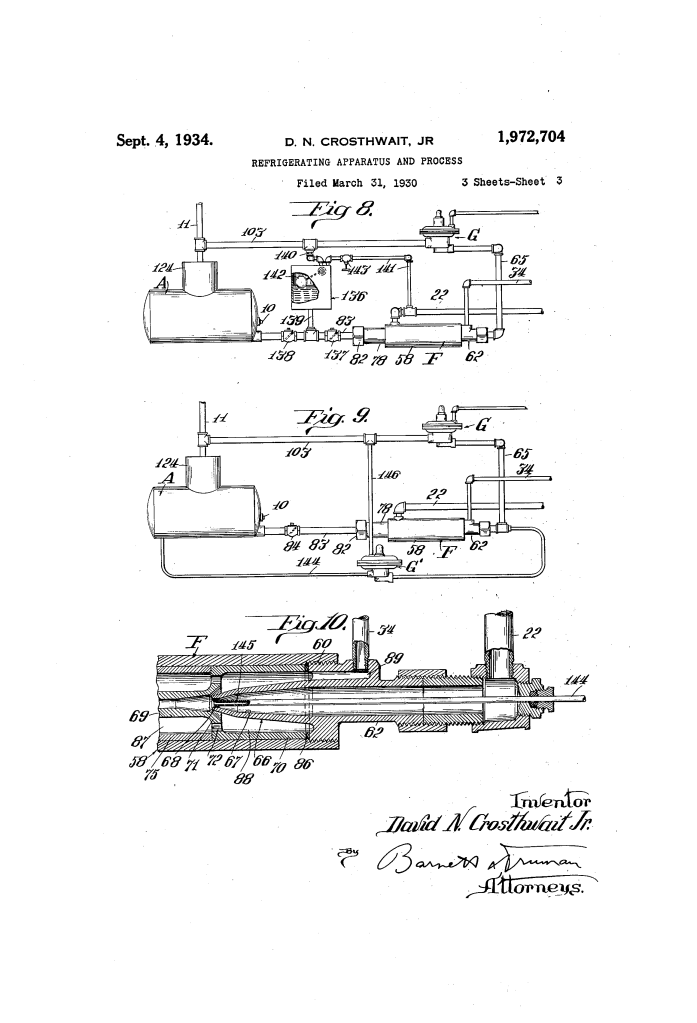
1. The Jet Compressor (F)
The system’s “engine” is a kinetic exhauster. It takes high-pressure vapor from the generator and shoots it through a series of nozzles.
- Modern Translation: A Steam-Jet Ejector.
- Function: As the high-pressure jet passes through the nozzles, it creates a vacuum that “entrains” (sucks in) the low-pressure vapor from the evaporator. This process converts heat energy directly into the mechanical work of compression.
2. The Low-Pressure Jacket (Pre-Cooling)
Crosthwait introduced a novel counter-current heat exchange within the compressor itself. The nozzles are surrounded by a “jacket” (80, 87, 88) containing the cold vapor returning from the evaporator.
- Modern Translation: An Integrated Regenerative Heat Exchanger.
- Function: This jacket “pre-cools” the high-pressure jet before it mixes with the low-pressure gas. By lowering the jet’s temperature, it increases the efficiency of the suction and helps the mixture condense back into a liquid more quickly.
3. The Recirculator (H)
A small secondary jet located between the expansion valve and the evaporator.
- Modern Translation: A Secondary Induction Loop.
- Function: It ensures that a small portion of the cooling vapor is constantly pulled through the compressor’s jacket, maintaining the thermal differential even when the main cooling cycle is at a low ebb.
Comparison Table
| Feature | Standard 1930s Compressor | Crosthwait’s Jet Apparatus |
| Moving Parts | Pistons, Rods, Valves, Belts. | None (Static fluid flow). |
| Noise Profile | Loud thumping/vibration. | Silent operation. |
| Maintenance | High (oil changes, seal repairs). | Minimal (No friction points). |
| Power Source | Electric Motor (Mechanical). | Heat Source (Gas flame or Electric heater). |
Significance Section
- Foundation of “Absorption” Logic: While this is a compression system, its use of heat as a driver paved the way for modern absorption refrigerators used in off-grid and RV applications.
- Safety & Reliability: By removing mechanical seals, Crosthwait eliminated the most common point of failure for early refrigerators, leading to safer home appliances.
- Fluid Dynamics Masterclass: The use of tandem nozzles (multiple jets in a row) to achieve higher compression ratios was a sophisticated application of supersonic flow principles decades ahead of its time.
