
Reel-Carrier (1896)
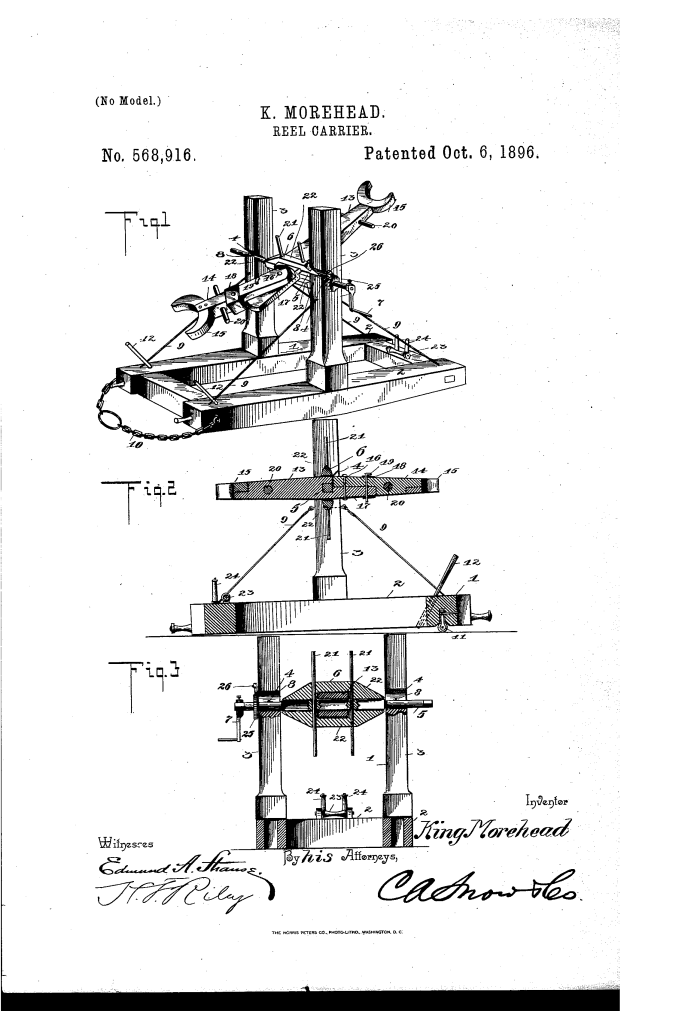
U.S. Patent No. 568,916, granted on October 6, 1896, to King Morehead, describes a versatile, rugged transport and tensioning system designed to simplify the gathering, stretching, and unreeling of heavy agricultural fence wire. King Morehead, an inventor based in Salisbury, Missouri, engineered this mechanical solution during the late 19th-century expansion of wire fencing across the American Midwest.
This specific invention solved a persistent and labor-intensive problem for farmers and ranchers: how to wind up and store barbed or smooth fence wire tightly under tension, while still allowing the coiled wire to be easily slid off the spool for compact storage without uncoiling or tangling.
The Innovation: The “Pivoted-Arm Spool”
Traditional wire spools of the era were entirely rigid, meaning that once hundreds of feet of wire were tightly wound onto the reel, the coil was locked in place. It could only be reclaimed by laboriously unreeling it again.
Morehead’s breakthrough was a collapsible, dual-arm spool design consisting of one rigid arm (13) and one pivoted arm (14). When it was time to store the gathered wire, the operator could swing the pivoted arm to the side, allowing the intact coil of wire to slide cleanly off the frame.
How the Collapsible Spool Works:
- The Extension (17): The rigid arm features a recessed extension to which the movable arm is connected.
- The Sliding Sleeve (18): A heavy metal collar slides over the joint where the two arms meet, locking them into a perfectly flush, rigid, straight line.
- The Locking Pin (19): A simple removable pin passes through the sleeve and the arm to prevent the collar from sliding out of place during high-tension winding.
- Tapered Design: The arms are slightly tapered toward their ends, which naturally reduces friction and allows the securing sleeve and the wound wire to slide off smoothly.
Key Mechanical Components
The carrier is built on a heavy-duty sled platform with a highly functional layout:
| Component | Function |
| Supporting Frame (1) | Comprises a rectangular base (2) and vertical standards (3) that hold the main shaft. |
| Pivoted Arm (14) | Swings laterally to collapse the spool diameter, allowing instant removal of the wire coil. |
| Concave Heads (15) | Curved brackets at the outer ends of the arms that keep the wire from slipping off the spool. |
| Ratchet (25) & Pawl (26) | A one-way locking mechanism that holds the spool under tension, acting as a built-in wire stretcher. |
| Guide Rollers (23, 24) | A system of one horizontal and two vertical pulleys at the rear that feed and align incoming wire onto the spool. |
| Caster Wheel (11) & Chain (10) | Allows the entire heavy-duty frame to be dragged easily across fields like a sled. |
Performance: Winding and Stretching
Morehead’s design is a multi-functional field tool. Rather than requiring separate machines to transport, spool, and stretch wire, this apparatus handles the entire lifecycle of a fence line:
- Gathering: One end of a discarded fence line is attached to the spool, and the operator winds it up using one or two crank handles (7) on the squared ends of the shaft.
- Guiding: The guide rollers prevent the wire from tangling or snagging on the wooden frame as it is pulled in.
- Stretching: When installing a new fence, the wire is unreeled, anchored, and then cranked tight. The integrated ratchet and pawl lock the spool in place, holding the line taut while the farmer staples it to the fence posts.
- Anchoring: To keep the frame from moving during high-tension stretching, the base features perforations for stakes (12) that can be driven directly into the ground.
About the Inventor: King Morehead
King Morehead was an inventor and citizen residing in Salisbury, Chariton County, Missouri, during the late 19th century.
- Era of Innovation: The 1890s marked a massive boom in the installation of barbed wire across the American plains, transforming agricultural land management.
- Practical Problem Solving: Morehead’s invention targeted the practical, day-to-day difficulties faced by farmers who needed to constantly repair, move, or store expensive wire assets.
- Design Philosophy: His focus on simple, rugged parts—relying on gravity, sliding sleeves, and basic drop-pins rather than complex gearing—ensured the reel-carrier could be easily maintained in the field far from industrial repair shops.
Summary of Claims
The patent explicitly claims:
- A spool construction featuring a rigid arm with an extension, a pivoted arm adapted to swing laterally, and a sliding sleeve with a locking pin to secure them in alignment.
- The addition of concave heads at the outer ends of the arms to retain wire, paired with handles (20) adjacent to those outer ends for easy manual carrying.
- A mounting system using centrally-arranged cross-pieces and removable pins (21) passing through the spool and the squared drive shaft to lock the spool to the shaft.
