
Redox Couple Radiation Cell (1966)
U.S. Patent No. 3,255,044, granted on June 7, 1966, to Robert A. Powers, Douglas R. Allenson, and Albert C. Stewart (assigned to Union Carbide Corporation), describes a sealed, self-contained electrochemical cell designed to convert high-energy radiation directly into electricity.
While scientists had long recognized that radiation could break down chemical solutions and yield hydrogen gas, nobody had successfully harnessed this radiochemical effect in a practical, continuous power generator. Powers, Allenson, and Stewart solved this by designing a system that operates using a single, homogeneous electrolyte, completely eliminating the need for fragile mechanical dividers, physical separators, or complex external circulation machinery.
The Innovation: The In Situ Separator-Free Cell
Standard electrochemical cells rely on permeable membranes or physical separators to keep anode and cathode reactions distinct. In radioactive environments, traditional semi-conductive materials and separator membranes break down rapidly under radiation exposure.
The inventors bypassed this issue by leveraging selective electrode kinetics and natural phase separation:
- Selective Overvoltage: The electrodes are chemically tuned to react only with their designated partner. The cathode actively drives ferric reduction while resisting hydrogen reactions due to a high overvoltage.
- Natural Phase Distribution: Radiolysis produces hydrogen gas, which bubbles up into the headspace to interact with the anode, while the oxidized ions remain dissolved in the liquid bath in contact with the cathode.
- Self-Sustaining Cycle: The system converts radiochemical products into electrical current and allows them to recombine in situ, meaning the device continues to function even if stirred or shaken.
How the Radiation Cell Functions
The device operates via a closed, continuous radiochemical cycle:
| Step | Action | Operational Purpose |
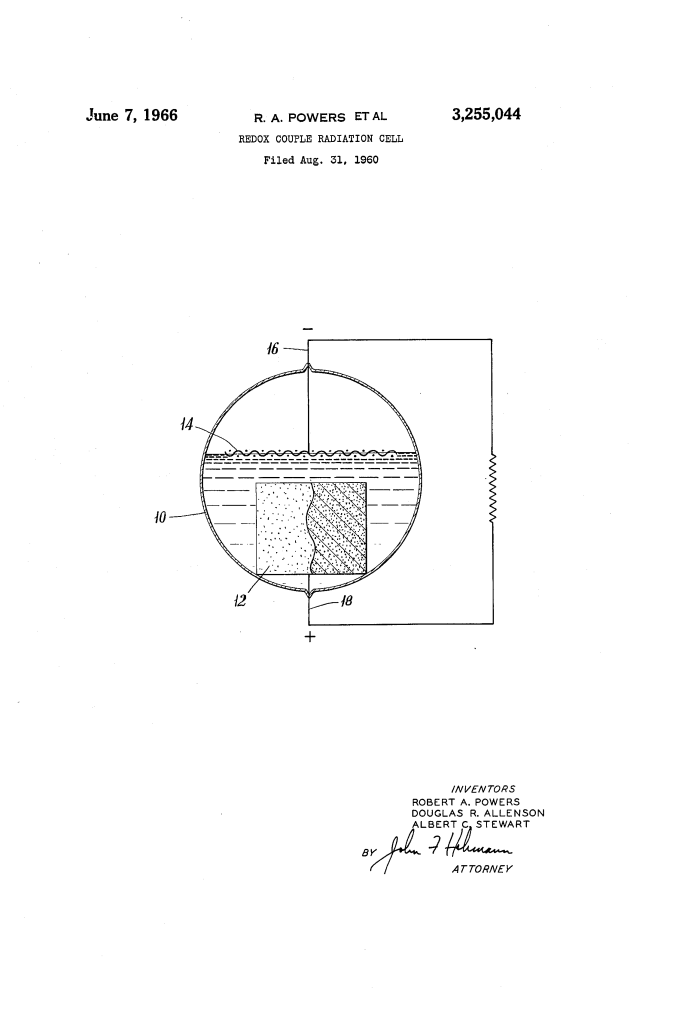
| 1. Radiation Exposure | High-energy rays (gamma, UV, or X-rays) penetrate the sealed vessel (10). | Radiochemically splits the solution into hydrogen gas (H2) and oxidized metal ions (e.g., Fe3+). |
| 2. Phase Partitioning | Hydrogen migrates to the gas headspace; oxidized ions remain in the liquid bath. | Naturally isolates the active chemical species without needing a physical membrane. |
| 3. Anodic Oxidation | Hydrogen gas contacts the catalyzed platinum anode (14) at the liquid-gas interface. | Releases electrons to the external circuit as hydrogen is converted back into hydrogen ions. |
| 4. Cathodic Reduction | Oxidized ions contact the submerged porous carbon cathode (12). | Absorbs incoming electrons from the external circuit, reducing the chemical species back to its starting state. |
Technical Components
- Sealed Vessel (10): A durable enclosure made of graphite, glass, metal, or fused quartz (for UV penetration). Its internal volume exceeds the combined volume of the electrolyte and electrodes to form an upper gas reservoir.
- Porous Cathode (12): Fully submerged in the liquid electrolyte. Typically composed of porous carbon, it provides high overvoltage against hydrogen reactions while remaining completely immune to radiation degradation.
- Catalyzed Anode (14): Positioned precisely at the liquid-gas boundary. Made of a platinum group metal, it offers a low overvoltage for hydrogen conversion, catalyzing oxidation at the gas interface.
- Homogeneous Electrolyte: A dilute acid (such as sulfuric or hydrochloric acid) containing a dissolved, radiation-sensitive redox couple (such as ferrous/ferric, selenite/selenate, arsenite/arsenate, or uranous/uranyl).
- Terminal Leads (16, 18): Extend through the sealed housing to deliver direct current to an external load resistance.
Performance: Direct Conversion of Radiation
The patent details continuous, steady-state power generation under diverse radiation sources:
- Gamma Radiation Test (Cobalt-60): A cell loaded with acid ferrous ammonium sulfate generated continuous power for 4 weeks straight, delivering a continuous output of 1.0 mA at 0.75 V (approx. 1.5% radiation energy conversion). The back-reaction rate of the reactants was limited to just 1% of the formation rate.
- Ultraviolet Light Test (Mercury Resonance Lamp): A spherical fused quartz cell charged with ferrous sulfate in sulfuric acid operated continuously for 24 hours under 2537 A UV radiation, delivering 1.7 mA at 0.34 V, with an open-circuit potential of 0.6 V and a maximum output of 1.88 mA.
- Internal Energy Sources: The system demonstrated equal viability when energized by dissolved internal radionuclides (such as Strontium-90), opening avenues for maintenance-free atomic battery packs.
Scientific Impact and Legacy
The Powers, Allenson, and Stewart radiation cell represented a major conceptual leap in nuclear battery technology:
- Solid-State and Machinery Independence: It achieved direct conversion without requiring heat cycles, turbines, dynamos, or radiation-vulnerable solid-state semiconductors.
- Radiation Immunity: Because every component—carbon, platinum, quartz, and simple acid solutions—is inherently radiation-resistant, the device bypassed the degradation issues that plagued conventional electronics in extreme radiation fields.
- Deep-Space and Remote Power Applications: The cell laid practical groundwork for passive power cells capable of operating inside nuclear reactors, deep underwater installations, or long-duration outer space probes.
About the Inventors
The inventors developed this cell at the Union Carbide Corporation research facilities in Ohio:
- Albert C. Stewart: A pioneering African American physical chemist and nuclear researcher. After earning his Ph.D. from St. Louis University, Stewart conducted significant radiochemical research at the Oak Ridge National Laboratory and Union Carbide, later holding leadership posts evaluating advanced energy systems and technical development.
- Robert A. Powers & Douglas R. Allenson: Senior research scientists with Union Carbide who specialized in electrochemistry, battery innovation, and the chemical dynamics of novel electrode surfaces.
Summary of Claims
The patent explicitly claims:
- An electrical conversion device comprising a sealed vessel partly filled with an electrolyte to define a gas space, paired with a dissolved radiation-sensitive redox couple.
- An inert carbon cathode submerged in the electrolyte with a high overvoltage for the hydrogen reaction.
- An inert platinum group anode stationed at the liquid-gas interface having a low overvoltage and acting as a hydrogen catalyst.
- The direct generation of electric current without physical separators between the electrodes, relying on selected redox couples such as ferrous/ferric, selenite/selenate, arsenite/arsenate, and uranous/uranyl.
